Have you noticed how our Old Testament readings have been circling around the issue of trust? Two weeks ago, the first Sunday in Lent, Adam and Eve, with the snake in the garden saying “You will not die; for God knows that when you eat of it your eyes will be opened, and you will be like God, knowing good and evil” (Gen 3:4-5). God is selfish, unworthy of your trust. Last week, God to Abram and Sarai “Go from your country and your kindred and your father’s house to the land that I will show you” (Gen 12:1)—and they trust, they go. And today’s lesson: the people in the middle of nowhere, without water. “Why did you bring us out of Egypt, to kill us and our children and livestock with thirst?” (Exo 17:3). Trust, front and center.
Today’s psalm recalls that moment, urges us not to repeat it: “Harden not your hearts, / as your forebears did in the wilderness, / at Meribah, and on that day at Massah, / when they tempted me.”
It would be easier if trust could be sorted out in calm moments, not, say, in the middle of nowhere with no Kwik Trip on the horizon. Or not, say, in the middle of Roman-occupied Galilee. Or not, say, here and now. Recall what we were hearing just before entering Lent:
“Blessed are the merciful, for they will receive mercy.
Blessed are the pure in heart, for they will see God.
Blessed are the peacemakers, for they will be called children of God.” (Mat 5:7-9)
Do we trust enough to risk living like that or, as it were, pick up swords with the Zealots, signal that we’re the right sort with the Pharisees, slither up to Empire with the Sadducees? Our Ash Wednesday liturgy spoke of “the need which all Christians continually have to renew their repentance and faith,” and here we are.
What might help us with this renewal?
Paul recalls Jesus’ self-offering: “But God proves his love for us in that while we still were sinners Christ died for us.” I’m all for impartial judges, but our culture’s picture of God as impartial judge often does more harm than good. God in love called Abram and Sarai. In God’s love Christ died for the ungodly. God really wants the project started with Abram and Sarai to succeed: “in you all the families of the earth shall be blessed” (Gen 12:3). To say that God is bending over backwards for it to succeed would be an understatement.
As the rabbis and Paul picked up, there’s a hint of that in our first reading: “I will be standing there in front of you on the rock at Horeb. Strike the rock, and water will come out of it, so that the people may drink.” Is Moses striking the rock without striking the Lord? In any case, the rabbis figured that rock accompanied the people in the wilderness, and so Paul writes: “For they drank from the spiritual rock that followed them, and the rock was Christ” (1Cor 10:4). Perhaps our psalm is also recalling that: “let us shout for joy to the Rock of our salvation.”
There are many reasons to come together regularly, one being that our common worship nurtures our capacity for trust. The Great Story from Genesis to Revelation, our liturgy, shared across the globe and—in its essentials—across the centuries, Jesus again feeding us with his own Body and Blood: these renew our capacity to trust this God, to respond humanly, humanely, to our world.
Come, let us sing to the Lord;
let us shout for joy to the Rock of our salvation.
Let us come before his presence with thanksgiving
and raise a loud shout to him with psalms.
The lectionary accompanies these readings with Jesus’ conversation with a Samaritan woman at a well. It contrasts with last week’s conversation with Nicodemus. Nicodemus has the more impressive religious resume; Jesus seems to get further with the Samaritan woman. That might give us pause.
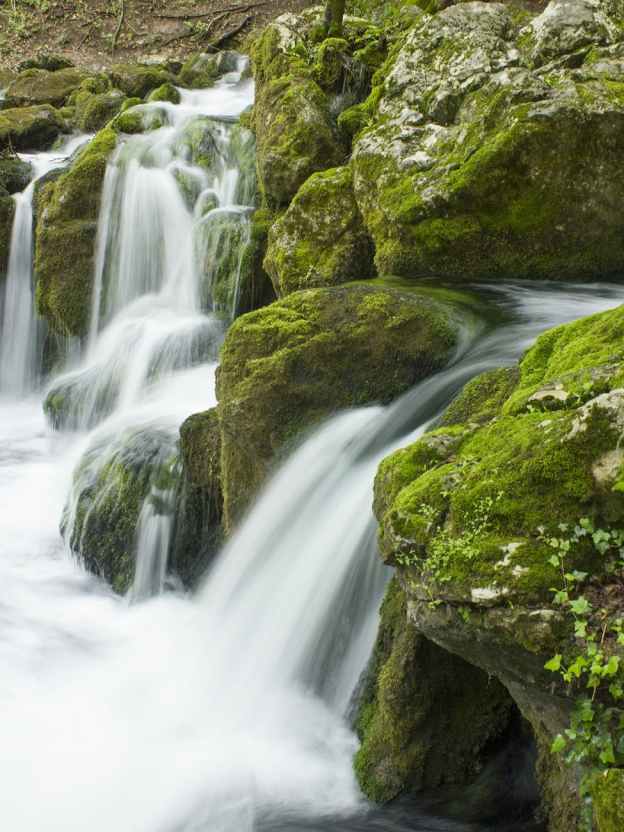
As in the wilderness, water is again the presenting issue. Jesus: “but those who drink of the water that I will give them will never be thirsty. The water that I will give will become in them a spring of water gushing up to eternal life.” Shades of that rock that followed the people!
I wonder if the conversation doesn’t circle back to that theme of trust we noticed. The woman does not appear to trust easily, and has some skill in verbal sparring. Jesus too is not unskilled, and at the end of the conversation the woman’s at a different place than she was at the beginning. “Come and see a man who told me everything I have ever done! He cannot be the Messiah, can he?”
We’ve all had experiences that encourage us to avoid trusting. Avoid trusting: that can end up, effectively, as a life goal. But unless we swap reality for illusion, it’s a non-starter. We’re still in the wilderness; we still need water. And it’s not a matter of one bottle, but of a continual communal pattern. Notice how ‘trust’ and ‘hope’ are virtual synonyms in Paul’s words: we “boast in our hope of sharing the glory of God. And not only that, but we also boast in our sufferings, knowing that suffering produces endurance, and endurance produces character, and character produces hope, and hope does not disappoint us, because God’s love has been poured into our hearts.” It’s trust that allows the story to continue, so that the pouring of God’s love (there’s the water again) is not the end of the story, but continues in that love irrigating our choices, our actions.
“Blessed are the merciful, for they will receive mercy.
Blessed are the pure in heart, for they will see God.
Blessed are the peacemakers, for they will be called children of God.”
“[T]he need which all Christians continually have to renew their repentance and faith.” That Samaritan woman, not the only one profiting from a conversation with Jesus. What conversations might Jesus have with us? How, during Lent, might we make time for these?
 With Jacob at Bethel