Author Archives: Fr. Tom McAlpine

Unknown's avatar

About Fr. Tom McAlpine

Fr. Tom is a semi-retired priest in the Episcopal Church living in Fitchburg, Wisconsin.

Re the Daily Office Readings August 27 Anno Domini 2020

Photo by Annie Spratt

The Lessons: Job 8:1-10, 20-22; Acts 10:17-33; John 7:14-36

Job. Bildad: “if you are pure (zak) and upright (yashar), surely then he will rouse himself for you and restore to you your rightful place.” This would be more convincing had not both the narrator and God described Job as “blameless (tam) and upright (yashar)” (1:1, 8; 2:3). Pulling back the camera, one of the issues in play in the book is the variety of images or metaphors for God, each with their corresponding set of expectations. If God is King, one expects (traditionally) the righteous to be rewarded and the wicked punished. But an inherent limitation of metaphor is that the metaphor itself does not tell us when it is applicable. “For everything there is a season” (Eccl 3:1) applies also to the metaphors we choose to employ to interpret God’s action, and here too we, like Job’s friends, can choose with various combinations of wisdom and folly.

John. Jesus: “Whoever wants to do God’s will can tell whether my teaching is from God or whether I speak on my own” (CEB). We might hear this as a more careful restatement of “search, and you will find” (Matt 7:7) for it includes the proviso of prior commitment on our part.

In passing, the Greek thelō covers the range from ‘to desire’ (stressing the affective) to ‘to will’ (stressing the volitional). Likewise thelēma, from ‘what is desired’ to ‘what is willed’. Translating into English is challenging: “Whoever desires to do what God desires” and “Whoever wills to do what God wills” are both possible, but have quite different connotations. Here, and elsewhere, it’s helpful to keep the range in mind.

Re the Daily Office Readings August 26 Anno Domini 2020

Photo by Michelle

The Lessons: Job 6:1; 7:1-21; Acts 10:1-16; John 7:1-13

Job. Part of the power of texts like today’s comes from Job’s later testimony re his former life, e.g., “…because I delivered the poor who cried, / and the orphan who had no helper. / The blessing of the wretched came upon me, / and I caused the widow’s heart to sing for joy” (29:12-13). This is what Job did for the needy; is it fitting for God in Job’s case to do so much less?

The combination of this chapter and Job 29 challenges us readers, for chapters like Job 7 “boosts the signal” of the voice of the many sufferers in our midst that we might not hear—or be too numb to hear, and chapter 29 asks us point-blank what we’re doing about it.

Acts. As we’ll hear in the next readings, the visions accomplish their immediate purpose: Peter accepts Cornelius’ invitation. At the same time, we might wonder about Peter’s vision. “What God has made clean, you must not call profane.” Within the vision the reference is to food, an apparent stunning reversal of the dietary laws of Leviticus 11 and Deuteronomy 14. Peter thinks that the vision isn’t (primarily?) about food, (later) saying to Cornelius “God has shown me that I should not call anyone profane or unclean.” But does the Law or the Old Testament ever declare the gentiles per se to be ‘profane’ or ‘unclean’? And later, as Paul tells the story, in Antioch Peter draws back from eating with Gentile Christians (Gal 2:11-13). The dietary laws made Jews and Gentiles sharing a common life difficult, if not impossible; was Peter’s vision also about food? As with Jesus’ teaching re what defiles (Matt 15:1-20; Mk 7:1-23), his followers drew different conclusions re the status of the food laws. “(Thus he declared all foods clean.)” is in Mark (7:19) but not in Matthew.

John. Since Jesus does make a public appearance at the Feast (see tomorrow’s reading), why does John give us today’s text? Jesus seems torn re tactics and timing. I find v.7 equally puzzling: “The world cannot hate you, but it hates me because I testify against it that its works are evil.” Outside of driving the merchants and money changers out of the temple (2:13-17), what words or actions does this testimony reference? Is it a question of light vs. darkness (1:5; 3:19-21)?

Re the Daily Office Readings August 25 Anno Domini 2020

Photo of Icon of Theotokos by Krzewgorejacy

The Lessons: Job 6:1-4, 8-15, 21; Acts 9:32-43; John 6:60-71

While Job and his friends often seem to be talking past each other in chapters 4-27, here Job is engaging Eliphaz’s response (e.g., ‘vexation’ in 5:2 and 6:2). Situations like Job’s are too much for any person to deal with alone (vv.11-13), so what friendship demands becomes an important question. Verse 14 is key—and also a challenge to translators. The NRSV represents one tradition: “Those who withhold kindness from a friend forsake the fear of the Almighty” (similarly CEB). The NJPS another: “A friend owes loyalty to one who fails, Though he forsakes the fear of the Almighty” (similarly Alter, Seow). The verse invites double reflection: (1) What does Job think “loyalty” (chesed) from his friends should look like? (2) When we disagree profoundly with a friend, what does loyalty demand?

“We have come to believe and know that you are the Holy One of God” (Jn. 6:69). How might John want us to hear Peter’s confession? Commentators give us a start in noticing “If those to whom the word of God came were called ‘gods’—and the scripture cannot be annulled—can you say that the one whom the Father has sanctified and sent into the world is blaspheming because I said, ‘I am God’s Son’?” (10:35-36) and “And for their sakes I sanctify myself, so that they also may be sanctified in truth” (17:19).

Perhaps it is worth recalling that in the Old Testament holiness is dynamic, not static. ‘Holiness’ first appears in Exod. 3:5: “Then he said, ‘Come no closer! Remove the sandals from your feet, for the place on which you are standing is holy ground’” (literally, ground of holiness). And that starts a conversation that ends not with Moses setting up a retreat center, but with Moses returning to Egypt to liberate a people. Is it accidental that Peter’s confession “the Holy One of God” comes near Passover (6:4)? There is a whole world that needs turning upside down, and that requires some serious holiness. And so Mary sings “for the Mighty One has done great things for me, and holy is his name” (Lk. 1:49).

In the Orthodox tradition the Unburnt Bush of Exodus 3 is associated with Mary, hence the accompanying icon.

Re the Daily Office Readings August 24 Anno Domini 2020

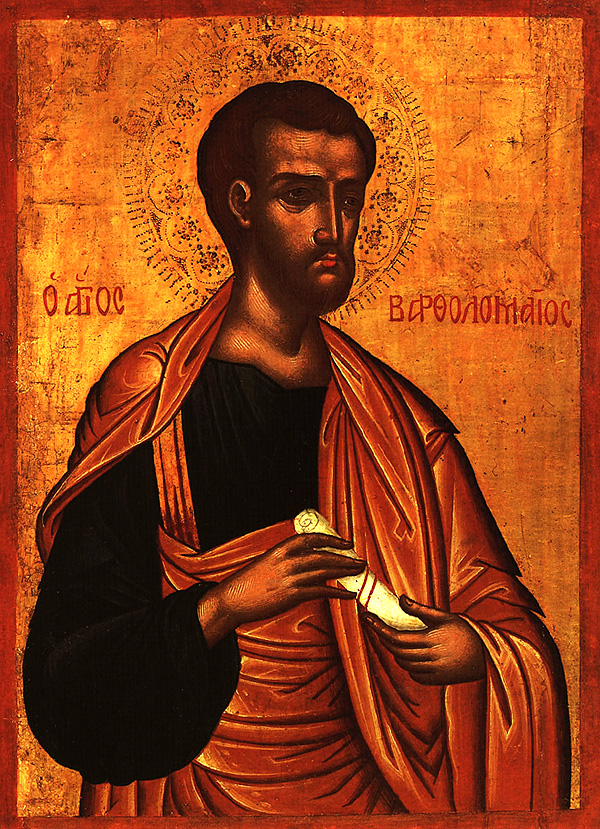
St Bartholomew (Source: Orthodox Church in America)

August 24 is the Feast of Saint Bartholomew the Apostle. The following lessons are the course readings otherwise assigned.

The Lessons: Job 4:1; 5:1-11, 17-21, 26-27; Acts 9:19b-31; John 6:52-59

Job: Eliphaz continues his initial speech, offering to Job additional strategies for responding to his suffering. Vexation: not appropriate, since “trouble” is simply part of the human condition (vv.1-7). Commit one’s cause to God (vv.8-16): precisely what Job does. Accept what has happened as “reproof” or “discipline” (vv.17-27)? “At destruction and famine you shall laugh… You shall know that your tent is safe, / you shall inspect your fold and miss nothing. / You shall know that your descendants will be many…” (vv.22b, 24-25a): here (recall chapter 1) Eliphaz appears to have gone on autopilot!

Acts: In one of the readings accompanying the Feast of St. Bartholomew Philip brings Nathanael to Jesus (Jn 1:43-53; an early tradition identifies the Nathanael in the Gospel according to John with the Bartholomew in the synoptic Gospels). In our Acts 9 reading Barnabas performs a parallel function, connecting him with the understandably cautious apostles, and apparently without an Ananias-type vision!

John: “Just as the living Father sent me, and I live because of the Father, so whoever eats me will live because of me.” With this we might pair “As the Father has sent me, so I send you” (20:21). What has the Gospel according to John done? Matthew: “But strive first for the kingdom of God and his righteousness, and all these things will be given to you as well” (6:33). Hearing only this text we might assume that the striving is a matter of our effort; one of John’s contributions is to explore the organic connection between Jesus and the disciples, and, elsewhere, between the Holy Trinity and the disciples.

Re the Daily Office Readings August 23 Anno Domini 2020

Photo by NeONBRAND

The Lessons: Job 4:1-6, 12-21; Rev. 4:1-11; Mark 6:1-6a

Job: For a long stretch the narrator offers no judgments, demanding more of us listeners (the “cool” end of McLuhan’s spectrum). So we wonder: what do Job’s friends get right? If they get it wrong, where and how? Job sounds ready to throw in the towel; is Eliphaz wrong to encourage a different response? But there’s some tension between Eliphaz’s two arguments (vv.6-11, 12-21); how does Eliphaz hold them together?

Revelation: We miss gathering together for Holy Eucharist. This reading reminds us that the worship—unmasked—continues. As when physically together, so now physically apart, we intentionally join our voices “with Angels and Archangels and with all the company of heaven…”

Mark: Ever since Constantine declared us legal early in the 4th century, we’ve been proudly building places of worship, houses of God, places where Jesus can feel at home. And setting Jesus up for further experiences of déjà vu all over again?

Re the Daily Office Readings August 22 Anno Domini 2020

Photo by Alex Paganelli

The Lessons: Job 3:1-26; Acts 9:10-19a; John 6:41-51

Job 2-3: It will turn out that Job’s friends are at their best in chapter 2: “They sat with him on the ground seven days and seven nights, and no one spoke a word to him, for they saw that his suffering was very great.” We might wonder where we ought to mirror the friends’ behavior. Job, in turn, begins with a lengthy curse. We might wonder: what groups today might join their voices to Job’s.

Back in 1952 J. B. Phillips gave us Your God is too small. The book’s title might serve as the heading for the Acts and John readings, Ananias assuming that God is unaware of Saul’s doings, Jesus’ audience assuming that they have all the information they need about Jesus. Happily, they articulate their assumptions, and the assumptions can be dealt with. But what happens when our assumptions remain unarticulated?

Re the Daily Office Readings August 21 Anno Domini 2020

Photo by Leiliane Fagundes

The Lessons: Job 2:1-13; Acts 9:1-9; John 6:27-40

The second appearance of “the accuser” (haśśāṭān) gives us an opportunity to recalibrate our use of words like ‘satanic’. Our culture tends to use ‘satanic’ for a narrow range of behaviors, explicit worship of the devil, unrestrained cruelty or unrestrained indulgence in the so-called “sins of the flesh.” This is convenient, for what the accuser is about is seeing the worst in people, promoting the most negative interpretation of their actions. (“Job’s ‘blameless and upright’ only for what he gets out of it!”) So the ‘satanic’ is properly the demeaning of individuals or groups, encouraging us to write them off as too bad, dangerous, lazy, etc.

This is not to encourage more frequent use of ‘satanic’—our political discourse is toxic enough already. It is to recognize the satanic as a temptation for “us” as well as “them.” Racism, for example, is satanic. Critique of those involved in racist behavior becomes satanic when it dehumanizes those critiqued. Satan has many ways of winning.

John: Jesus’ use of the bread metaphor is striking. Jesus: the Bread of life. The metaphor by itself puts the onus on us: we eat, or not. So Jesus steps out of the metaphor: “Everything that the Father gives me will come to me, and anyone who comes to me I will never drive away… And this is the will of him who sent me, that I should lose nothing of all that he has given me.” Jesus will guard all who come to him (the Good Shepherd metaphor of John 10 resonating here). The Father gave manna; the Father gives Jesus; Jesus’ love is as active as the Father’s. This is good news for those of us whose response to Jesus often leaves so much to be desired.

Re the Daily Office Readings August 20 Anno Domini 2020

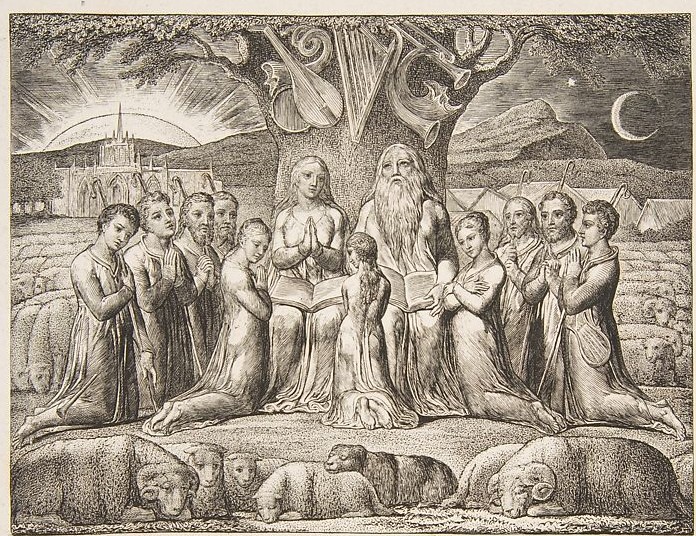
Job and his family by William Blake

The Lessons: Job 1:1-22; Acts 8:26-40; John 6:16-27

Today we begin the prodigy that is the Book of Job. It is “about” multiple things, not least of which is the adversary’s question “Does Job fear God for nothing?” (This is, perhaps, the flip side of the issue of simony that we met in yesterday’s Acts reading!)

‘The adversary’ or ‘the accuser’: the NRSV, oddly, translates as ‘Satan’. But in Job the word always appears with the definite article, so it’s not yet a proper name. In any case, having moved the plot along, the figure does not reappear after chapter 2.

Re what Job’s “about,” Davis, noticing that Job, like Jeremiah, curses the day of his birth (Job 3:1-26; Jer 20:14-18) and that Job’s suffering looks like the servant’s in Isaiah (52:13-53:12), suggests: “These [and other] various connections align this wisdom book with the two prophetic traditions that deal most directly with the problem of massive suffering in relation to Jerusalem’s destruction and the Babylonian exile, suffering that defies comprehension and feels like the enmity of God” (Opening Israel’s Scriptures). How does one respond to such suffering?

The Ethiopian is reading from Isa 52:13-53:12 when he encounters Philip. “About whom, may I ask you, does the prophet say this, about himself or about someone else?” doesn’t have a single correct answer—Stephen, newly buried, comes to mind—but Philip’s proclaiming Jesus is more than appropriate.

How much of Isaiah is Luke pointing to in this story? After introducing the Ethiopian (v.27), he thereafter refers to him simply as “the eunuch” (four times). Is it accidental that it’s in Isaiah that we encounter the following?

3 Do not let the foreigner joined to the LORD say,
“The LORD will surely separate me from his people”;
and do not let the eunuch say,
“I am just a dry tree.”
4 For thus says the LORD:
To the eunuchs who keep my sabbaths,
who choose the things that please me
and hold fast my covenant,
5 I will give, in my house and within my walls,
a monument and a name
better than sons and daughters;
I will give them an everlasting name
that shall not be cut off.
6 And the foreigners who join themselves to the LORD,
to minister to him, to love the name of the LORD,
and to be his servants,
all who keep the sabbath, and do not profane it,
and hold fast my covenant–
7 these I will bring to my holy mountain,
and make them joyful in my house of prayer;
their burnt offerings and their sacrifices
will be accepted on my altar;
for my house shall be called a house of prayer
for all peoples. (56:3-7)

The servant about whom the eunuch is reading is key to making this vision a reality.

John: “Do not work for the food that perishes, but for the food that endures for eternal life…” Texts like these are the reason we understand that in the Hebrew idiom—and other languages influenced by that idiom—“Not A, but B” may mean “While A is important, B is more important.” This launches a long conversation which reveals why John the Evangelist noted the proximity of the feeding to Passover (v.4): rather than record the institution of the Eucharist at Passover, the Gospel of John gives us a long reflection on the Eucharist here.

Re the Daily Office Readings August 19 Anno Domini 2020

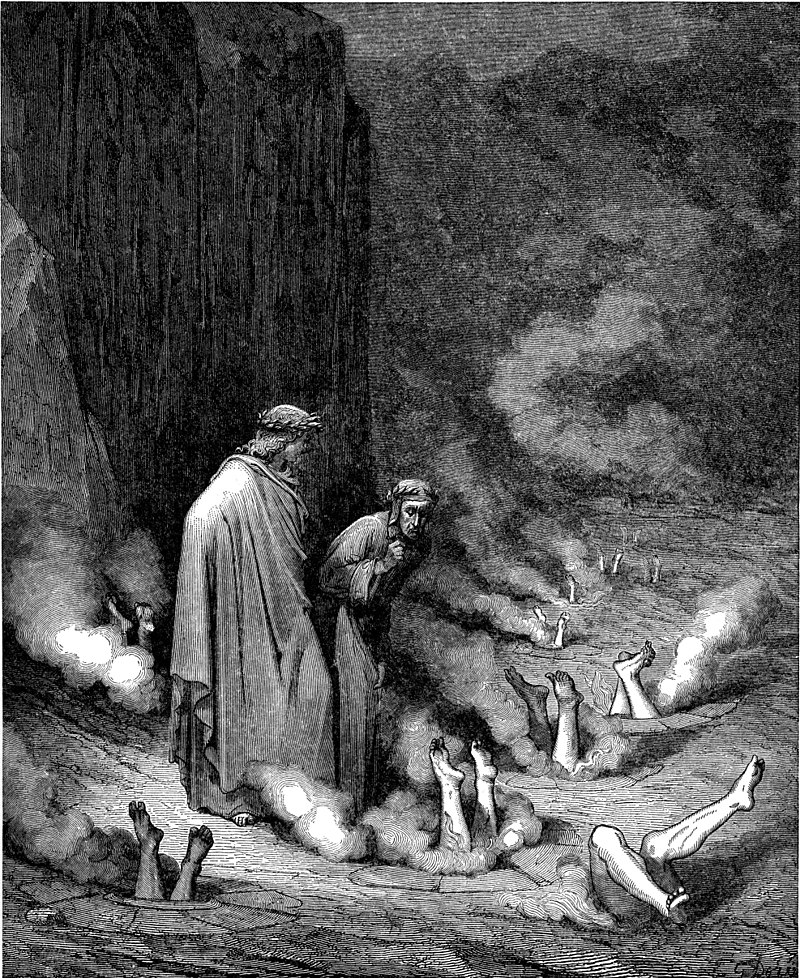
Dante speaking to Pope Nicholas III by Gustave Doré

The Lessons: Judges 18:16-31; Acts 8:14-25; John 6:1-15

Re Judges, if we find the reading depressing, the editors have succeeded. Their message: something has to change; their hope is that kingship will be a good change. The inclusion of Judges 19-21 (omitted in our Lectionary) is perhaps overkill on the editors’ part. (The soundtrack for Judges 17-21 could easily be taken from John Boorman’s Deliverance [1972].) The combination of Judges 19-21, portraying Benjamin at its worst, and Ruth, portraying Judah at its best, does set us up for the conflict in 1 Samuel between Saul (tribe of Benjamin) and David (tribe of Judah).

Re Acts, recall “A bribe is like a magic stone in the eyes of those who give it; / wherever they turn they prosper” (Prov. 17:8). As with all proverbs, time and circumstance matter, and in Simon’s case the proverb misfires spectacularly. Hence “simony,” procuring or attempting to procure spiritual goods through offering material goods, a sin at which Pope Nicholas III was reputed to excel (see illustration from Dante’s Inferno). As Proverbs (repeatedly) observes, money is powerful, also (particularly?) when we aren’t paying attention to its power.

Re John, both John the Evangelist and Jesus as portrayed in the Gospel display ambivalence re signs (“Unless you see signs and wonders you will not believe” [4:48]). So feeding the five thousand is liable to be counterproductive, and turns out to be so (“When Jesus realized that they were about to come and take him by force to make him king…”). It’s interesting that counterproductive is not a deal-killer: five thousand human beings are involved.

Re the Daily Office Readings August 18 Anno Domini 2020

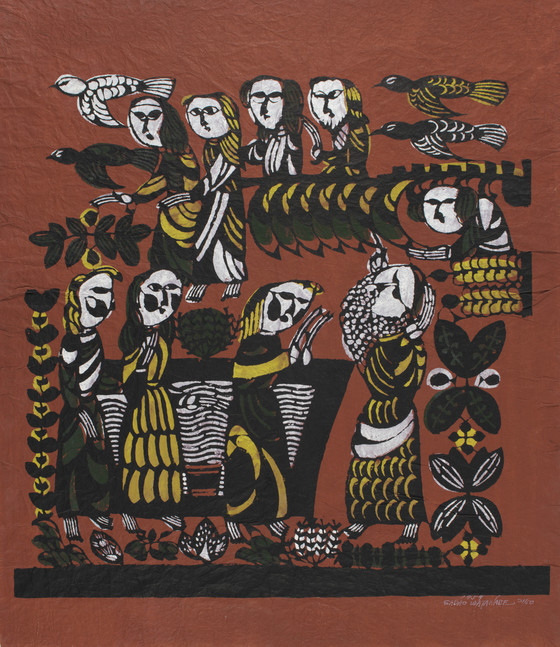
The Well in Samaria by Sadao Watanabe

The Lessons: Judges 18:1-15; Acts 8:1-13; John 5:30-47

Re Judges, Zorah and Eshtaol (vv.2, 8, 11) may sound familiar: they’re where Samson began causing good trouble (13:25) and where he was buried (16:31). In retrospect, “It is he [Samson] who shall begin to deliver Israel from the hand of the Philistines” (13:5) sounds like overstatement: the Danites in that area decided that they’d be happier elsewhere, and so send out spies, the spies who encounter the young Levite at Micah’s house.

Re Acts, since the apostles are not scattered (v.1), the Philip who evangelizes in Samaria is the deacon, named after Stephen in the roster (6:5). The Holy Spirit was, again, not limited by the apostles’ vision of the deacons’ role (6:2-4). Simon the magician, who also figures in tomorrow’s reading, gives us, together with the Judges readings, opportunity to reflect on “You shall not covet” (Exod 20:17; see the August 8 post).

Re John, Jesus’ argument with the Jewish authorities continues. As various commentators have noticed, this Gospel periodically conflates two settings: Jesus’ setting and the author’s setting toward the end of the first century, when the heirs of the Pharisees are working to exclude groups like Jesus’ followers from Judaism. So taking Jesus’ words as a reliable description of all Jews in all times and places would be an egregious misreading. One helpful reading might start with v.44 (CEB): “How can you believe when you receive praise from each other but don’t seek the praise that comes from the only God?” We tend to think that believing and status-seeking are separate issues; Jesus sees a connection. That might be something to wonder about.