Category Archives: Daily Office Readings

Re the Daily Office Readings June 6 Anno Domini 2020

Photo by Marco Bianchetti

The Readings: Ecclesiastes 5:8-20; Galatians 3:23––4:11; Matthew 15:1-20

Many things we might wonder about in the first reading; here are three.

“If you see in a province the oppression of the poor and the violation of justice and right, do not be amazed at the matter; for the high official is watched by a higher, and there are yet higher ones over them.”

In the teacher’s world, oppression is not a bug, but a feature. How ought the wise/righteous respond? At first glance the teacher is the outlier in the wisdom tradition. Recall:

“I put on righteousness, and it clothed me;
my justice was like a robe and a turban.
I was eyes to the blind,
and feet to the lame.
I was a father to the needy,
and I championed the cause of the stranger.
I broke the fangs of the unrighteous,
and made them drop their prey from their teeth.” (Job 29:14-17)

“If you faint in the day of adversity,
your strength being small;
if you hold back from rescuing those taken away to death,
those who go staggering to the slaughter;
if you say, ‘Look, we did not know this’–
does not he who weighs the heart perceive it?
Does not he who keeps watch over your soul know it?
And will he not repay all according to their deeds? (Prov. 24:10-12)

But Proverbs also observes:

“When the righteous triumph, there is great glory,
but when the wicked prevail, people go into hiding.” (28:12)

The teacher sees no point in fighting apparently unwinnable battles. This collection of the teacher’s words challenges us readers: do we agree?

A second thing to wonder about: “This also is a grievous ill: just as they came, so shall they go; and what gain do they have from toiling for the wind?” There’s that word ‘gain’ (yitrôn) again. We might wonder: is the teacher (or the editor) pulling our leg a little? Is it all for nothing if you can’t take it with you?

A third thing to wonder about: how to translate the ending of v.20. The problem is that there are a number of homonyms for the Hebrew verb ˁānâ, so translators have to decide which is in play. Here are two representative translations:

“For they will scarcely brood over the days of their lives, because God keeps them occupied with the joy of their hearts.” (NRSV)

“Indeed, people shouldn’t brood too much over the days of their lives because God gives an answer in their hearts’ joy.” (Common English Bible)

If the NRSV is correct, joy is an exercise in bread and circuses, a distraction from our grim reality. If CEB is correct, joy is a privileged clue to God’s benevolent intentions in the midst of our grim reality. And which we lean towards depends on how we read the book as a whole.


Re the Daily Office Readings June 5 Anno Domini 2020

Potters at work – Imado, by Katsushika Hokusai

The Readings: Ecclesiastes 4:4—5:7; Galatians 3:15-22; Matthew 14:22-36

The Lectionary, oddly, omits 4:4-16. I’ve included these verses with today’s reading (5:1-7) in the link above, because they’re helpful in thinking about how we read the book.

“Then I saw that all toil and all skill in work come from one person’s envy of another. This also is vanity and a chasing after wind” (4:4). All toil and all skill? Hardly. Counterexamples come to mind quickly, whether from our own experience or from Scripture (Bezalel, Oholiab, and others whose skill is a divine gift and whose toil is inspired by the work of constructing the tabernacle; Jacob’s seven years of toil for Rachel, which “seemed to him but a few days because of the love he had for her” (Gen. 29:20). What apparently is true: “Then I saw that…” As Anaïs Nin observed, “We don’t see the world as it is, we see it as we are.” Is the author here tipping his/her hand, inviting us to wonder not simply about the teacher’s words, but about the teacher’s character?

“Fools fold their hands
and consume their own flesh.
Better is a handful with quiet
than two handfuls with toil,
and a chasing after wind” (4:5-6).

Two sayings, back to back, pointing in opposite directions. We have similar sayings: “A stitch in time saves nine”; “Haste makes waste.” The teacher likes putting such competing sayings back to back, and probably for different reasons. Here, perhaps, a traditional reminder that wisdom consists in recognizing which saying is relevant, whether we’re in the time for this or that (recall 3:1-8). The teacher does not seem to have given up on the hope of being able to recognize these times (see 8:5-6).

“Two are better than one, because they have a good reward for their toil” (4:9). Equally interesting are the claims the teacher does not pair with a counter-claim (no claim that one is better than two). The teacher could have included a long exhortation on selecting friends, building and maintaining friendships, but opted to let the hearers draw their own conclusions. Strikingly, we know the threefold cord proverb (v.12) from the Gilgamesh Epic, a reminder that wisdom is an international enterprise, and that the teacher is quite happy to pass on selected traditional wisdom.

Re the Daily Office Readings June 4 Anno Domini 2020

The Readings: Ecclesiastes 3:16––4:3; Galatians 3:1-14; Matthew 14:13-21

“Unless I see the mark of the nails in his hands, and put my finger in the mark of the nails and my hand in his side, I will not believe” (Jn. 20:25). There’s theological integrity here, securing Thomas’ place as the spiritual, if not biological, descendant of the teacher in our first reading, an integrity particularly on display in this reading.

“I said in my heart, God will judge the righteous and the wicked, for he has appointed a time for every matter, and for every work.” If “For everything there is a season, and a time for every matter under heaven” (v.1); surely that must include judgment. But as the teacher repeatedly observes (e.g., 7:15; 8:14) judgment is not visible in this life. Judgment is part of the tradition the teacher’s received, and the teacher’s too aware of the limitations of his knowledge to toss it prematurely. What about the life to come as the setting for judgment?

A bit of background: until well into the time under Persian and later Greek domination, most Jews believed that at death everyone descended to Sheol, where there was neither reward nor punishment, simply disconnection from the living and from God. In part to answer the question of where God’s justice happens, some Jews variously reconceptualize the afterlife. It’s one of the issues that splits the Pharisees, who affirm the resurrection and Sadducees, who deny it. In today’s text the teacher responds to this emerging argument: “All go to one place; all are from the dust, and all turn to dust again. Who knows whether the human spirit goes upward and the spirit of animals goes downward to the earth?”

Integrity. Opting for the human spirit going upward would have answered many of the teacher’s questions. But, lacking evidence, “who knows?” Nor does the teacher discard “God will judge the righteous and the wicked.” The teacher preserves the tension. Complains about it. Repeatedly. And that’s perhaps as close as the teacher comes to praying in the book.

Postscript: Pulling back the camera to include today’s other readings, while the New Testament retains divine judgment (e.g., Matt. 25:31-45), it stresses more the need we all have for divine mercy.

Re the Daily Office Readings June 3 Anno Domini 2020

NASA Image

The Readings: Ecclesiastes 3:1-15; Galatians 2:11-21; Matthew 14:1-12

“He brings everything to pass precisely at its time; He also puts eternity in their mind, but without man ever guessing, from first to last, all the things that God brings to pass” (NJPS).

Translations of the verse vary. “He hath made everything beautiful in his time” (KJV) is equally possible for the beginning of the verse. NRSV paraphrases ‘eternity’ as “a sense of past and future”; others, “the world”; others, assuming a textual error, “toil.” Nevertheless, the general sense is clear. It’s not that God is absent or inactive, but that the speaker can’t make out what God is doing.

This inability is clearly a source of pain, and the speaker is all over the map in the implicit evaluations of God’s conduct.

Is the situation different if we pull the camera back to include the rest of the Bible? On the one hand there is the Great Story running from Genesis to Revelation whose highlights we Christians celebrate in the course of the Church Year. On the other hand, there’s the experience of Abraham, recipient of splendid promises of posterity and land, who remains childless for decades after receiving the promises and has to negotiate for a place to bury his wife. Or Jacob, in his self-description on meeting Pharaoh: “The days of the years of my pilgrimage are an hundred and thirty years: few and evil have the days of the years of my life been, and have not attained unto the days of the years of the life of my fathers in the days of their pilgrimage” (KJV).

It’s not that the speaker doesn’t know the Great Story; it’s that where the speaker is living it doesn’t help. So with us, and in these places the speaker isn’t a bad traveling companion. “Two are better than one…  For if they fall, one will lift up the other” (4:9-10).

Re the Daily Office Readings June 2 Anno Domini 2020

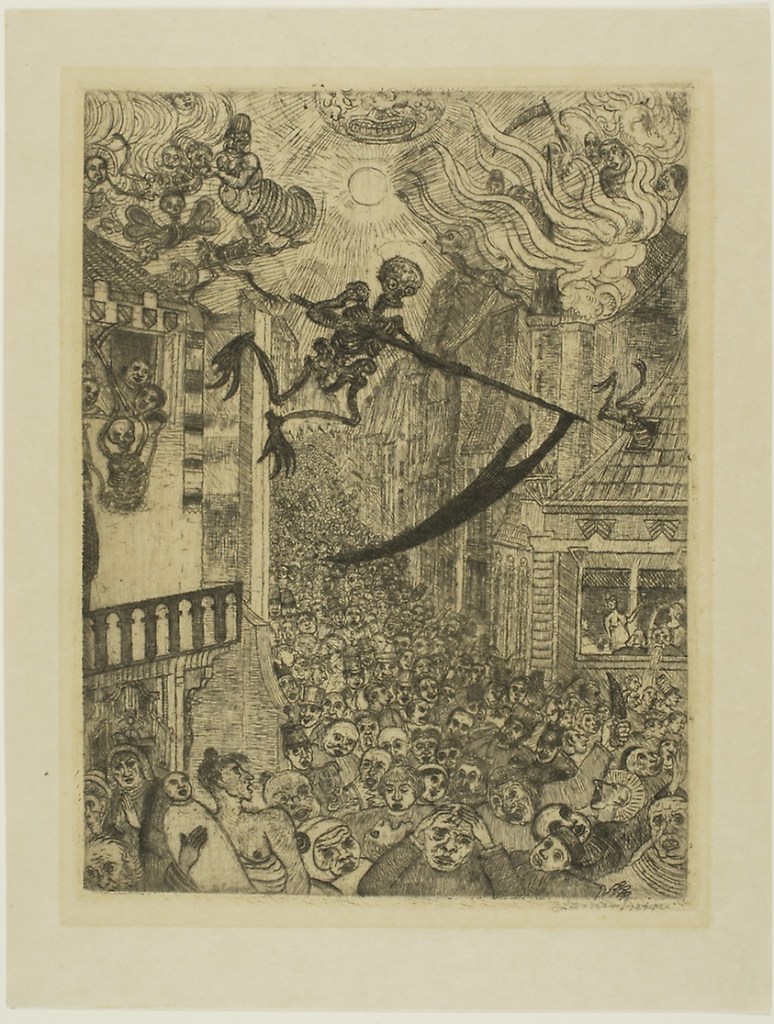
Death chasing a flock of mortals by James Ensor

The Readings: Ecclesiastes 2:16-26; Galatians 1:18––2:10; Matthew 13:53-58

Death is a deal-breaker in Ecclesiastes, but not in Proverbs. Why? Part of the answer may lie in the difference between the worlds implied in the two books. Here are a couple characteristic contrasts:

“The memory of the righteous is a blessing, but the name of the wicked will rot.” (Prov. 10:7)

“For there is no enduring remembrance of the wise or of fools.” (Eccl. 2:16a)

“Train children in the right way, and when old, they will not stray.” (Prov. 22:6)

“I hated all my toil in which I had toiled under the sun, seeing that I must leave it to those who come after me — and who knows whether they will be wise or foolish?”  (Eccl. 2:18-19a)

And with the social world becoming less stable, the sense of self links less to the multi-generational community, more to the individual—which can also shift perceptions of what counts as justice. Jeremiah: “In those days they shall no longer say: ‘The parents have eaten sour grapes, and the children’s teeth are set on edge.’ But all shall die for their own sins; the teeth of everyone who eats sour grapes shall be set on edge” (31:29-30).

The world of Proverbs may feel like a more comfortable world— “Nice work if you can get it”—but it’s Ecclesiastes that sets death up as the enemy, with its conqueror not yet on the horizon.

Re the Daily Office Readings June 1 Anno Domini 2020

St Mark’s Cathedral, Venice

The Readings: Ecclesiastes 2:1-15; Galatians 1:1-17; Matthew 13:44-52

In the first two chapters—and only there—the speaker adopts a royal persona (“the son of David, king in Jerusalem”), thus the traditional identification of Solomon as the author. “Then I considered all that my hands had done and the toil I had spent in doing it, and again, all was vanity and a chasing after wind, and there was nothing to be gained under the sun.” Why, wondered early readers, would Solomon say that?

Early Jewish interpretation, preserved in an Aramaic paraphrase (the Targum), provides one answer: ”When Solomon the King of Israel foresaw, by the spirit of prophecy that the kingdom of Rehoboam his son would be divided with Jeroboam the son of Nebat, that Jerusalem and the holy temple would be destroyed, and that the people of Israel would be exiled, he said by the divine word, ‘Vanity of vanities is this world! Vanity of vanities is all which I and my father David strived for. All of it is vanity.’”

Well, even if we don’t follow the Targum in making Solomon a prophet, the Targum’s picked up on one of the book’s central themes: our works don’t last. They turn out to be no more substantial than hebel (‘breath’, ‘vanity’, etc.). Recall Shelley’s Ozymandias with its line “Look on my works, ye mighty, and despair.”

So what? Perhaps (1) O Hearer, if this is Solomon’s verdict, what does this say about the toil you’re investing in your more modest projects? And (2) O Hearer, perhaps Solomon will help you properly evaluate the conspicuous consumption practiced by the movers and shakers in your time?

What do you see?

Re the Daily Office Readings May 31 Anno Domini 2020

Sisyphus by Titian

The Readings: Deuteronomy 16:9-12; Acts 4:18-21, 23-33; John 4:19-26

The OT Reading bumped by Pentecost: Ecclesiastes 1:1-11

Since I’m focusing on Ecclesiastes over the next two weeks, today the focus is on its first 11 verses, bumped in the Lectionary for the Feast of Pentecost.

By numerous measures we’re the world’s leading nation, and we have over 100,000 coronavirus deaths, around 40 million unemployed, the House and Senate on different pages, the President and his scientific advisors only sporadically on the same page. Have we had enough futility yet? Enter Ecclesiastes, our conversation partner for the next couple weeks. Upfront, I need to remember that (1) what Ecclesiastes means by futility/vanity/absurdity is not necessarily what I (or Paul) mean, and (2) the author’s perspective and the perspective of the “I” in the book are not necessarily the same. The second point is important because it’s quite possible that the book is a sort of thought-experiment: if I assume this, where do I end up?

As for the first point, ‘futility’, ‘vanity’, ‘absurdity’ are interpretations of Hebrew hebel, which literally means “the flimsy vapor that is exhaled in breathing, invisible except on a cold winter day and in any case immediately dissipating in the air” (Alter). It’s a metaphor, and perhaps we should let it do its work as a metaphor without tying it down to a particular meaning.

“All is mere breath” (Robert Alter’s translation). Here, and elsewhere, we might wonder: what would it take for this not to be true?

One of the book’s innovations is the use of a number of terms from the world of economics, e.g., ‘gain’ or ‘profit’ in v.3. Same question: what would gain look like? Pulling back the camera: how well does approaching life as an exercise in bookkeeping work?

Finally, something (else) notably odd: the tradition out of which the book works (“wisdom”) typically values tradition, the old, the well-tested. Anything new is likely an outlier. But here’s the speaker (complaining): “there is nothing new under the sun.” What sort of world does the speaker inhabit that makes this complaint make sense?

Perhaps this is an apt moment for reflection. Where am I particularly encountering “mere breath” now?

Re the Daily Office Readings May 30 Anno Domini 2020

The Readings: Ezekiel 36:22-27; Ephesians 6:10-24; Matthew 9:18-26

“A new heart I will give you, and a new spirit I will put within you;
and I will remove from your body the heart of stone and give you a heart of flesh.”

Hearing these words from the exilic prophet Ezekiel we might recall the lines from Psalm 51:

“Create in me a clean heart, O God,
and put a new and right spirit within me.”

Psalm 51—bear with me here—is notable for its casual attitude toward chronology. On the one hand, the superscript links it to David’s life: “A Psalm of David, when the prophet Nathan came to him, after he had gone in to Bathsheba.” On the other hand, its final verses imply the post-exilic devastation:

“Do good to Zion in your good pleasure;
rebuild the walls of Jerusalem,
then you will delight in right sacrifices,
in burnt offerings and whole burnt offerings;
then bulls will be offered on your altar.”

The psalmist knows Ezekiel’s words. But rather than consign them to sometime in the future the psalmist prays: what you promised to do for the nation do for me now: a clean heart, a new and right spirit. And do we think that God turned a deaf ear to this prayer?

This does put Pentecost in a different light. For generations—for centuries—the Jews have been praying “Create in me a clean heart, O God, and put a new and right spirit within me.” And God has been answering. And as part of that answer, the dramatic coming of the Spirit which we remember tomorrow.

Re the Daily Office Readings May 29 Anno Domini 2020

The Readings: Jeremiah 31:27-34; Ephesians 5:1-20; Matthew 9:9-17

From last Sunday on, the Lectionary’s OT readings have offered a pre-Pentecost collage. How the Jeremiah reading might relate to Pentecost is unclear. (And a quick review of Jeremiah’s use of ruach [‘spirit’] suggests that the S/spirit does not play an obvious role in his visions of the renewal of Israel!) Nevertheless, Jeremiah’s words re the new covenant, understood by Christians from the New Testament on as fulfilled in Jesus (see, particularly, the Words of Institution and Hebrews), might get us wondering: just what does the New Covenant look like? How is it new? And while the other two readings are course readings in their respective books, and so not chosen to answer these questions, they certainly can complicate the questions.

“No one sews a piece of unshrunk cloth on an old cloak, for the patch pulls away from the cloak, and a worse tear is made. Neither is new wine put into old wineskins; otherwise, the skins burst, and the wine is spilled, and the skins are destroyed; but new wine is put into fresh wineskins, and so both are preserved.” There’s Jeremiah’s old/new contrast, but who would have guessed that the new covenant involved calling not the “righteous,” but the “sinners”? (For that matter, exploring Jesus’ words a bit, we old wineskins—in whatever proportion of “righteous” and “sinner”—how are we supposed to receive the new wine without bursting?)

So, Jesus at Matthew’s house, with many tax collectors and sinners, because “Those who are well have no need of a physician, but those who are sick.” If Paul, a Pharisee, knew this story, what did he make of it? “Be sure of this, that no fornicator or impure person, or one who is greedy (that is, an idolater), has any inheritance in the kingdom of Christ and of God. Let no one deceive you with empty words, for because of these things the wrath of God comes on those who are disobedient. Therefore do not be associated with them.” Are Jesus and Paul on the same page here?

Re Psalm 137, May 28 Anno Domini 2020

Psalm 137 is one of the psalms assigned to the 28th day in the BCP’s 30-day cycle.

“Happy shall he be who takes your little ones,
and dashes them against the rock!”

This is the verse in the Psalter, perhaps in the entire Bible, that prompts the most soul-searching. How can this be in our Bible? Yet, as Caitlin Dickerson reports, in March-April of this year we deported 915 migrant children back to the violence from which they fled, sometimes without notifying their families, sometimes in the middle of the night.

Are we happy yet?