“Surely the Lord is in this place—and I did not know it” (Gen 28:16). Here we wonder about encountering G-d at the intersection of Bible and Life–typically prompted by the (Episcopal) Book of Common Prayer.
“Come out of her, my people…” When is this the word we need to hear? This is a question of community discernment, and highlights the importance of an element in today’s Gospel reading: “So when you are offering your gift at the altar, if you remember that your brother or sister has something against you, leave your gift there before the altar and go; first be reconciled to your brother or sister, and then come and offer your gift.” It’s likely that the brother or sister whose voice we most need to hear for discernment here (and elsewhere!) is the brother or sister with whom we’re at odds.
Job. I yield the floor to G. K. Chesterton (The Book of Job, 1916):
…it is one of the splendid strokes that God rebukes alike the man who accused and the men who defended Him: that He knocks down pessimists and optimists with the same hammer, And it is in connection with the mechanical and supercilious comforters of Job that there occurs the still deeper and finer inversion of which I have spoken. The mechanical optimist endeavors to justify the universe avowedly upon the ground that it is a rational and consecutive pattern. He points out that the fine thing about the world is that it can all be explained. That is the one point, if I may put it so, on which God, in return, is explicit to the point of violence. God says, in effect, that if there is one fine thing about the world, as far as men are concerned, it is that it cannot be explained. He insists on the inexplicableness of everything; “Hath the rain a father? … Out of whose womb came the ice?” (38:28f.). He goes farther, and insists on the positive and palpable unreason of things; “Hast thou sent the rain upon the desert where no man is, and upon the wilderness wherein there is no man?” (38:26). God wIll make man see things, if it is only against the black background of nonentity. God will make Job see a startling universe if He can only do it by making Job see an idiotic universe. To startle man God becomes for an instant a blasphemer; one might almost say that God becomes for an instant an atheist. He unrolls before Job a long panorama of created things, the horse, the eagle, the raven, the wild ass, the peacock, the ostrich, the crocodile. He so describes each of them that it sounds like a monster walking in the sun. The whole is a sort of psalm or rhapsody of the sense of wonder. The maker of all things is astonished at the things He has Himself made.
This we may call the third point. Job puts forward a note of interrogation; God answers with a note of exclamation. Instead of proving to Job that it is an explicable world, He insists that it is a much stranger world than Job ever thought it was. Lastly, the poet has achieved in this speech, with that unconscious artistic accuracy found in so many of the simpler epics, another and much more delicate thing. Without once relaxing the rigid impenetrability of Jehovah in His deliberate declaration, he has contrived to let fall here and there in the metaphors, in the parenthetical imagery, sudden and splendid suggestions that the secret of God is a bright and not a sad one—semi-accidental suggestions, like light seen for an instant through the cracks of a closed door.
It would be difficult to praise too highly, in a purely poetical sense, the instinctive exactitude and ease with which these more optimistic insinuations are let fall in other connections, as if the Almighty Himself were scarcely aware that He was letting them out. For instance, there is that famous passage where Jehovah, with devastating sarcasm, asks Job where he was when the foundations of the world were laid, and then (as if merely fixing a date) mentions the time when the sons of God shouted for joy (38:4-7). One cannot help feeling, even upon this meager information, that they must have had something to shout about. Or again, when God is speaking of snow and hail in the mere catalogue of the physical cosmos, He speaks of them as a treasury that He has laid up against the day of battle-a hint of some huge Armageddon in which evil shall be at last overthrown.
If Job is useful as a Voters’ Guide (yesterday’s post), it’s equally useful (challenging) as a mirror: how lightly I hold my possessions, what I wish for my enemies, my generosity, my earthkeeping… (It’s more than a little puzzling that Old Testament saints like Job do not appear in the Episcopal Calendar. He’s celebrated May 6 in most Orthodox calendars, May 10 in the Roman.)
Acts. What’s the basis for James’ decision, specifically vv. 20 (“but we should write to them to abstain only from things polluted by idols and from fornication and from whatever has been strangled and from blood”)? Commentators generally look to the “Noachian precepts” (binding on all as per Gen 9:4-6) or to the laws covering non-Israelites resident in Israel in Lev 17-18. In either case, (1) Moses’ law is assumed to be in full force, the issue being its interpretation, and (2) a sort of two-track arrangement (Jewish and Gentile believers) is envisioned. Between the destruction of Jerusalem and Gentile arrogance such arrangements turned out to have a very short shelf life.
John. Jesus weeps before Lazarus’ tomb. But, as John tells the story, Jesus had delayed responding to Mary and Martha’s news of Lazarus’ illness. Jesus: “This illness does not lead to death; rather it is for God’s glory, so that the Son of God may be glorified through it.” Later: “Lazarus is dead. For your sake I am glad I was not there, so that you may believe. But let us go to him.” God’s glory and belief: John certainly and perhaps Jesus give these greater weight than we readers might. Something to ponder.
Job. Since the Lectionary has jumped around a bit, Job 29-31 is Job’s final speech in the dialogue with the three friends. (Elihu appears in chapter 32, and talks until the LORD’s appearance in chapter 38.) In this final speech Job recalls his past (chapter 29), laments his present (chapter 30), and ends with an extended set of self-curses (this chapter): may such-and-such happen to me if… If we’re looking for a summary of what is exemplary, this chapter (along with chapter 29) is more than adequate. We could do worse than use it to evaluate our choices—up and down the ballot—on November 3.
Acts. Luke started his account with this: “In the days of King Herod of Judea, there was a priest named Zechariah, who belonged to the priestly order of Abijah. His wife was a descendant of Aaron, and her name was Elizabeth. Both of them were righteous before God, living blamelessly according to all the commandments and regulations of the Lord” (Lk. 1:5-6). Now we hear Peter: “why are you putting God to the test by placing on the neck of the disciples a yoke that neither our ancestors nor we have been able to bear?” The “yoke” was unbearable for Zechariah and Elizabeth (and Joseph and Mary and…)?
The Book of Job is also an essential complement to the Psalter. There’s a lot of overlap between Job’s complaints and many of the psalms. While the psalms are generally anonymous (the attribution to David serving some of the same functions as the overlap with Job I’m describing), Job’s words, e.g., today’s reading, help us better imagine the human experiences behind the Psalter’s words.
Acts. How to hear the references to the Jews in today’s reading without putting ourselves—and them—in danger? At the end of Simeon’s encounter with the Holy Family in the temple: “Then Simeon blessed them and said to his mother Mary, ‘This child is destined for the falling and the rising of many in Israel, and to be a sign that will be opposed so that the inner thoughts of many will be revealed– and a sword will pierce your own soul too’” (Lk. 2:34-35). Jesus periodically throws us into crisis, so that it’s not enough to have been faithful yesterday.
How to make sense of this? James Russell Lowell’s “The Present Crisis” (excerpted as #519 in the Hymnal of 1940, dropped from the Hymnal of 1982), offers powerful images, but shows little interest in listening sympathetically to one’s opponents. Then there’s this from Dimble in C. S. Lewis’ That hideous strength: “If you dip into any college, or school, or parish, or family—anything you like—at a given point in its history, you always find that there was a time before that point when there was more elbow room and contrasts weren’t quite so sharp; and that there’s going to be a time after that point when there is even less room for indecision and choices are even more momentous. Good is always getting better and bad is always getting worse: the possibilities of even apparent neutrality are always diminishing. The whole thing is sorting itself out all the time, coming to a point, getting sharper and harder” (Chapter 13, Section 4).
Returning to Acts, the Old Testament reflects a fair amount of ambiguity (Dimble’s “elbow room”) re what God will do with/about the Gentiles. Between Jesus and the Spirit’s work some of that ambiguity disappears, and that forces choices, since Israel’s identity is also involved. “The falling and the rising of many in Israel,” indeed. Nor was this the last time Jesus threw us into crisis (the institution of slavery, the status of women, ecological justice—the list keeps growing because Jesus dreams big).
Yesterday was Labor Day. As a sort of belated celebration…
Whatever your hand finds to do, do with your might; for there is no work or thought or knowledge or wisdom in Sheol, to which you are going. (Eccl. 9:10)
We must work the works of him who sent me while it is day; night is coming when no one can work. (Jn. 9:4)
“My Father is still working, and I also am working.” (Jn. 5:17 NRS)
Today’s readings: an invitation to (continue to) mirror the Father’s generosity.
Job. I find Newsom’s approach to the Elihu speeches helpful: in the Persian/Hellenistic periods there’s increasingly attention paid to the dynamics of repentance (Prayer of Manasseh, Nebuchadnezzar in Daniel 4); the Elihu speeches are inserted in part to develop this theme. Is repentance barely offstage in our other two texts, the implied preferred course of action for Paul’s and Jesus’ interlocutors?
Acts. Luke’s “orderly account” (Lk 1:3) may strain the reader’s patience: the Jews “filled with jealousy; and blaspheming,” Paul and Barnabas speaking out “boldly” and claiming to the that “light for the Gentiles.” I am still thinking about Job’s questions:
7 Will you speak falsely for God, and speak deceitfully for him? 8 Will you show partiality toward him, will you plead the case for God? 9 Will it be well with you when he searches you out? Or can you deceive him, as one person deceives another? 10 He will surely rebuke you if in secret you show partiality. 11 Will not his majesty terrify you, and the dread of him fall upon you? (Job 13:7-11)
Or, perhaps more directly: Luke’s citation of the “Golden Rule:” does it apply (as in today’s Acts reading) to how we describe those who disagree with us?
John. “If you are the Messiah, tell us plainly.” In all the Gospel accounts Jesus is reluctant to engage that question directly, perhaps (also) because ‘Messiah’ is too misleading a title. Jesus points (again) to his works, and talks about his “sheep” (the shepherd image also having heavy messianic overtones—see here and here). Jesus’ “you do not belong to my sheep” could be a conversation stopper; it could reset the conversation.
Righteousness is in the spotlight in our first and third readings: Job and his friends argue about its applicability to humans; Jesus calls for a righteousness exceeding that of “the scribes and Pharisees.” If righteousness is a sort of excellence, it may help to recall what excellence in the arts and sports looks like: always learning, seeking to improve, expanding one’s range of awareness, and so regularly thinking/working outside the box. In the Gospel according to Matthew Joseph is the first person identified as righteous (a tsaddiq); an angel helps him understand that being a tsaddiq means handling Mary’s unexpected pregnancy differently. Job is a tsaddiq. But when God finally shows up, it’s not to affirm Job’s status (though that happens too), but to push Job further along his journey of discovery and self-transcendence. Tamar, one of Jesus’ ancestors: her family is badly stuck, her creative and risky strategy gets it unstuck and earns her father-in-law’s verdict “She’s more righteous than I am.” (Read the story!) Our world gets stuck in too many ways. We need more Tamars and Josephs, more tsaddiqim, to get it unstuck.
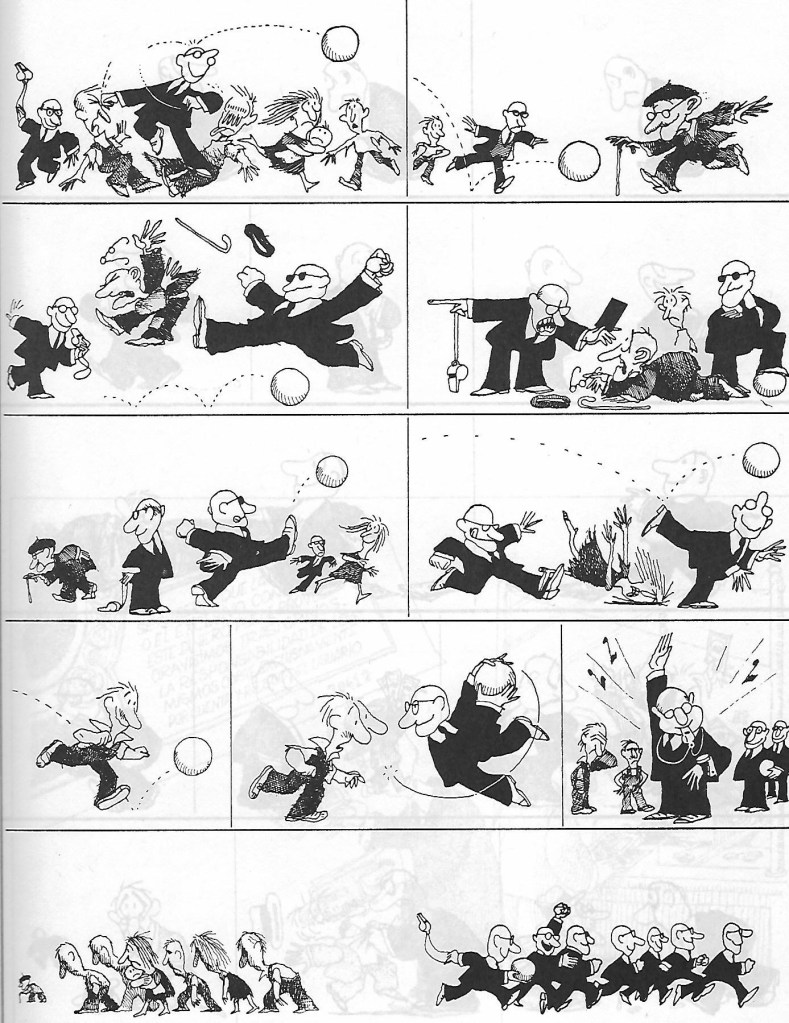
Quino (“And they say that you can’t live in this country.”)
Job. Expanding on yesterday’s observation, as the argument between Job and his friends has continued, the evil worthy of divine judgment and human condemnation has come into sharper focus: indifference to or squeezing of the poor, e.g., here in Eliphaz’ speech:
5 Is not your wickedness great? There is no end to your iniquities. 6 For you have exacted pledges from your family for no reason, and stripped the naked of their clothing. 7 You have given no water to the weary to drink, and you have withheld bread from the hungry. 8 The powerful possess the land, and the favored live in it. 9 You have sent widows away empty-handed, and the arms of the orphans you have crushed. 10 Therefore snares are around you, and sudden terror overwhelms you,
This is the evil that Job accuses God of ignoring; it’s the evil that had no place in Job’s past. Here Job and his friends are in full agreement. In our context in which indifference and squeezing are increasingly public policy (e.g., raids on No More Deaths), that should give us pause.
Acts. As in Peter’s Pentecost sermon, Jesus’ resurrection is pivotal: if God raised Jesus, then many things need to be rethought. As in that sermon, Paul leads with the “forgiveness of sins:” “Let it be known to you therefore, my brothers, that through this man forgiveness of sins is proclaimed to you; by this Jesus everyone who believes is set free [literally ‘justified’] from all those sins from which you could not be freed by the law of Moses.” Commentators wonder what contrast between Moses and Jesus Luke/Paul has in mind; this commentator wonders whether this rhetorical strategy doesn’t reduce Jesus to being a better brand of detergent.
John. Among the many metaphors used in the New Testament for Jesus’ death, Jesus’ metaphor here perhaps deserves more attention: The Good Shepherd deals with the wolf.
Job’s speech continues to develop previously introduced themes. Around vv.7-12 the distinction between Job’s fate and Jerusalem’s fate (586 BC) pretty much disappears. Job’s call for “pity” (v.21) echoes standard wisdom instruction (Prov 14:21, 31). Job again looks to someone (anyone!) to arbitrate his dispute with God (vv.25-27). With apologies to Handel, capitalization of ‘Redeemer’ is a theological dead end (Wrathful God vs. Merciful Jesus—see August 28 post).
The Lectionary omits chapters 20 (Zophar on the doom of the wicked) and 21 (Job on the prosperity of the wicked). The oppression of the poor emerges as a key element in Zophar’s description of the wicked (vv.19-21), and Eliphaz will accuse Job of the same in chapter 22.
Re whether the oppressing wicked in fact prosper, our experience suggests that Job has the stronger argument. Here, as with other themes in the wisdom traditions, More in Bolt’s A Man for all seasons provides useful commentary: “If we lived in a State where virtue was profitable, common sense would make us good, and greed would make us saintly. And we’d live like animals or angels in the happy land that needs no heroes. But since in fact we see that avarice, anger, envy, pride, sloth, lust and stupidity commonly profit far beyond humility, chastity, fortitude, justice and thought, and have to choose, to be human at all…” So we’re back to “Does Job fear God for nothing?” (1:9)
Acts. The beginning of Paul’s speech is partly throat-clearing, partly stage-setting. Paul’s news is as important as Israel’s prior key moments (the exodus, king David) and it is news already announced by the prophets. If “put up with them” rather than “cared for them” is the correct reading in v.18, Paul’s also warning the audience not to repeat their ancestors’ mistakes.
John. “…for the Jews had already agreed that anyone who confessed Jesus to be the Messiah would be put out of the synagogue.” The underlined phrase translates aposunagōgos (only in John: here; 12:42; 16:2). In every generation God’s people have opportunity to prove Jesus’ words true: “We played the flute for you, and you did not dance; we wailed, and you did not weep” (Lk. 7:32).








 With Jacob at Bethel