“Surely the Lord is in this place—and I did not know it” (Gen 28:16). Here we wonder about encountering G-d at the intersection of Bible and Life–typically prompted by the (Episcopal) Book of Common Prayer.
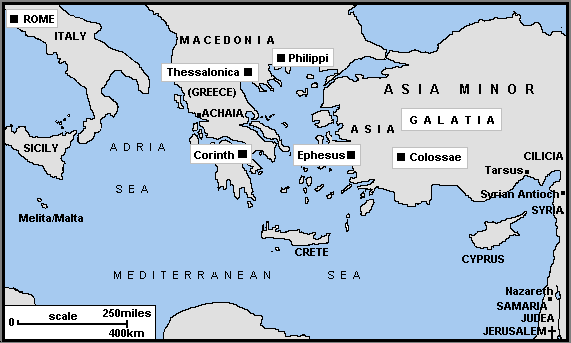
Coming from our readings in Romans there are at least two things we might wonder about from the reading from Acts—which is in fact Luke’s ending to that book.
Recalling in particular Rom 9-11, Paul’s struggle to understand Jewish resistance to and Gentile acceptance of the Gospel within the larger context of God’s faithfulness, had Paul had the opportunity to suggest edits to Luke’s final paragraphs, what, if anything, might he have suggested?
At a couple points Luke summarizes Paul’s proclamation:
“testifying to the kingdom of God and trying to convince them about Jesus” (v.23)
“proclaiming the kingdom of God and teaching about the Lord Jesus Christ” (v. 31)
(This is like Luke’s summary of Philip’s proclamation in Samaria: “who was proclaiming the good news about the kingdom of God and the name of Jesus Christ” [Acts 8:12].) What would it look like for our proclamation to be organized in this way? What might we gain? What might we lose?
“I appeal to you, brothers and sisters, by our Lord Jesus Christ and by the love of the Spirit, to join me in earnest prayer to God on my behalf, that I may be rescued from the unbelievers in Judea, and that my ministry to Jerusalem may be acceptable to the saints, so that by God’s will I may come to you with joy and be refreshed in your company” (15:30-32).
“Earnest prayer” is perhaps an understatement. This is the visit to Jerusalem in which Paul is seized in the temple, taken into Roman custody, subjected to various inconclusive hearings—until his appeal to Caesar results in his finally reaching Rome. That long sequence of events (Acts 21:17-28:31) started with Paul putting into practice “Each of us must please our neighbor for the good purpose of building up the neighbor” (Rom 15:2), building/repairing bridges with the Torah-observant Christians. Paul has a notable ability to send many of us up the wall, but there’s no question that, as the saying goes, he both talked the talk and walked the walk.
Looking further ahead:
“But now, with no further place for me in these regions, I desire, as I have for many years, to come to you when I go to Spain. For I do hope to see you on my journey and to be sent on by you, once I have enjoyed your company for a little while” (15:23-24). Dunn notices of the verb translated “to be sent on by you” that “In earliest Christianity it becomes almost a technical term for the provision made by a church for missionary support.” Even though he’s had no prior contact with these folk, Paul apparently judges he has more to gain than lose by giving them a heads-up that he’s going to be looking for funding.
Picking up with Rom 15:7, Paul is reprising the story he presented in Rom 1-8. God promises that Abraham will be “the father of many nations” (4:17); the Messiah makes it happen; Paul has no insignificant role in this long-anticipated end-time ingathering of the Gentiles.
Arguing for understanding Rom 7:14-25 as describing Paul’s Christian experience, Cranfield recalls Shakespeare:
But I can see his pride Peep through each part of him? (Henry 8th I.i.68f)
And, of course, Paul in today’s text is not immune. But in the midst of plenty of reasons for discouragement, the sense that God is at work creating joy and beauty and that we get to be part of that—we could use more of that “thing with feathers” (yesterday’s post).
“Hope” is the thing with feathers – That perches in the soul – And sings the tune without the words – And never stops – at all –
These lines might not be a bad lens through which to read today’s Romans text. Christ, responding to the “God of hope” “has become a servant of the circumcised.” So John recalls the time when Jesus “got up from the table, took off his outer robe, and tied a towel around himself. Then he poured water into a basin and began to wash the disciples’ feet and to wipe them with the towel that was tied around him.… After he had washed their feet, had put on his robe, and had returned to the table, he said to them, ‘Do you know what I have done to you? You call me Teacher and Lord– and you are right, for that is what I am. So if I, your Lord and Teacher, have washed your feet, you also ought to wash one another’s feet’” (13:4-14).
Jesus had so many reasons to be discouraged with this lot (with us). But that thing with feathers…
So it’s more than appropriate that “May the God of hope fill us with all joy and peace in believing through the power of the Holy Spirit” be one of the sentences with which Morning Prayer can send us out into our day (BCP 60, 102).
Nils Dahl, the Norwegian New Testament scholar, remarked that some biblical texts needed warning labels. Today’s Romans text is probably one of them.
“Christians do not drink, smoke, dance, play cards, or go to movies.” In Christian traditions endorsing such lists, the listed conduct is simply wrong. When cracks appear in this argument: the back-up argument: if you do it, a weaker brother or sister will stumble (conflating vv. 13 and 15). The result: vv.1-12 are silenced and the purported weaker brother’s/sister’s conscience is the norm.
Paul has a legitimate concern: “We who are strong ought to put up with the failings of the weak, and not to please ourselves. Each of us must please our neighbor for the good purpose of building up the neighbor. For Christ did not please himself; but, as it is written, “The insults of those who insult you have fallen on me.” (15:1-3; the argument in 14:13-23 continues in 15:1-6). But it is hard to believe that he did not have ample opportunity to observe the process described in the previous paragraph playing out in his own context.
Perhaps Paul’s argument goes off the tracks with the decision to label “eat anything” as the argument of the “strong” and “eat vegetables” as the argument of the “weak,” thereby identifying which group is to make concessions.
“Owe no one anything, except to love one another; for the one who loves another has fulfilled the law” (13:8). We might read most of Rom 14-15 as unpacking this exhortation with respect to the food laws and calendar in the Torah. Paul and the Jerusalem Council (Acts 15:19-21) agree that Gentiles are not bound by these; opinion is split as to whether Jews who follow Jesus are bound (Mark’s “(Thus he declared all foods clean.)” [7:19] does not appear in Matthew’s parallel text [15:17].) Today’s text: “Let all be fully convinced in their own minds.… Why do you pass judgment on your brother or sister?” For Paul’s vision of united Jewish/Gentile communities, this is crucial. And Paul’s exhortations have remained relevant in countless parallel situations.
Not that things to wonder about are lacking. Here are three:
Re eating, the Jerusalem Council: “to abstain only from things polluted by idols and from fornication and from whatever has been strangled and from blood” (Acts 15:20). Is Paul assuming the last two items, or overwriting them?
The “weak/strong” (15:1) shorthand would probably be deeply offensive to those labeled “weak.” Does Paul use it to ingratiate himself with the “strong” since he’s about to ask concessions of them (vv.13ff), or for some other reason?
“Why do you pass judgment on your brother or sister?” Paul’s question is erased by the claim “On this question there can be no disagreement,” a claim Paul occasionally (?) makes (e.g., Gal 1:8-9). Is it not past time to recognize “Here there can be no disagreement” as a self-disqualifying power grab?
The NRSV treats the Romans text as two paragraphs: vv.8-10 and 11-14. That looks right, with the first focusing on conduct from the perspective of love, the second on conduct from the perspective of the historical moment. The transition (“Pay everyone what is owed… Owe no one anything…” [New English Translation]) suggests that Paul is coming at the previous material (13:1-7? 12:9-13:7?) from a complementary perspective. I wonder if the selection of themes (the commandments in v.9, the deeds of the night in v.13) is not motivated in part by a concern that 13:1-7 not be understood as giving the governing authorities (13:1) a blank check.
(A variety of Paul’s texts, e.g., 1 Cor 7:9, prompt readers to wonder about his attitude toward sex. I wonder if the choice of illustrations in 13:13 (and 1:26-27?) is not less about that, and more about Rome’s reputation. As the Jeffrey Epstein affair has reminded us, sex is often about power and privilege.)
Asked by a scribe about the which commandment was first of all, Jesus replied “The first is, ‘Hear, O Israel: the Lord our God, the Lord is one; you shall love the Lord your God with all your heart, and with all your soul, and with all your mind, and with all your strength.’ The second is this, ‘You shall love your neighbor as yourself.’ There is no other commandment greater than these” (Mk. 12:29-31, citing Deut 6:4-5 and Lev 19:18). I wonder if this reply is not echoed in Paul’s exhortations in 12:1ff. “You shall love the Lord your God”: 12:1-2(3-8); “You shall love your neighbor as yourself”: 12:9-13:10. So Paul can focus on the second half of the law (the horizontal) in vv.9-10 because he started with the first half (the vertical) in 12:1-2(3-8)?
As is its custom on Sundays, the Lectionary pauses the Romans reading and today offers this reading from Acts. With Romans still in mind, we might notice three elements:
“Then the high priest Ananias ordered those standing near him to strike him on the mouth.” This quasi-judicial practice is the background for “so that every mouth may be silenced” (Rom. 3:19).
“Are you sitting there to judge me according to the law, and yet in violation of the law you order me to be struck?” See Rom 2:17-24.
“When Paul noticed that some were Sadducees and others were Pharisees, he called out in the council, ‘Brothers, I am a Pharisee, a son of Pharisees. I am on trial concerning the hope of the resurrection of the dead.’” Not only an Israelite, a member of the tribe of Benjamin (Rom 11:1), but—in the right circumstances—happy to continue self-identifying as a Pharisee. Since the Lectionary previously had us in Ecclesiastes: “the wise mind will know the time and way” (8:5).
Paul has been describing “reasonable worship” (12:1) in the context of the church (12:3-13) and society (12:14-21). He now turns to a particularly problematic dimension of that society: the state. (Does “overcome evil with good” [12:21] provide an obvious segue to this topic? I’m not certain that Paul would be displeased by the idea.)
Laub: “The Paul who speaks in Rom 13:1-7 is not the ‘apostle of Jesus Christ’ but the diaspora Jew.” Re the affirmation, recall Daniel 4:17b and Wisdom 6:
“in order that all who live may know that the Most High is sovereign over the kingdom of mortals; he gives it to whom he will and sets over it the lowliest of human beings” (Dan. 4:17b).
“Listen therefore, O kings, and understand; learn, O judges of the ends of the earth. Give ear, you that rule over multitudes, and boast of many nations. For your dominion was given you from the Lord, and your sovereignty from the Most High; he will search out your works and inquire into your plans. Because as servants of his kingdom you did not rule rightly, or keep the law, or walk according to the purpose of God, he will come upon you terribly and swiftly, because severe judgment falls on those in high places. For the lowliest may be pardoned in mercy, but the mighty will be mightily tested. For the Lord of all will not stand in awe of anyone, or show deference to greatness; because he himself made both small and great, and he takes thought for all alike. But a strict inquiry is in store for the mighty. To you then, O monarchs, my words are directed, so that you may learn wisdom and not transgress. For they will be made holy who observe holy things in holiness, and those who have been taught them will find a defense. Therefore set your desire on my words; long for them, and you will be instructed” (Wis. 6:1-11).
Re Laub’s denial, the text is probably a warning not to think that the politically charged language Paul uses throughout the letter (Jesus is Lord) authorizes disregarding the current authorities.
And, of course, the same diaspora tradition out of which Paul writes (e.g., Dan 3:16-18; 6:10) as well as apostolic example (e.g., Acts 4:19-20; 23:1-5) show that this being subject (13:1) has limits. “Give to the emperor the things that are the emperor’s, and to God the things that are God’s” (Mk 12:17).
Paul’s words assume a specific political context. In a different context some transposition is necessary. The saints can model exemplary transpositions. So, with gratitude, this post concludes with the collect for the feast of Martin Luther King, Jr. (April 4):
“Almighty God, by the hand of Moses your servant you led your people out of slavery, and made them free at last: Grant that your Church, following the example of your prophet Martin Luther King, may resist oppression in the name of your love, and may secure for all your children the blessed liberty of the Gospel of Jesus Christ; who lives and reigns with you and the Holy Spirit, one God, now and for ever.”
Today’s Romans text, an extended series of exhortations. As such, not a bad resource for preparing to make one’s confession.
The following are perhaps worth noticing:
Grammatically, after an independent phrase, vv.9-13 consists of a string of participles: “Genuine love: hating what is evil, being devoted to…” We might take it as a working definition of genuine love. (Just as vv.3-21 provide a first approximation of “reasonable worship” [v.1]. Re the last point, the plentiful words describing emotions check misunderstanding “reasonable” as contrasting with “emotional.”)
“Heap burning coals on their heads” (v.20, part of the citation of Prov 25:21-22). Commentators cite an Egyptian text as evidence that the Proverbs text can be understood as inducing “a burning shame leading to repentance” (Dunn). Perhaps. Or perhaps—in the spirit of “Do not be too righteous” (Eccl 7:16)—Paul, aware of the multiple ways the Proverbs text might be interpreted, simply lets the citation run, so that whatever the motivation at least the enemies will get the right treatment.







 With Jacob at Bethel