“Surely the Lord is in this place—and I did not know it” (Gen 28:16). Here we wonder about encountering G-d at the intersection of Bible and Life–typically prompted by the (Episcopal) Book of Common Prayer.
“Jesus answered, ‘Neither this man nor his parents sinned; he was born blind so that God’s works might be revealed in him.’” Perhaps Jesus is talking only about this man. Perhaps Jesus is talking about what it means to be human: a sort of stage on which God’s works are seen. Read as the latter, multiple connections with today’s other readings. Job: the arguments (chs. 4-27) are over just what divine works are being seen! In the arguments all the participants are a potential stage, and what is seen is as much a function of who is seeing as what God is doing.
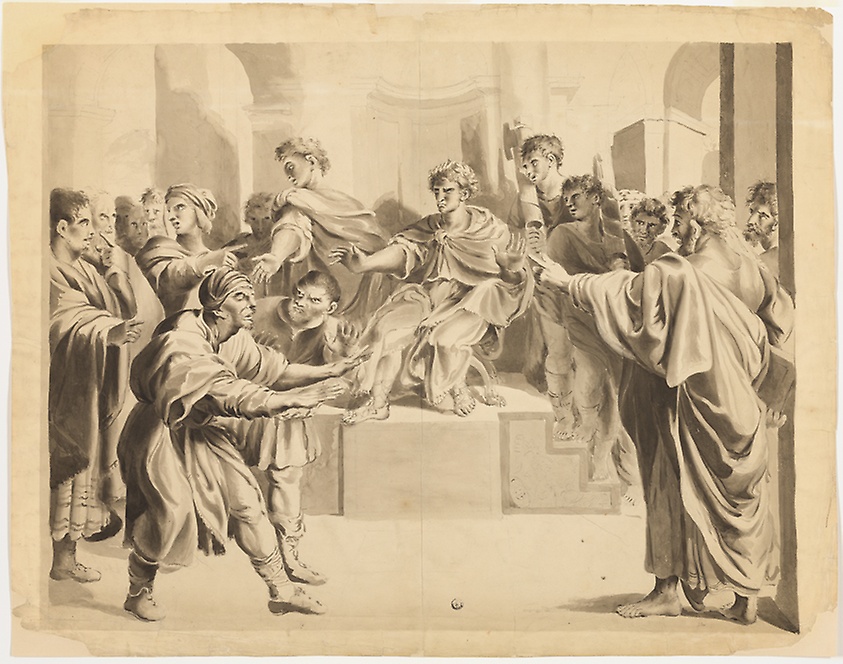
While in John Jesus gives a man sight, in Acts Paul takes a man’s sight. (Commentators notice echoes of Paul’s blinding on the Damascus road [Acts 9].) As in the previous Herod story, “God’s works” are clear and satisfying to those who share Job’s friends’ commitments (“God’s justice now!”). Luke describes Paul as “filled with the Holy Spirit.” Paul, who will later write “Bless those who persecute you; bless and do not curse them,” (Rom. 12:14) delivers a scathing accusation followed by an announcement (curse?). The Holy Spirit, on board with Paul’s speech and action, or simply unwilling to leave Paul hanging?
Job. Job’s speech combines a number of themes, the major one being that human life is too ephemeral for God to worry about. “…look away from them, and desist, that they may enjoy, like laborers, their days.”
Out of a very different context Kundera wrote “We live everything as it comes, without warning, like an actor going on cold. And what can life be worth if the first rehearsal for life is life itself? That is why life is always like a sketch. No, ‘sketch’ is not quite the word, because a sketch is an outline of something, the groundwork for a picture, whereas the sketch that is our life is a sketch for nothing, an outline with no picture” (The Unbearable lightness of being). Does all of this just get swept away with the Doctrine of the Resurrection?
Acts. The slapstick comes to an abrupt end: “When Herod had searched for him and could not find him, he examined the guards and ordered them to be put to death.” Later, in Philippi, when an earthquake frees Paul and Silas in another prison: “When the jailer woke up and saw the prison doors wide open, he drew his sword and was about to kill himself, since he supposed that the prisoners had escaped. But Paul shouted in a loud voice, ‘Do not harm yourself, for we are all here’” (16:27-28). So the apostles learned something from Peter’s experience?
In vv.20-23 Luke affirms (celebrates?) a direct connection between Herod’s impiety and his appalling death. Is the world a better place when God meets and sometimes exceeds our expectations? Is Herod a stand-in for Luke’s expectations for other officials (in this life or the next)?
John. Both Jesus and the crowd are attacking. Is Jesus’ appeal to his not seeking glory another attempt to give the crowd reason to believe that will make sense to them? It’s hard to over-emphasize the importance of character in arguments, whether then or now.
Job. With our different perspectives, experiences, and commitments, it would be surprising if we didn’t argue. And some of us have heard the calls to fear God, to love God, to trust God—and that affects the arguments. Vv.7-11 are an equally important call: don’t show God partiality. We might wonder what that means. It certainly means not knowingly using faulty arguments to defend God. Does it mean that if we’re going to err, err in favor of those protesting against God?
Acts. If there’s a soundtrack for Peter’s story here it’s perhaps Yakety Sax (h/t Benny Hill). Is Luke really venturing into the genre of slapstick? (V.8: Peter is clearly only half awake. Vv.12-15: Peter at the gate.) Does Luke employ this genre elsewhere?
John. “You are from your father the devil…” The catastrophic ways Christians have used this text threaten to render it permanently radioactive. Here, as elsewhere in John, a variety of strategies have been proposed, including rendering hoi Ioudaioi by “the Judeans” rather than “the Jews” (rejected by Adele Reinhartz in The Jewish Annotated New Testament). I think a more radical strategy is needed.
Consider these two texts:
He came to what was his own, and his own people did not accept him. But to all who received him, who believed in his name, he gave power to become children of God, (Jn. 1:11-12)
Then Jesus said to the Jews who had believed in him, “If you continue in my word, you are truly my disciples; and you will know the truth, and the truth will make you free.” (Jn. 8:31-32)
From this Gospel’s perspective, after Jesus’ coming “his own” include the believers. Recalling Spufford’s HPtFtU (Human Propensity to F*** things Up), there’s no reason to think that the believers won’t replicate the conduct of the Jews. In other words, rather than soften “the Jews,” give it its full weight so that we who now claim to be included in “his own” recognize our danger. (Here I’m channeling Paul: the vine metaphor and wilderness relectura).
Hence the importance of “continue in my word.” That I am baptized, that I have been faithful—that’s good. But that doesn’t relativize the importance of what I do today. So Ezekiel emphasizes the importance of the present, concluding “Cast away from you all the transgressions that you have committed against me, and get yourselves a new heart and a new spirit! Why will you die, O house of Israel? For I have no pleasure in the death of anyone, says the Lord GOD. Turn, then, and live” (18:31-32).
Theologically, this may be why it’s important that Judas was one of the Twelve in all four Gospel accounts. Betrayal comes from within “his own.” And no better way to blind ourselves to the danger than to decide that the problem is die Juden.
In John’s stark language, my choices reveal my parentage. The LORD would have me remember that today’s choices are not bound by yesterday’s.
Job’s speech, a terrifying portrayal of unchecked divine power. The perspective has broadened considerably, taking in counselors, judges, kings, priests, the mighty, “those who are trusted,” the enders, princes, and the strong. (Job numbers himself among these when he recalls his past in his final speech [chapter 29].) The result? “The tents of robbers are at peace, / and those who provoke God are secure”—and more cries of the poor and oppressed go unanswered.
There’s a textual problem in Acts 11:20, and translations like CEB (“also to Gentiles”) probably make more sense than those like NRSV (“to the Hellenists”). So while Luke showcases Peter’s preaching to Cornelius, that may not have been the first outreach to the Gentiles. Barnabas (recall 4:36-37; 9:26-27): thank God for the contributions folk with his gifts make to our common life.
“31 Then Jesus said to the Jews who had believed in him, ‘If you continue in my word, you are truly my disciples; 32 and you will know the truth, and the truth will make you free.’” There are many reasons we might pause over these two verses; here are two. First, it’s ironic that v.32 is so often used divorced from v.31, when the “truly” – “truth” link demands that we keep the verses connected. Freedom comes from continuing in Jesus’ word. Second, ‘disciple’ (mathētēs) while used extensively in the Gospels and Acts, is not used elsewhere as a descriptor of Christians. There seem to have been a variety of reasons for that (mathētēs may have been too closely tied to its Aramaic inspiration, may have tended to identify Christianity as a philosophical school). The downside is that the imperative to continue to learn easily slides to the margin of our self-understanding. Heaven help us if Christians become known as the folk who think they have nothing more to learn. (In which case, our new themesong.)
With the November 3 election about two months out, our New Testament lessons might serve as a Voters’ Guide. They’re certainly more, but not less. The “Lion of the tribe of Judah” appears as “a Lamb standing as if it had been slaughtered,” and we hear: “You are worthy to take the scroll and to open its seals, for you were slaughtered and by your blood you ransomed for God saints from every tribe and language and people and nation; you have made them to be a kingdom and priests serving our God, and they will reign on earth.” And again: “Worthy is the Lamb that was slaughtered to receive power and wealth and wisdom and might and honor and glory and blessing!” That is our benchmark for worth.
And Jesus on the mount: “Blessed are the poor in spirit… those who mourn… the meek… those who hunger and thirst for righteousness” etc.
Up the down the ballot, which candidates mirror this worth? Which candidates help us believe Jesus’ words?
Job. How to offer commentary without sounding like a misbegotten version of Job’s friends? Perhaps one way of respecting the text is to let it inform our daily use of the psalms, the plurality of which hold similar unexplained suffering before God.
Acts. The recurrent issue of whether/how the Gentiles are to be incorporated into the church is not our issue. But far from being irrelevant, it invites (compels?) us to reflect on how we do theology/do multicultural. Peter’s “You yourselves know that it is unlawful for a Jew to associate with or to visit a Gentile” (10:28) and the critique of “those of the circumcision”: these are issues on which non-Christian Jews disagreed among themselves (see Gary Gilbert’s notes to Acts 10 in The Jewish Annotated New Testament). And Gentile Christians, once they had leverage, used that leverage in a variety of helpful and unhelpful ways. My identity: centered in Jesus, or Jesus playing a supporting role for other more important identities? And that’s a question that can be asked properly only in the first person.
John. How does the Father testify? Raymond Brown offers a helpful list, summarizing 5:31-39: “John the Baptist; the works of Jesus; the abiding word of God in the hearts of the audience; the Scriptures.” These works of Jesus (the “signs”): we might wonder: do they succeed, and how might that success be measured? (This is perhaps a question to take up again when reading 12:36b-43.)
Job. In the last chapter of Job we read “After the LORD had spoken these words to Job, the LORD said to Eliphaz the Temanite: ‘My wrath is kindled against you and against your two friends; for you have not spoken of me what is right, as my servant Job has. Now therefore take seven bulls and seven rams, and go to my servant Job, and offer up for yourselves a burnt offering; and my servant Job shall pray for you, for I will accept his prayer not to deal with you according to your folly; for you have not spoken of me what is right, as my servant Job has done.’” A useful text to read in tandem with today’s reading; it might expand our understanding of what speaking “what is right” sounds like.
Job laments the lack of an umpire (NRSV; “arbiter” in the NET) in his dispute with God (v.33). Christian commentators are tempted to rush in with “For there is one God; there is also one mediator between God and humankind, Christ Jesus, himself human” (1 Tim. 2:5). That is probably a temptation to be resisted; it plays into the hostile God and loving Jesus script that is the antithesis of the New Testament’s vision: “God so loved the world that he gave his only Son…”
Acts. For neither the first nor the last time God’s challenge is not the pagan (Cornelius), but “the circumcised believers” (us), for whom “I truly understand that God shows no partiality, but in every nation anyone who fears him and does what is right is acceptable to him” is may be repeatedly a new thought.
John. “Search and you will see that no prophet is to arise from Galilee.” Understandably and justifiably this Gospel speaks from and to its context, in which hostile relations with the non-Christian Jewish community are front and center. One of the things that means for us is suggested by this from Bonhoeffer: “We no longer read the Bible seriously. We read it no longer against ourselves but only for ourselves.” Reading the Bible “against ourselves”: wondering which of our assumptions (like “no prophet is to arise from Galilee”) blind us to what God is doing in our midst now.
Job. Bildad: “if you are pure (zak) and upright (yashar), surely then he will rouse himself for you and restore to you your rightful place.” This would be more convincing had not both the narrator and God described Job as “blameless (tam) and upright (yashar)” (1:1, 8; 2:3). Pulling back the camera, one of the issues in play in the book is the variety of images or metaphors for God, each with their corresponding set of expectations. If God is King, one expects (traditionally) the righteous to be rewarded and the wicked punished. But an inherent limitation of metaphor is that the metaphor itself does not tell us when it is applicable. “For everything there is a season” (Eccl 3:1) applies also to the metaphors we choose to employ to interpret God’s action, and here too we, like Job’s friends, can choose with various combinations of wisdom and folly.
John. Jesus: “Whoever wants to do God’s will can tell whether my teaching is from God or whether I speak on my own” (CEB). We might hear this as a more careful restatement of “search, and you will find” (Matt 7:7) for it includes the proviso of prior commitment on our part.
In passing, the Greek thelō covers the range from ‘to desire’ (stressing the affective) to ‘to will’ (stressing the volitional). Likewise thelēma, from ‘what is desired’ to ‘what is willed’. Translating into English is challenging: “Whoever desires to do what God desires” and “Whoever wills to do what God wills” are both possible, but have quite different connotations. Here, and elsewhere, it’s helpful to keep the range in mind.
Job. Part of the power of texts like today’s comes from Job’s later testimony re his former life, e.g., “…because I delivered the poor who cried, / and the orphan who had no helper. / The blessing of the wretched came upon me, / and I caused the widow’s heart to sing for joy” (29:12-13). This is what Job did for the needy; is it fitting for God in Job’s case to do so much less?
The combination of this chapter and Job 29 challenges us readers, for chapters like Job 7 “boosts the signal” of the voice of the many sufferers in our midst that we might not hear—or be too numb to hear, and chapter 29 asks us point-blank what we’re doing about it.
Acts. As we’ll hear in the next readings, the visions accomplish their immediate purpose: Peter accepts Cornelius’ invitation. At the same time, we might wonder about Peter’s vision. “What God has made clean, you must not call profane.” Within the vision the reference is to food, an apparent stunning reversal of the dietary laws of Leviticus 11 and Deuteronomy 14. Peter thinks that the vision isn’t (primarily?) about food, (later) saying to Cornelius “God has shown me that I should not call anyone profane or unclean.” But does the Law or the Old Testament ever declare the gentiles per se to be ‘profane’ or ‘unclean’? And later, as Paul tells the story, in Antioch Peter draws back from eating with Gentile Christians (Gal 2:11-13). The dietary laws made Jews and Gentiles sharing a common life difficult, if not impossible; was Peter’s vision also about food? As with Jesus’ teaching re what defiles (Matt 15:1-20; Mk 7:1-23), his followers drew different conclusions re the status of the food laws. “(Thus he declared all foods clean.)” is in Mark (7:19) but not in Matthew.
John. Since Jesus does make a public appearance at the Feast (see tomorrow’s reading), why does John give us today’s text? Jesus seems torn re tactics and timing. I find v.7 equally puzzling: “The world cannot hate you, but it hates me because I testify against it that its works are evil.” Outside of driving the merchants and money changers out of the temple (2:13-17), what words or actions does this testimony reference? Is it a question of light vs. darkness (1:5; 3:19-21)?
While Job and his friends often seem to be talking past each other in chapters 4-27, here Job is engaging Eliphaz’s response (e.g., ‘vexation’ in 5:2 and 6:2). Situations like Job’s are too much for any person to deal with alone (vv.11-13), so what friendship demands becomes an important question. Verse 14 is key—and also a challenge to translators. The NRSV represents one tradition: “Those who withhold kindness from a friend forsake the fear of the Almighty” (similarly CEB). The NJPS another: “A friend owes loyalty to one who fails, Though he forsakes the fear of the Almighty” (similarly Alter, Seow). The verse invites double reflection: (1) What does Job think “loyalty” (chesed) from his friends should look like? (2) When we disagree profoundly with a friend, what does loyalty demand?
“We have come to believe and know that you are the Holy One of God” (Jn. 6:69). How might John want us to hear Peter’s confession? Commentators give us a start in noticing “If those to whom the word of God came were called ‘gods’—and the scripture cannot be annulled—can you say that the one whom the Father has sanctified and sent into the world is blaspheming because I said, ‘I am God’s Son’?” (10:35-36) and “And for their sakes I sanctify myself, so that they also may be sanctified in truth” (17:19).
Perhaps it is worth recalling that in the Old Testament holiness is dynamic, not static. ‘Holiness’ first appears in Exod. 3:5: “Then he said, ‘Come no closer! Remove the sandals from your feet, for the place on which you are standing is holy ground’” (literally, ground of holiness). And that starts a conversation that ends not with Moses setting up a retreat center, but with Moses returning to Egypt to liberate a people. Is it accidental that Peter’s confession “the Holy One of God” comes near Passover (6:4)? There is a whole world that needs turning upside down, and that requires some serious holiness. And so Mary sings “for the Mighty One has done great things for me, and holy is his name” (Lk. 1:49).
In the Orthodox tradition the Unburnt Bush of Exodus 3 is associated with Mary, hence the accompanying icon.









 With Jacob at Bethel