Re the Daily Office Readings August 21 Anno Domini 2020

Photo by Leiliane Fagundes

The Lessons: Job 2:1-13; Acts 9:1-9; John 6:27-40

The second appearance of “the accuser” (haśśāṭān) gives us an opportunity to recalibrate our use of words like ‘satanic’. Our culture tends to use ‘satanic’ for a narrow range of behaviors, explicit worship of the devil, unrestrained cruelty or unrestrained indulgence in the so-called “sins of the flesh.” This is convenient, for what the accuser is about is seeing the worst in people, promoting the most negative interpretation of their actions. (“Job’s ‘blameless and upright’ only for what he gets out of it!”) So the ‘satanic’ is properly the demeaning of individuals or groups, encouraging us to write them off as too bad, dangerous, lazy, etc.

This is not to encourage more frequent use of ‘satanic’—our political discourse is toxic enough already. It is to recognize the satanic as a temptation for “us” as well as “them.” Racism, for example, is satanic. Critique of those involved in racist behavior becomes satanic when it dehumanizes those critiqued. Satan has many ways of winning.

John: Jesus’ use of the bread metaphor is striking. Jesus: the Bread of life. The metaphor by itself puts the onus on us: we eat, or not. So Jesus steps out of the metaphor: “Everything that the Father gives me will come to me, and anyone who comes to me I will never drive away… And this is the will of him who sent me, that I should lose nothing of all that he has given me.” Jesus will guard all who come to him (the Good Shepherd metaphor of John 10 resonating here). The Father gave manna; the Father gives Jesus; Jesus’ love is as active as the Father’s. This is good news for those of us whose response to Jesus often leaves so much to be desired.

Re the Daily Office Readings August 20 Anno Domini 2020

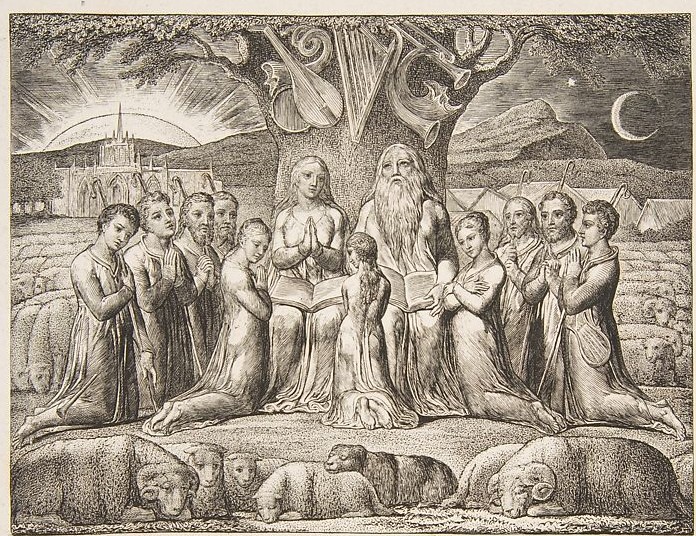
Job and his family by William Blake

The Lessons: Job 1:1-22; Acts 8:26-40; John 6:16-27

Today we begin the prodigy that is the Book of Job. It is “about” multiple things, not least of which is the adversary’s question “Does Job fear God for nothing?” (This is, perhaps, the flip side of the issue of simony that we met in yesterday’s Acts reading!)

‘The adversary’ or ‘the accuser’: the NRSV, oddly, translates as ‘Satan’. But in Job the word always appears with the definite article, so it’s not yet a proper name. In any case, having moved the plot along, the figure does not reappear after chapter 2.

Re what Job’s “about,” Davis, noticing that Job, like Jeremiah, curses the day of his birth (Job 3:1-26; Jer 20:14-18) and that Job’s suffering looks like the servant’s in Isaiah (52:13-53:12), suggests: “These [and other] various connections align this wisdom book with the two prophetic traditions that deal most directly with the problem of massive suffering in relation to Jerusalem’s destruction and the Babylonian exile, suffering that defies comprehension and feels like the enmity of God” (Opening Israel’s Scriptures). How does one respond to such suffering?

The Ethiopian is reading from Isa 52:13-53:12 when he encounters Philip. “About whom, may I ask you, does the prophet say this, about himself or about someone else?” doesn’t have a single correct answer—Stephen, newly buried, comes to mind—but Philip’s proclaiming Jesus is more than appropriate.

How much of Isaiah is Luke pointing to in this story? After introducing the Ethiopian (v.27), he thereafter refers to him simply as “the eunuch” (four times). Is it accidental that it’s in Isaiah that we encounter the following?

3 Do not let the foreigner joined to the LORD say,
“The LORD will surely separate me from his people”;
and do not let the eunuch say,
“I am just a dry tree.”
4 For thus says the LORD:
To the eunuchs who keep my sabbaths,
who choose the things that please me
and hold fast my covenant,
5 I will give, in my house and within my walls,
a monument and a name
better than sons and daughters;
I will give them an everlasting name
that shall not be cut off.
6 And the foreigners who join themselves to the LORD,
to minister to him, to love the name of the LORD,
and to be his servants,
all who keep the sabbath, and do not profane it,
and hold fast my covenant–
7 these I will bring to my holy mountain,
and make them joyful in my house of prayer;
their burnt offerings and their sacrifices
will be accepted on my altar;
for my house shall be called a house of prayer
for all peoples. (56:3-7)

The servant about whom the eunuch is reading is key to making this vision a reality.

John: “Do not work for the food that perishes, but for the food that endures for eternal life…” Texts like these are the reason we understand that in the Hebrew idiom—and other languages influenced by that idiom—“Not A, but B” may mean “While A is important, B is more important.” This launches a long conversation which reveals why John the Evangelist noted the proximity of the feeding to Passover (v.4): rather than record the institution of the Eucharist at Passover, the Gospel of John gives us a long reflection on the Eucharist here.

Re the Daily Office Readings August 19 Anno Domini 2020

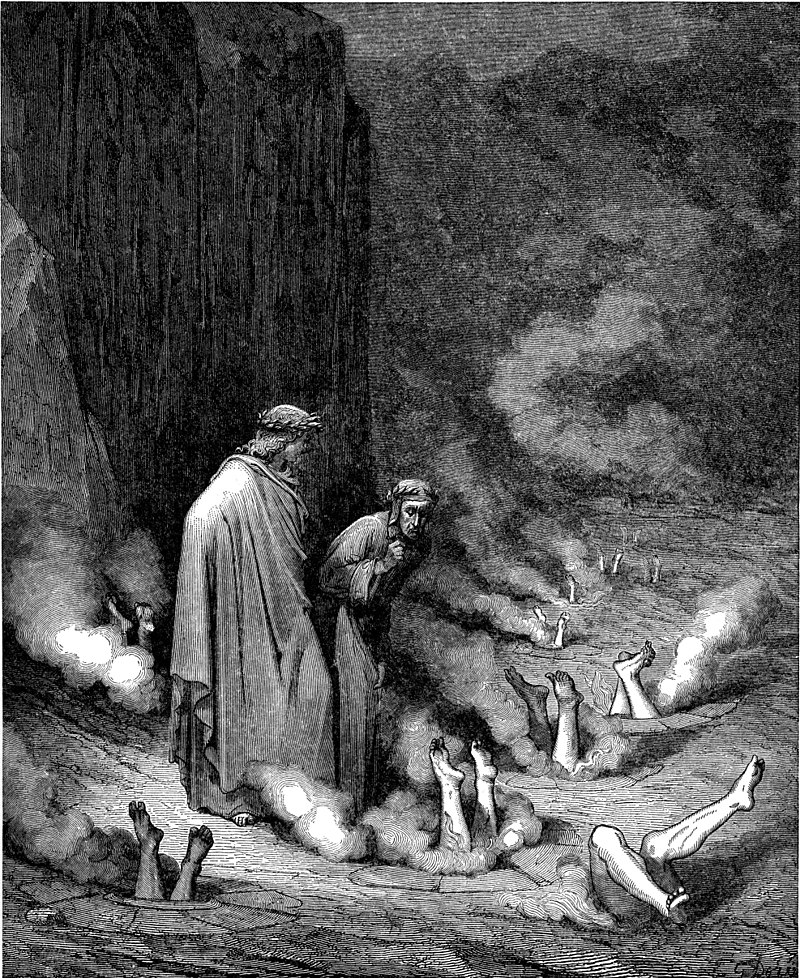
Dante speaking to Pope Nicholas III by Gustave Doré

The Lessons: Judges 18:16-31; Acts 8:14-25; John 6:1-15

Re Judges, if we find the reading depressing, the editors have succeeded. Their message: something has to change; their hope is that kingship will be a good change. The inclusion of Judges 19-21 (omitted in our Lectionary) is perhaps overkill on the editors’ part. (The soundtrack for Judges 17-21 could easily be taken from John Boorman’s Deliverance [1972].) The combination of Judges 19-21, portraying Benjamin at its worst, and Ruth, portraying Judah at its best, does set us up for the conflict in 1 Samuel between Saul (tribe of Benjamin) and David (tribe of Judah).

Re Acts, recall “A bribe is like a magic stone in the eyes of those who give it; / wherever they turn they prosper” (Prov. 17:8). As with all proverbs, time and circumstance matter, and in Simon’s case the proverb misfires spectacularly. Hence “simony,” procuring or attempting to procure spiritual goods through offering material goods, a sin at which Pope Nicholas III was reputed to excel (see illustration from Dante’s Inferno). As Proverbs (repeatedly) observes, money is powerful, also (particularly?) when we aren’t paying attention to its power.

Re John, both John the Evangelist and Jesus as portrayed in the Gospel display ambivalence re signs (“Unless you see signs and wonders you will not believe” [4:48]). So feeding the five thousand is liable to be counterproductive, and turns out to be so (“When Jesus realized that they were about to come and take him by force to make him king…”). It’s interesting that counterproductive is not a deal-killer: five thousand human beings are involved.

Re the Daily Office Readings August 18 Anno Domini 2020

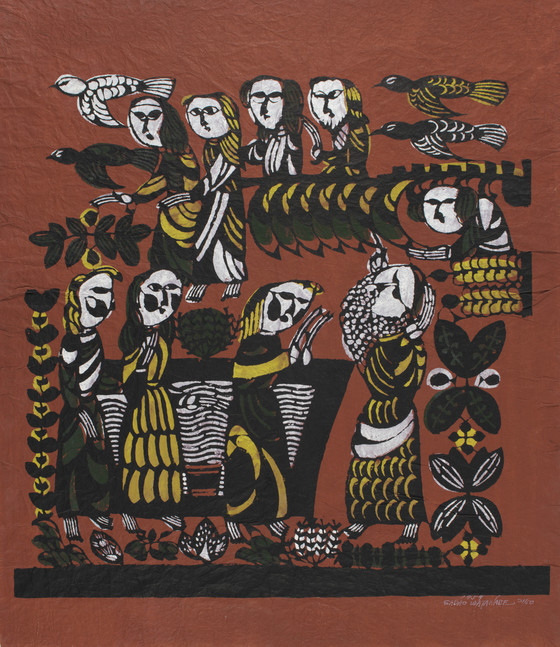
The Well in Samaria by Sadao Watanabe

The Lessons: Judges 18:1-15; Acts 8:1-13; John 5:30-47

Re Judges, Zorah and Eshtaol (vv.2, 8, 11) may sound familiar: they’re where Samson began causing good trouble (13:25) and where he was buried (16:31). In retrospect, “It is he [Samson] who shall begin to deliver Israel from the hand of the Philistines” (13:5) sounds like overstatement: the Danites in that area decided that they’d be happier elsewhere, and so send out spies, the spies who encounter the young Levite at Micah’s house.

Re Acts, since the apostles are not scattered (v.1), the Philip who evangelizes in Samaria is the deacon, named after Stephen in the roster (6:5). The Holy Spirit was, again, not limited by the apostles’ vision of the deacons’ role (6:2-4). Simon the magician, who also figures in tomorrow’s reading, gives us, together with the Judges readings, opportunity to reflect on “You shall not covet” (Exod 20:17; see the August 8 post).

Re John, Jesus’ argument with the Jewish authorities continues. As various commentators have noticed, this Gospel periodically conflates two settings: Jesus’ setting and the author’s setting toward the end of the first century, when the heirs of the Pharisees are working to exclude groups like Jesus’ followers from Judaism. So taking Jesus’ words as a reliable description of all Jews in all times and places would be an egregious misreading. One helpful reading might start with v.44 (CEB): “How can you believe when you receive praise from each other but don’t seek the praise that comes from the only God?” We tend to think that believing and status-seeking are separate issues; Jesus sees a connection. That might be something to wonder about.

Re the Daily Office Readings August 17 Anno Domini 2020

Rembrandt

The Lessons: Judges 17:1-13; Acts 7:44––8:1a; John 5:19-29

Re Judges, by now it’s clear that Israel doesn’t need exterior enemies to suffer damage. “People did what was right in their own eyes” is amply illustrated. If having a king would have made things better—we’ll see.

Re Acts, James Dunn’s The Partings of the Ways explores how two Second Temple groups, the Pharisees and Jesus’ followers, ended up as Judaism and Christianity. If the “pillars” of Second Temple faith are monotheism, election, covenant focused in Torah, and land focused in Temple, Stephen’s speech represents perhaps the earliest parting. Stephen describes the Temple as “made with human hands” (cheiropoiētos), a word typically used for idols (Lev 26:1, Isa 2:18, Dan 5:4, etc.)! If that’s what the Temple is…

Re John, the Feast of St. Mary (Aug 15) bumped the reading of the beginning of John 5. There Jesus, back in Jerusalem, heals the paralytic—on the Sabbath. The Jewish authorities challenge him; today’s reading picks up his response. Why does Jesus focus on the resurrection? Perhaps the answer has something to do with “Rise, take up thy bed, and walk” (v.8 KJV). The former paralytic and the authorities focus on “take up thy bed, and walk” (vv.11, 12). ‘Raise up/rise’ (egeirō) can also be used of resurrection (v.21; cf. Isa 28:19, Matt 14:2, etc.), and Jesus focuses on this part of the command. The healing is life-giving (v.21, health and death being on a continuum); the healing is a foretaste of what Jesus will be doing.

Re the Daily Office Readings August 16 Anno Domini 2020

Samson, Woodcut by Eberhard Viegener

The Lessons: Judges 16:15-31; 2 Cor. 13:1-11; Mark 5:25-34

Soundtrack

The Samson story ends on a strange combination of notes: anger, exaltation, answered prayer, death, and “He had judged Israel twenty years.”

Blind Willie Johnson’s powerful “If I had my way” retells Samson’s story, while leaving his death unstated. It captures one current in protest, that combination of rage and passion for some combination of justice and revenge that no longer attends to the cost, personal or otherwise. Better than acquiescence to or cooptation by “the wicked world,” but not, we hope, the only option.

Samson, also a riddle in which the people of God are mirrored. Lest this sound strange, consider the political choices those who self-identify as God’s people have made and are making.

Re the Daily Office Readings August 15 Anno Domini: St Mary the Virgin

The Domition of the Virgin by Ioannes Mokos

The Readings (Morning Prayer): 1 Samuel 2:1-10; John 2:1-12

Hannah’s song looks like the inspiration for Mary’s song (“The Magnificat”). Both songs are notable in uniting the singer’s story with the story of God’s gracious dealings with Israel/Humanity. Seeing in our lives something that can be credibly called ‘story’, seeing a connection to a story larger than ourselves: we’re hungry for that, with the alternative always hovering: “Life is just one damned thing after another, whether it is private or public life” (Toynbee).

And Mary is properly central in so much of Christian spirituality and imagination. Her “Here am I, the servant of the Lord; let it be with me according to your word” (Lk 1:38) articulates the faith to which we aspire; God would form Christ in each one of us (recall Gal 4:19).

From the Gospel reading (the subject, from a different angle, of the August 7 post), after, and continuing, a classic mother-son interchange (vv.3-4): “His mother said to the servants, ‘Do whatever he tells you.’” After Lk 1:38 (above), Mary can say that with authenticity; we do well to respond with alacrity.

The Feast of the Dormition of the Theotokos (the “falling asleep” of the God-bearer) is one of the oldest Marian feasts, set on August 15 in the East in the 6th century and adopted in the West in the 7th Century (detail here and here).

Re the Daily Office Readings August 14 Anno Domini 2020

Photo by Scott Walsh

The Readings: Judges 14:20––15:20; Acts 7:17-29; John 4:43-54

The foxes and the torches: for one stretch of the story’s history we were invited to enjoy the trickster Samson pulling another one on the Philistines. Now, impossible to escape the sadness of it all. The Timnite and his daughter (Samson’s betrothed): what were their names? The moral logic of the protagonists (15:3, 7, 10, 11), fitting for the playground (“he hit me first”)—but they are no longer children. Samson calls on the LORD for water, and receives it. The LORD can give Samson what he asks for, but how to give him what he has no idea that he needs?

Re Stephen’s speech, recall William Faulkner: “The past is never dead. It’s not even past” (Requiem for a Nun). So giving a truthful account of our past…

John’s narrative contains two apparent non sequiturs, both attributed to Jesus (vv.44, 48 [in which ‘you’ is plural in both occurrences]), and commentators have long sought to make sense of them—without apparent success. But, bottom line, Jesus’ word (“your son will live”) is reliable, and the royal official believes. ‘Believe’—another word important to this Gospel. Michael Gorman, focusing on Paul, offers this definition of faith: “Faith is that response to God’s initiative that opens the gates of self to God’s transforming power” (Cruciformity: Paul’s Narrative Spirituality of the Cross).

Re the Daily Office Readings August 13 Anno Domini 2020

Samson rending the lion by Albrecht Dürer

The Readings: Judges 14:1-19; Acts 6:15––7:16; John 4:27-42

After the auspicious and ceremonial announcement of Samson’s calling, the beginning of his career could not be more jolting. (Drawing back the camera, the prominence of riddles in the stories suggests that Samson himself is a riddle, for which one solution may be Samson = Israel.) God calls Israel into covenant at Sinai; Israel responds with the Golden Calf. Samson is called to be a nazirite; Samson seeks a bride among the Philistines, eats and shares honey from a ritually unclean source, hosts a drinking party. But God has already been adapting: the spirit has begun to drive him (13:25; Alter’s translation, who notes “more literally, ‘to pound/pulsate [within]’”); Samson’s libido is also the Lord’s getting him engaged against the Philistines.

Where does all this leave God’s justice? Olson (New Interpreter’s Bible Commentary) wrestles with the question: “God seems constrained to work through such devious and sinful means in the disordered context of a splintered and rebellious Israelite nation. God is free to contravene the very laws God has given to Israel for the sake of God’s mercy and love for the people and for the sake of the punishment of the oppressive Philistines.” Perhaps. Re the last point, note Alter’s translation of v.19 “and struck down from among them thirty men and took their armor” (the italicized word occurs also in 2 Sam 2:21, there translated ‘spoil’) and his comment “Samson, then, chooses to confront and kill armed warriors.”

The Gospel of John is interested in testimony (‘witness’ [marturia] 14x vs. 4x in the other Gospels; ‘to witness’ [martureō] 31x vs. 2x in the other Gospels), and in this story notices the price the woman pays for her testimony. V.27: how many degrees did the temperature drop with the disciples’ arrival? V.42: Jesus may be the “Savior of the world” but that doesn’t mean any less care is needed to guard the male ego. The Gospel honors her, honors her witness.

Another Postscript to the August 9 Post

Dealing with our vulnerability: this from Ellen F. Davis on the psalms of petition in Opening Israel’s Scriptures, quoting André Chouraqui:

The only thing he [the psalmist] opposes to the arrows that pierce him through, is his own voice[.] His hands are empty; God alone is his weaponry, his fortress. The Innocent never relies on his material strength for deliverance from his enemies…

… Every one of the psalms—and especially the psalms which seem the most bellicose—[all] are animated by an absolute contempt for material brute strength. This is not a question of heroic renunciation, but rather one of objective certitude. Might is good for nothing, serves as the foundation for nothing, and leads to nothing… As for the Just, he is committed to the victorious action of justice and truth.