Re the Daily Office Readings May 15 Anno Domini 2020

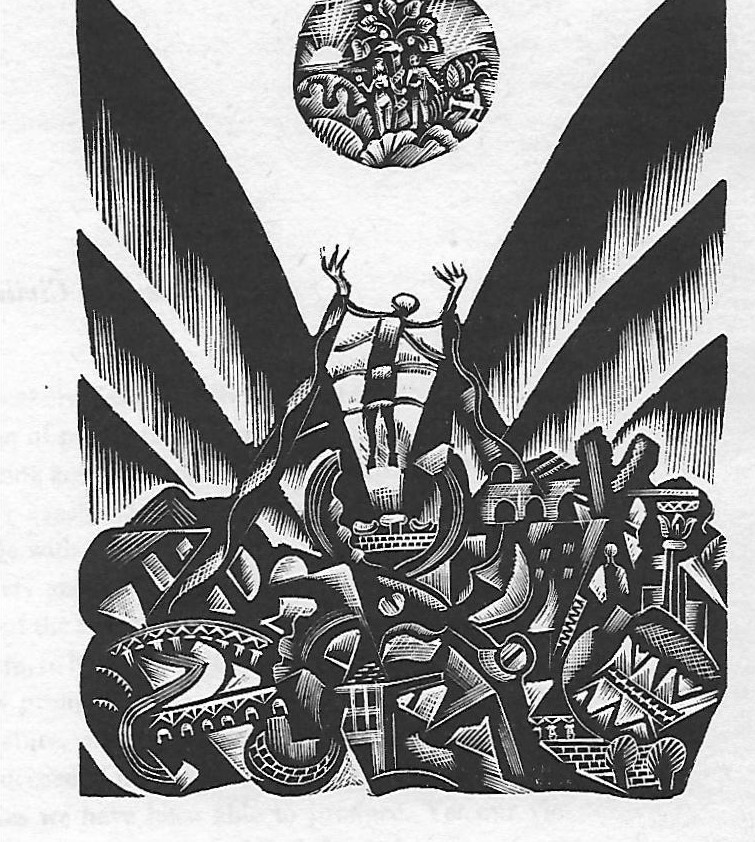
Wood Engraving by Ilya Schor in Heschel’s The Sabbath.

The Readings: Leviticus 23:1-22; 2 Thessalonians 2:1-17; Matthew 7:1-12

Leviticus 23 contains one of the Torah’s summaries of the major festivals. Our lectionary splits it between the Sabbath and Spring festivals (today) and the Fall festivals (tomorrow).

Readers whose introduction to the Sabbath is the arguments in the Gospels about permitted work and Paul’s arguments against the Gentile believers needing to observe the entire Law are liable to miss the joy, the spirituality, of the gift of the Sabbath. Abraham Heschel’s The Sabbath is a welcome corrective. Here’s a bit:

“According to the Talmud, the Sabbath is me’en ‘olam ha-ba, which means: somewhat like eternity or the world to come. This idea that a seventh part of our lives may be experienced as paradise is a scandal to the pagans and a revelation to the Jews. And yet to Rabbi Hayim of Krasne the Sabbath contains more than a morsel of eternity. To him the Sabbath is the fountainhead (ma’ yan) of eternity, the well from which heaven or the life in the world to come takes its source.

“Unless one learns how to relish the taste of Sabbath while still in this world, unless one is initiated in the appreciation of eternal life, one will be unable to enjoy the taste of eternity in the world to come. Sad is the lot of him who arrives inexperienced and when led to heaven has no power to perceive the beauty of the Sabbath.”

It is not necessary to define the precise relationship between the OT Sabbath and the Lord’s Day (Sunday) for Heschel to point us to a deepened appreciation of Sunday, the Eighth Day, the first day of the New Creation. At present we deeply miss being able to gather together on Sunday. But Sunday is exalted, a permanent source of joy and hope, not because we gather together. We have gathered together and will again gather together because it’s Sunday.

Better, recall that centuries before we celebrated Easter as an annual feast, we were celebrating Jesus’ resurrection—the inbreaking of the New Creation—every Sunday. So, for instance, we’d be quite justified in freeing the hymns filed under “Easter” (##174-213) for use on any Sunday. So, in the kitchen, Sunday is the day for the whole household to pull out all the stops. Every Sunday the ears of the chocolate Easter bunny may be at risk. Booze, bubble wands, fireworks: the current social distancing is our opportunity to find new ways to celebrate apart-and-together.

For more on Sunday, the Eighth Day, Preachers Institute, The Catholic Spirit.

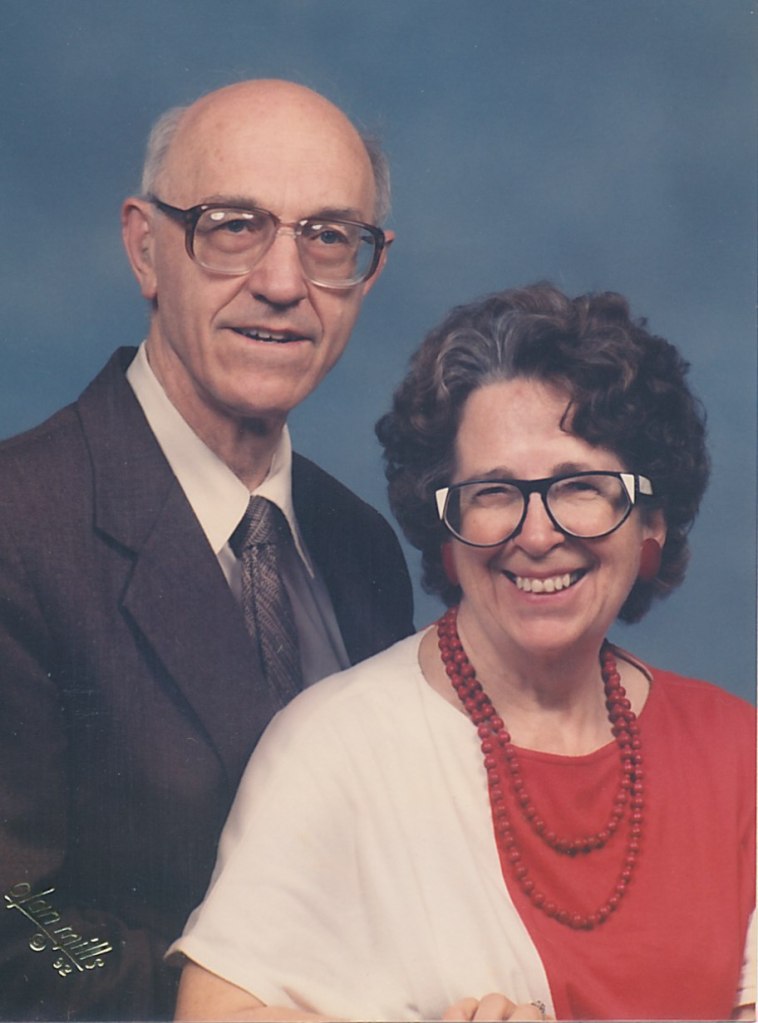
Francis I. Andersen 7/28/1925-5/12/2020

Drs. Francis & Lois Andersen

One of the great gifts during my undergraduate years at U.C. Berkeley was the presence of Dr. Francis I. Andersen at the Church Divinity School of the Pacific. His love of God was deeply infectious, his love of the Old Testament, equally so. His wit, patience, curiosity, laugh: all continue to be an inspiration. He entered into glory on May 12. “Let us pray with confidence to God, the Giver of life, that he will raise him to perfection in the company of the saints.”

Re the Daily Office Readings May 14 Anno Domini 2020

The Readings: Leviticus 19:26-37; 2 Thessalonians 1:1-12; Matthew 6:25-34

I would love to hear what you’re discovering in your voyage through this chapter. In the meantime…

In the creation story G-d brings order and stability out of chaos by dividing what needs to be kept apart, e.g., earth and sea. Distinguishing (dividing) is core to the priests’ job description, e.g., Leviticus 10:10. In this chapter, dividing (distinguishing, separating) turns out to be core to everyone’s job description. But what should be divided, what not divided? Here’s where the discovery, the surprises come.

“When you come into the land and plant all kinds of trees for fruit…” (vv.23-25)—so distinguish between the times to abstain, the times to offer, the times to consume.

“Do not profane your daughter by making her a prostitute” (v.29)—so parental decisions re children’s vocations should be divided into the proper and improper, with ‘to profane’ strikingly applied to persons!

“The alien who resides with you shall be to you as the citizen among you” (v.34). So distinguishing between the citizen and the alien is not OK?

Newly freed slaves with lots to unlearn. Thankfully, we have the gift of time.

Re the Daily Office Readings May 13 Anno Domini 2020

The Readings: Leviticus 19:1-18; 1 Thessalonians 5:12-28; Matthew 6:19-24

Leviticus 19 is a unique and important collection of diverse laws introduced by “You shall be holy, for I the LORD your God am holy” and frequently punctuated with “I am the LORD.” In an environment in which the two most frequent uses of ‘holy’ are “holier than thou” and “holy s—,” and in which “Lord” is associated with oppression there’s some preliminary work to do.

‘LORD’ (typically in small caps) is a stand-in for the name YHWH, unpronounced in Jewish tradition, often vocalized as ‘Yahweh’. In an important Old Testament tradition the introduction of the name ‘LORD’ is tied directly to the Exodus:

“God also spoke to Moses and said to him: ‘I am the LORD. I appeared to Abraham, Isaac, and Jacob as God Almighty, but by my name ‘The LORD’ I did not make myself known to them.… Say therefore to the Israelites, “I am the LORD, and I will free you from the burdens of the Egyptians and deliver you from slavery to them. I will redeem you with an outstretched arm and with mighty acts of judgment. I will take you as my people, and I will be your God. You shall know that I am the LORD your God, who has freed you from the burdens of the Egyptians”’” (Exod. 6:2-3, 6-7).

‘Holy’ appears in the creation story in relation to the Sabbath (the Sabbath itself interpreted as a way of remembering the Exodus in Deuteronomy), but then not significantly until Exodus 3:5, the LORD’s initial appearance to Moses, kicking off the Exodus (“Come no closer! Remove the sandals from your feet, for the place on which you are standing is holy ground.”).

‘The LORD’ and ‘holy’ are intimately tied to the Exodus. They are freedom words. Not surprisingly, Leviticus 19 recalls the Exodus as motivation (v.34, 36). And what’s the point of giving the people freedom if they keep acting like slaves? So: “be holy.”

What does ‘be holy’ mean? Leviticus 19 answers the question with a whirlwind of examples (e.g., “Do not profane your daughter by making her a prostitute.”) and principles (e.g., “you shall not profit by the blood of your neighbor.”). The collection is by nature not exhaustive. Rather, it sets the hearers/readers on a voyage of discovery.

The New Testament writers, celebrating Exodus 2.0, echo the call to holiness (John, Peter, Paul—in today’s reading). Recall Paul’s pivotal exhortation: “So, brothers and sisters, because of God’s mercies, I encourage you to present your bodies as a living sacrifice that is holy and pleasing to God. This is your appropriate priestly service. Don’t be conformed to the patterns of this world, but be transformed by the renewing of your minds so that you can figure out what God’s will is– what is good and pleasing and mature” (Rom. 12:1-2 CEB; boldface mine). Same voyage, same destination.

Re the Daily Office Readings May 12 Anno Domini 2020

The Readings: Leviticus 16:20-34; 1 Thessalonians 5:1-11; Matthew 6:7-15

More echoes of the Day of Atonement analogy in our tradition:

“All glory be to thee, Almighty God, our heavenly Father, for that thou, of thy tender mercy, didst give thine only Son Jesus Christ to suffer death upon the cross for our redemption; who made there, by his one oblation of himself once offered, a full, perfect, and sufficient sacrifice, oblation, and satisfaction, for the sins of the whole world; and did institute, and in his holy Gospel command us to continue, a perpetual memory of that his precious death and sacrifice, until his coming again” (BCP 334).

“Lord Jesus Christ, Son of the living God, we pray you to set your passion, cross, and death between your judgment and our souls, now and in the hour of our death. Give mercy and grace to the living; pardon and rest to the dead; to your holy Church peace and concord; and to us sinners everlasting life and glory; for with the Father and Holy Spirit you live and reign, one God, now and for ever.” (BCP 282).

And from the Epistle to the Hebrews:

“For when every commandment had been told to all the people by Moses in accordance with the law, he took the blood of calves and goats, with water and scarlet wool and hyssop, and sprinkled both the scroll itself and all the people, saying, ‘This is the blood of the covenant that God has ordained for you.’ And in the same way he sprinkled with the blood both the tent and all the vessels used in worship. Indeed, under the law almost everything is purified with blood, and without the shedding of blood there is no forgiveness of sins. Thus it was necessary for the sketches of the heavenly things to be purified with these rites, but the heavenly things themselves need better sacrifices than these. For Christ did not enter a sanctuary made by human hands, a mere copy of the true one, but he entered into heaven itself, now to appear in the presence of God on our behalf. Nor was it to offer himself again and again, as the high priest enters the Holy Place year after year with blood that is not his own; for then he would have had to suffer again and again since the foundation of the world. But as it is, he has appeared once for all at the end of the age to remove sin by the sacrifice of himself. And just as it is appointed for mortals to die once, and after that the judgment, so Christ, having been offered once to bear the sins of many, will appear a second time, not to deal with sin, but to save those who are eagerly waiting for him” (Heb. 9:19-28).

So, in the Christian tradition, the Day of Atonement is an analogy. Nothing more, nothing less. The different analogies speaking to the question of how G-d deals with human sin with all its destructive effects are perhaps like the different tools in a toolbox. So perhaps we might wonder: in our particular context what work might this tool/analogy do well for us?

Re the Daily Office Readings: The Psalms appointed

Praying in the middle of the COVID 19 pandemic is hard. The psalms assigned to the 11th day of the month in the Book of Common Prayer Psalter, Psalms 56-61, are curiously comforting, reminding me that praying was no less hard for the psalmist. For example,

Whenever I am afraid,
I will put my trust in you.
In God, whose word I praise,
in God I trust and will not be afraid,
for what can flesh do to me? (56:3-4)

“Will not be afraid”—perhaps prayed in desperation, and repeated in v.10.

Do you indeed decree righteousness, you rulers?
do you judge the peoples with equity?
No; you devise evil in your hearts,
and your hands deal out violence in the land. (58:1-2)

Dealing with a constant barrage of spin, propaganda, and deceit is nothing new.

They go to and fro in the evening;
they snarl like dogs and run about the city. (59:7)

But the vivid images bring no sort of catharsis. The last two verses of the psalm:

Let everyone know that God rules in Jacob,
and to the ends of the earth.
They go to and fro in the evening;
they snarl like dogs and run about the city. (59:15-16)

At present everyone certainly does not know that. Too much snarling and running, which in the psalm gets the last word. But God’s rule is the future for which the psalmist struggles to hope, struggles to pray into being.

Praying is hard work. But abandoning oneself and one’s world to the current realities: even harder.

Re the Daily Office Readings May 11 Anno Domini 2020

The Readings: Leviticus 16:1-19; 1 Thessalonians 4:13-18; Matthew 6:1-6,16-18

Of many things we say “It’s not rocket science.” Here, on the threshold of the Day of Atonement (Yom Kippur in the Jewish tradition), we might say that rocket science is easy compared to this. This being how G-d deals with human sin with all its destructive effects, Spufford’s HPtFtU (see May 4). And here the prophet’s words are perhaps particularly relevant: “For my thoughts are not your thoughts, nor are your ways my ways, says the LORD. For as the heavens are higher than the earth, so are my ways higher than your ways and my thoughts than your thoughts” (Isa. 55:8-9). It appears that the closest G-d can come to an explanation intelligible to us humans of the how is a rich set of irreducible analogies. One analogy is the father, torn by conflicting emotions:

“How can I give you up, Ephraim?
How can I hand you over, O Israel?
How can I make you like Admah?
How can I treat you like Zeboiim?
My heart recoils within me;
my compassion grows warm and tender.
I will not execute my fierce anger;
I will not again destroy Ephraim;
for I am God and no mortal,
the Holy One in your midst,
and I will not come in wrath. (Hos. 11:8-9)

Another analogy, the Day of Atonement, which analogy we encounter at various points in the Book of Common Prayer. Perhaps the most prosaic example appears in the Catechism:

Q.           What is the great importance of Jesus’ suffering and death?
A.           By his obedience, even to suffering and death, Jesus made the offering which we could not make; in him we are freed from the power of sin and reconciled to God.

The classic description (not explanation—see Isa. 55:8-9) of the analogy is in the Epistle to the Hebrews. I’ll close this post with a portion of that description. For the continuation of Lev. 16 in tomorrow’s reading I’ll include another portion of Hebrews together with other echoes of the analogy in our Book of Common Prayer.

“But when Christ came as a high priest of the good things that have come, then through the greater and perfect tent (not made with hands, that is, not of this creation), he entered once for all into the Holy Place, not with the blood of goats and calves, but with his own blood, thus obtaining eternal redemption. For if the blood of goats and bulls, with the sprinkling of the ashes of a heifer, sanctifies those who have been defiled so that their flesh is purified, how much more will the blood of Christ, who through the eternal Spirit offered himself without blemish to God, purify our conscience from dead works to worship the living God! For this reason he is the mediator of a new covenant, so that those who are called may receive the promised eternal inheritance, because a death has occurred that redeems them from the transgressions under the first covenant” (Heb. 9:11-15).

Re the Daily Office Readings May 10 Anno Domini 2020

The Readings: Leviticus 8:1-13, 30-36; Hebrews 12:1-14; Luke 4:16-30

The consecration of Aaron and his sons: our reflections could take us in so many directions; here are two.

Among the ceremonies setting individuals apart this account has no equal in the Old Testament. There may have been equally elaborate ceremonies for the consecration of a king, but the Old Testament does not bother recording them. The prophets? Typically, there was no public ceremony, another reason why the credibility of the prophets was a recurrent issue. And yet stories in which a high priest plays a decisive role in the nation’s history are few and far between. Because of who is telling and passing on the stories? Or another illustration of Charles Williams’ dictum “the sacrifice must be made ready, and the fire will strike on another altar”?

The second direction: Peter uses Exodus 19’s “priestly kingdom” language to describe our vocation: “like living stones, let yourselves be built into a spiritual house, to be a holy priesthood, to offer spiritual sacrifices acceptable to God through Jesus Christ… you are a chosen race, a royal priesthood, a holy nation, God’s own people, in order that you may proclaim the mighty acts of him who called you out of darkness into his marvelous light” (1 Pet. 2:5, 9). Alexander Schmemann (Of Water & the Spirit) has some words that may help us think about this priestly role:

“…to offer sacrifice, i.e., to be mediator between God and creation, the ‘sanctifier’ of life through its inclusion into the divine will and order.…

“The fall of man is the rejection by him of this priestly calling, his refusal to be priest. The original sin consists in man’s choice of a non-priestly relationship with God and the world. And perhaps no word better expresses the essence of this new, fallen, non-priestly way of life than the one which in our own time has had an amazingly successful career… consumer.… The first consumer was Adam himself. He chose not to be priest but to approach the world as consumer: to ‘eat’ of it, to use and to dominate it for himself, to benefit from it but not to offer, not to sacrifice, not to have it for God and in God.”

As the priest lifts up the bread and wine, asking God to do something wonderful with them, so our human vocation is to daily take whatever is in our hands (including, of course, ourselves) and lift it up to God, asking God to do with it something wonderful.

Three Prayers from Ghana

Ginger Johnston introduced me to these in the late sixties in Berkeley, California.

I lie on my mat and pray

Matthew, Mark, Luke, and John,
four men squat around the mat
on which I lie,
and pray,
and sleep.
Night comes,
sleep comes.
Dear Lord Jesus, come.
Four men
have told us this story.
Your story.
Two sit at the foot,
two at the head.
They will carry me to you,
Lord Jesus Christ,
when the last breath
beats against my tired lips.
Amen.

Is there work for me?

The day is there.
There is the sun.
Ships are in the harbor.
But is there work for me?
The others have friends.
They also have money.
They have given
a dash of whiskey.
And I stand aside
and have no work.
Can’t you make work for me
in the harbor,
dear Lord,
so that I can share money
with my wife and children?
Then, on Sunday,
I can put something in the plate.
Please, let me have work.
Dear Lord Jesus,
we praise you.
Amen.

I lie down to sleep

Come,
Lord,
and cover me with the night.
Spread your grace over us
as you assured us You would do.

Your promises are more
than all the stars in the sky;
Your mercy is deeper than the night.
Lord,
it will be cold.
The night comes with its breath of death.
Night comes,
the end comes,
but Jesus Christ comes also.

Lord,
we wait for Him
day and night.
Amen.

From I lie on my mat and pray and I sing your praise all the day long, edited by Fritz Pawelzik.

Making G-d’s Generosity Visible: A Sermon for the 6th Sunday after Epiphany

Good Shepherd, Sun Prairie, February 16, 2020.

The Readings: Deuteronomy 30:15-20; Psalm 119:1-8; 1 Corinthians 3:1-9; Matthew 5:21-37

Three years ago, I had the privilege of being with you to celebrate and to preach when we last heard these lessons. I focused on the Gospel text: how are we supposed to hear it today? Some interpreters think Jesus is promulgating a new law, others, that he is encouraging us to pay attention to the intention of the law. I sided with the second group for a variety of reasons. If “do not be angry” is a law, then Jesus is in trouble, because he is periodically angry, even calling the scribes and Pharisees “blind fools.” Again, almost from the start teachers have had to warn the enthusiasts that “If your right eye causes you to sin, pluck it out and throw it away” is not to be taken literally. Again, the various destructive attempts of the church to make “no divorce” a law are evidence enough of the shortcomings of this strategy. So, as sermons go, not a bad one, and I hope it was helpful.

Today I want to approach the text differently, focusing on its immediate context in Matthew, because it’s really important that today’s lesson is not recording the first words out of Jesus’ mouth. Or out of Matthew’s, for that matter. Recall: Matthew devotes the first two chapters to Jesus’ birth, starting with a genealogy that highlights his link with Abraham and David, and includes the story of the Magi, who set Jerusalem on edge asking “Where is the child who has been born king of the Jews?” The third chapter introduces John the Baptist and closes with Jesus’ baptism with the heavenly voice: “This is my Son, the Beloved, with whom I am well pleased.” Whatever else that voice is doing, it identifies Jesus as royal.

So—chapter four—we hear the temptation story, arguably about just what sort of king Jesus is going to be, about just what sort of kingdom Jesus is going to announce. Jesus returns to Galilee: “Repent, for the kingdom of heaven has come near.” The kingdom of heaven, the kingdom of God, the reign of God: throughout the Gospels Jesus tries to help us catch the vision. Here are two of the parables from later in Matthew:

“The kingdom of heaven is like treasure hidden in a field, which someone found and hid; then in his joy he goes and sells all that he has and buys that field. “Again, the kingdom of heaven is like a merchant in search of fine pearls; on finding one pearl of great value, he went and sold all that he had and bought it.”

Find that treasure, find that pearl, and so many issues sort themselves out. Returning to today’s Gospel, hearers often find the teaching absurdly demanding. And it is: if we haven’t encountered the treasure/the pearl. As we begin to catch the vision, the teaching approaches being self-evident.

Chapter 5, in which we find today’s Gospel, opens with the Beatitudes. Catch the vision of the kingdom, and you understand who is fortunate: the poor in spirit, those who mourn, the meek, those who hunger and thirst for righteousness, the merciful, etc. Or, take seriously Jesus’ declaration that these are the fortunate, and you get a sense of what sort of kingdom Jesus is proclaiming.

And then comes what may be the truly scary part. It’s one thing to hear Jesus say “I am the light of the world.” Wonderful: it’s on Jesus. But here, right after the Beatitudes: “You are the salt of the earth… You are the light of the world.” We’re on the critical path for the world’s healing, the world’s restoration: “let your light shine before others, so that they may see your good works and give glory to your Father in heaven.”

It’s important that that light shine, that God’s generous character be visible in the lives of those who bear God’s name. That, I think, is close to the heart of Jesus’ quarrel with the scribes and Pharisees, that they were spending too much energy seeking their individual purity, and way too little energy making God’s generosity visible.

Making God’s generosity visible: that may not be a bad way of summarizing what Jesus is getting at in today’s lesson. Handle your anger, handle your sexuality, in ways that make God’s generosity visible.

OK. Where does that leave us? I’ve read today’s lesson as flowing from Jesus’ vision of the kingdom. As we catch Jesus’ vision—and note that there’s no space between Jesus Himself and Jesus’ vision of the kingdom—texts like today’s lesson move from being absurdly demanding toward being self-evident.

But there’s where the rub is. Our vision of Jesus and the kingdom varies in clarity—to put it generously. But it’s fundamental. The Jesuit Pedro Arrupe put it this way:

“Nothing is more practical than finding God, that is, than falling in love in a quite absolute way. What you are in love with, what seizes your imagination, will direct everything. It will decide what will get you out of bed in the morning, what you will do with your evenings, how you will spend your weekends, what you read, who you know, what breaks your heart, and what amazes you with joy and gratitude.

“Fall in love, stay in love and it will decide everything.”[1]

It’s easy to get the impression that all this—motioning around the sanctuary—is about what we’re supposed to do. And what we’re supposed to do is, of course, important. But that risks missing the point. The point is what this generous God has done, is doing, and will be doing, and that this generous God invites us to join in the quest that what pleases this God be done on earth as it is in heaven. It’s worth protecting time for this reality to work on our imaginations, to mess with our imaginations. So we gather here, and at home we pray and open the Bible to catch and hold this vision, or, as Fr. Arrupe put it, to fall in love and stay in love. It’s a royal waste of time that our tradition cannot recommend highly enough.

But, since our bodies and spirits are intimately connected, it’s also true that as we follow Jesus’ teaching so that our bodies make God’s generosity visible, our spirits find it easier to catch and hold this vision of this God’s generous kingdom.

Let’s give John’s witnesses in the Revelation the last word:

17 The Spirit and the bride say, “Come.” And let everyone who hears say, “Come.” And let everyone who is thirsty come. Let anyone who wishes take the water of life as a gift.


[1] From James Martin’s The Jesuit Guide to (almost) everything, p. 219.