
Tag Archives: Christmas

Christ was born for this! (First Sunday after Christmas, 12/28/2025)

Readings

[Call and response:] Merry Christmas! Merry Christmas!

This year that line from the carol we just sang got my attention: “Christ was born for this!” What happens if we put that together with today’s readings?

In our first reading, it sounds like there are two voices There’s the “I” we meet midway through the reading: “For Zion’s sake I will not keep silent.” That sounds like a prophet, who begins to speak to Jerusalem. The “I” in the first lines? That sounds like Jerusalem personified, celebrating her coming vindication or salvation, so certain that it’s put in the past tense: “he has clothed me with the garments of salvation, / he has covered me with the robe of righteousness.”

Why should we gentiles care about that? Recall Isaiah’s vision that we heard a few weeks ago on the first Sunday of Advent:

In days to come
the mountain of the Lord’s house
shall be established as the highest of the mountains,
and shall be raised above the hills;
all the nations shall stream to it.
Many peoples shall come and say,
‘Come, let us go up to the mountain of the Lord,
to the house of the God of Jacob;
that he may teach us his ways
and that we may walk in his paths.’

That’s the Old Testament’s primary vision of how those words to Abraham “in you all the families of the earth shall be blessed” (Gen 12:3) are fulfilled. Not by military conquest, but by attraction. Israel’s trust in the Lord nurtures a national life that is so attractive that all the nations want in on it.

Things, obviously, didn’t play out that way, so today’s text from Isaiah looks to the Lord getting that project back on track. We hear the same hope at the beginning of today’s psalm: “The Lord rebuilds Jerusalem; / he gathers the exiles of Israel.” And we heard it in Mary’s song on the third Sunday of Advent:

He has come to the help of his servant Israel,
for he has remembered his promise of mercy,
The promise he made to our fathers,
to Abraham and his children for ever. (Lk 1:54-55)

“Christ was born for this!” And so, some years later, Jesus enters Jerusalem with the crowds shouting “Hosanna to the Son of David! Blessed is the one who comes in the name of the Lord! Hosanna in the highest heaven!” (Mat 21:9) It’s almost within reach: all the Jewish leaders and Pilate have to say is “OK, Jesus, we’ll do it your way” and it’s Isaiah’s vision on steroids.

As we recall every Holy Week, it doesn’t play out that way, and God says, in effect, “OK, this is going to take longer.” So what we encounter in today’s Epistle and Gospel is a focus on adoption. Galatians: “so that we might receive adoption as children.” John: “But to all who received him, who believed in his name, he gave power to become children of God.”

Daughters and sons of God! In the context of today’s readings, that suggests attention to Jesus’ words in the Gospel of John: “Very truly, I tell you, the Son can do nothing on his own, but only what he sees the Father doing; for whatever the Father does, the Son does likewise” (5:19). Those words to Abraham, “in you all the families of the earth shall be blessed:” that’s the family project. As daughters and sons, our project.

The same theme shows up in Matthew’s Gospel: “But I say to you, Love your enemies and pray for those who persecute you, so that you may be children of your Father in heaven; for he makes his sun rise on the evil and on the good, and sends rain on the righteous and on the unrighteous” (5:44-45).

It’s not that God has given up on the Jews. As Paul reminds us “the gifts and the calling of God are irrevocable” (Rom 11:29). But these congregations of Jewish and Gentile believers in all the world—even in Wisconsin—each can be a temple, a place where trust in the Lord nurtures a communal life that is so attractive that all the neighbors want in on it. As Paul puts it, “so that through the church the wisdom of God in its rich variety might now be made known to the rulers and authorities in the heavenly places” (Eph 3:10).

Isaiah’s vision: it’s been tweaked in unexpected ways. The “mountain of the Lord’s house” is distributed across the globe, also at 6205 University Avenue. But it’s still the endgame:

‘Come, let us go up to the mountain of the Lord,
to the house of the God of Jacob;
that he may teach us his ways
and that we may walk in his paths.’

And for that, as Paul celebrates, “God has sent the Spirit of his Son into our hearts, crying, ‘Abba! Father!’” Repairing the world (tikkun olam, as the Jews put it): it’s the family business. “Christ was born for this! Christ was born for this!”

[Call and response:] Merry Christmas! Merry Christmas!

Light in the Darkness (Christmas Day, 12/25/2025)

Readings

[Call & response:] Merry Christmas! Merry Christmas!
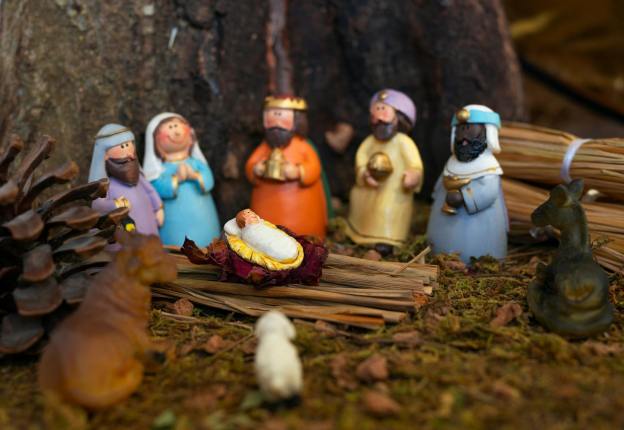
The truly odd thing about the way our culture celebrates Christmas, a.k.a. the Holiday Season, is the contrast between its obligatory gaiety and the despair-encouraging darkness assumed in the Christmas readings. “The people who walked in darkness” in our first reading: in Isaiah’s time, the northern tribes just swallowed up by the Assyrian Empire. Or the Roman Empire assumed in our Gospel reading. As Ben Franklin observed, “Guests, like fish, begin to smell after three days.” Only under the most generous reading are the Romans guests, and they’ve been throwing their weight around for decades. That registration decree from the Emperor Agustus? The Empire needs—wait for it—more money.

Then there’s Crete. Earlier in the letter Paul writes about its inhabitants “It was one of them, their very own prophet, who said, ‘Cretans are always liars, vicious brutes, lazy gluttons.’ That testimony is true” (1:12-13). It would be understandable if he’d given the place a wide berth, but, no, he’s left Titus there to sort things out. So, in the verses before today’s reading, Paul’s focused on what various groups need to hear: older men, older women, younger men, slaves… Not the finer points of etiquette, but painfully basic stuff: the older women shouldn’t be slaves to drink; the younger men should show some self-control; the slaves shouldn’t pilfer…

Why? In all that darkness booze etc. sound like rational responses! Paul in today’s reading: “For the grace/gift of God has appeared…” Later in the letter he writes: “He saved us, not because of any works of righteousness that we had done, but according to his mercy, through the water of rebirth and renewal by the Holy Spirit” (3:5). It’s a matter of remembering their identity, our identity. Every day we receive countless messages (print, TV, radio, social media, etc.) each encouraging us to experience ourselves in terms of a particular identity: consumer, tax-payer, citizen, privileged white male, oppressed white male… But we are baptized. Paul would have us use that as a filter, a spam blocker, if you like. How is this message relevant to us as baptized, in which Jew, Greek, slave, free, male, female, “all…one in Christ Jesus” (Gal 3:27-28)?

Because, as Paul writes, there’s a point to God’s gift/grace: “that he might redeem us from all iniquity and purify for himself a people of his own who are zealous for good deeds.” “A people of his own:” that’s a somewhat unwieldy translation for the phrase that occurs repeatedly in the Torah about Israel: “you shall be my treasured possession out of all the peoples” (Exo 19:5). God hasn’t given up on that, a people whose life is human, humane. As you may recall, Matthew uses “The people who walked in darkness have seen a great light” to celebrate Jesus’ arrival in Galilee (4:15-16). Jesus is the light. But then in the next chapter we hear Jesus saying “You are the light of the world” (5:14).

God’s gift, the gift that keeps giving in the lives of those who receive it. Our reading from Isaiah ended with “The zeal of the LORD of hosts will do this.” And if we wonder how that works, the ending from our reading from Titus supplies part of the answer: “and purify for himself a people of his own who are zealous for good deeds.”

“The people who walked in darkness…” A couple millennia on from Isaiah we have no lack of darkness, whether imported or home-grown. But, as Isaiah promised, we have God’s gracious gift, Emmanuel, God with us. The darkness will not get the last word. That Spirit that brooded over the dark chaos at the beginning of creation was given to us at baptism—or, better, we were given over to that Spirit at baptism—and the invitation of Christmas is to celebrate what that Spirit is stirring up in our midst.

[Call & response:] Merry Christmas! Merry Christmas!

Learning with the Astrologers (The Feast of the Epiphany, 1/6/2025)

Readings

Sometime in early Spring, shortly after what we celebrate as the Feast of the Annunciation, Mary had sung:

He has cast down the mighty from their thrones,
and has lifted up the lowly.
He has filled the hungry with good things,
and the rich he has sent away empty.
He has come to the help of his servant Israel,
for he has remembered his promise of mercy,
The promise he made to our fathers,
to Abraham and his children for ever.

We might mentally loop this song and let it play in the background throughout this sermon, for it provides an appropriate soundtrack for our Gospel reading, and the Gospel reading in turn shows the surprising ways in which it plays out.

And the Gospel reading, in turn, also looks like it’s playing off the texts we heard from Isaiah and our psalm. There’s the foreigners bringing gifts theme. Further, Matthew’s identified Jesus as Son of David in the opening verse of the Gospel, and here the quote from the prophet Micah identifies Jesus as the Messiah. Psalm 72’s gifts to the King’s Son fit right in. Gold and frankincense as gifts show up twice the the Bible: Isa 60 and Matt 2. Matthew’s interested in both the continuity (Ps 72) and discontinuity (Isa 60) of these texts with his story.

Our Isaiah text. For a sense of the situation, recall that when the returning exiles laid the foundation for the second temple, we’re told “many of the priests and Levites and heads of families, old people who had seen the first house on its foundations, wept with a loud voice when they saw this house, though many shouted aloud for joy” (Ezra 3:12). This temple: such an impoverished version of Solomon’s temple. But, proclaims the prophet: that’s not the last word. You will shine. Nations will come to your light. Nations, bringing gold and frankincense to the temple. Jesus’ “You are the light of the world” might come to mind.

So, enter the Magi, the astrologers. In Matthew’s world folk assumed that important events—like the birth of powerful kings—would be heralded in the heavens. Even the Book of Numbers recalled the pagan prophet Balaam’s words “I see him, but not now; I behold him, but not near– a star shall come out of Jacob, and a scepter shall rise out of Israel” (Num. 24:17a). The Magi have seen the star; they head for the capital.

We heard what happened: they’re redirected to Bethlehem. The gold and frankincense end up in Bethlehem. So Isaiah got it wrong? Not according to Matthew: if you’re looking for the true temple, it’s currently in Bethlehem. The Gospel of John made the same point with Jesus’ words “”Destroy this temple, and in three days I will raise it up” (Jn. 2:19); Matthew does it with this story.

Pulling back the camera, the Magi story reminds us of why we gentiles are celebrating this Jewish King’s birth. So in our second reading we heard “the Gentiles have become fellow heirs, members of the same body, and sharers in the promise in Christ Jesus through the gospel.” Jews and Gentiles, then (and now?) like the proverbial Hatfields and McCoys: and Jesus is uniting them. Matthew’s Gospel ends with the command to disciple all nations; the Magi story is the set-up.

The Magi. We met their counterparts in the competitions between Moses and Pharaoh’s magi and between Daniel and the Babylonian magi. The Jews (so to speak) get it right; the Gentiles get it wrong. And here the script gets reversed? Maybe. What doesn’t change is that in all three situations (Pharaoh’s court, the Babylonian court, Herod’s court) it’s the powerless who get it right.

That’s the warning both here and in Mary’s song. “He has come to the help of his servant Israel,” yes. But servant Israel—like servant Church—can be asleep at the switch. Not one of the chief priests or scribes accompany the Magi down to Bethelem. Better, I suppose, than Herod, who’s quite awake to any threat to his understanding of God’s kingdom. Being part of Israel or the Church: no guarantee that we’ll get it right. And the more power we have, the more careful we need to be.

Coming at this another way, in Mary’s song it sounds like God is making all the decisions. “He has filled the hungry with good things, / and the rich he has sent away empty.” In Matthew’s story the rich (so to speak) exclude themselves, the chief priests and scribes through some combination of sleep and inertia, Herod through fear.

Let’s return to Isaiah’s image of light.

Arise, shine; for your light has come,
and the glory of the LORD has risen upon you.
For darkness shall cover the earth,
and thick darkness the peoples;
but the LORD will arise upon you,
and his glory will appear over you.
Nations shall come to your light,
and kings to the brightness of your dawn.

No shortage of thick darkness these days. Isaiah—and Paul—don’t want us to be surprised by that. But precisely in the midst of that: “so that through the church the wisdom of God in its rich variety might now be made known to the rulers and authorities in the heavenly places.” And what is this wisdom that Paul is celebrating? That the Gentiles—all peoples—are now through the Messiah invited to full participation in God’s project of world healing initiated with Abraham and Sarah. Is this project of uniting all peoples in Christ sustainable? Is the water of baptism more potent than the inertia of ethnicity and culture? Did Mary and her song get it right? That’s what the Church—despite all its failings—is to demonstrate. “You are the light of the world.”

The Riddle (Christmas Day, 12/25/2024)

Readings

Some centuries before tonight’s events, the prophet Elijah’s generation was immersed in profound change—economic, social, cultural—you name it. The fear and anxiety in the air did not leave Elijah untouched. At one point he journeyed to Mt Sinai: “I have been very zealous for the LORD, the God of hosts; for the Israelites have forsaken your covenant, thrown down your altars, and killed your prophets with the sword. I alone am left, and they are seeking my life, to take it away” (1 Ki. 19:10).

As the story goes, the LORD said “’Go out and stand on the mountain before the LORD, for the LORD is about to pass by.’ Now there was a great wind, so strong that it was splitting mountains and breaking rocks in pieces before the LORD, but the LORD was not in the wind; and after the wind an earthquake, but the LORD was not in the earthquake; and after the earthquake a fire, but the LORD was not in the fire; and after the fire a sound of sheer silence” (1 Ki. 19:11-12).

All these convulsions, and the LORD is in none of them—until “a sound of sheer silence.” Surprising, both because these convulsions were characteristic on the LORD’s presence when Moses and the people showed up centuries earier at Sinai, and because these are the sort of convulsions Elijah probably thought necessary for the LORD to sort things out. But no: “a sound of sheer silence.” So the LORD’s appearance turns out to be a riddle: Who is this God? What is this God up to? What does this God want from us?

Tonight’s events mirror Elijah’s experience. All during Advent we’ve been praying “O come, O come Emmanuel,” our prayers echoing so many biblical texts (Isaiah: “O that you would tear open the heavens and come down, so that the mountains would quake at your presence” [Isa. 64:1]), and channeling our own fears and anxieties. An angel appears, then the choir of the angelic army (recall the Red Army Choir)—and the shepherds are directed to… a newborn baby: a sound of sheer silence—except when the diaper needs changing. All these images of irresistible power (the angel’s first words: “Do not be afraid”)—and then this baby. After four weeks of “O come, O come” and hoping (perhaps? probably?) for something like Arnold Schwarzenegger’s coming in Terminator 2: Judgment Day, a newborn baby. So we’re right there with Elijah: Who is this God? What is this God up to? What does this God want from us?

Whatever else Christmas is, it’s that riddle. Let us go with the shepherds to pay attention to that riddle; our lives and peace hang on it.

Conduits for God’s Future: Christmas Eve 2023

Readings

Both my brother and I enjoy sci-fi in multiple formats. A couple years back he sent me season 1 of Star Trek: Voyager; who knows what’ll be under the tree this year. As TV series go, my favorite is undoubtedly Dr. Who, particularly as played by Tom Baker. Dr. Who is a Time Lord, who travels through time in contraption called the TARDIS, which, due to a long-standing malfunction, has the outward appearance of a blue English police box.

Time travel has been particularly relevant in 2023. Who hasn’t instinctively reached for the fast forward button at multiple points—or perhaps the reverse button. But life doesn’t seem to come with that sort of remote. So 2023 has had more than its fair share of moments in which we might feel stuck.

And, at first, glance, our readings, particularly the first, are not of much help. “…endless peace…He will establish and uphold it / with justice and righteousness / from this time onward and forevermore.” And Isaiah fills out the vision: “they shall beat their swords into plowshares, / and their spears into pruning hooks;” “the wolf shall live with the lamb, / the leopard shall lie down with the kid.” But that’s then and we’re here. Add the devastation that forms the immediate backdrop to Isaiah’s words (“the yoke of their burden, / and the bar across their shoulders, / the rod of their oppressor”) and we have plenty of material for a “Blue Christmas” observance right here.

And yet, Jesus’ birth has something to tell us about this experience of feeling stuck, trapped in the present. For that, we might start with Santa Claus, who started out as St. Nicholas, bishop of Myra (now in Turkey) at the beginning of the 4th century. Nicholas did some of his most important work at night, anonymously distributing food, clothing, and—sometimes—small bags of gold down chimneys to those in need. During the day, he periodically used the full weight of his office to defend the innocent. Eventually the anonymity collapsed and he was honored also in the multiplication of stories about him.

If we wonder what was at the heart of what Nicholas was about, perhaps we could put it like this: he recognized that God invites us to open ourselves so that we become a sort of conduit through which God’s future—the sort of future Isaiah was describing—can flow into the present. He may have been distributing blankets in ad 320, but more than ad 320 was in play.

In this Nicholas was somewhat like Mary, part of whose story we heard in the Gospel. Nine months earlier an angel had appeared to her: would she be the conduit—in a quite literal sense—through which God’s future might arrive? She replied: “Here am I, the servant of the Lord, let it be with me according to your word.” That was one of the high points; it doesn’t take much reading between the lines to recognize the likelihood of low points in the story from the Gospel we just heard: tired after a multi-day journey, giving birth for the first time, far apart from most of the folk she would have liked around her, making do in the manger. The year was—scholars guess—about 4 bc, but much more than 4 bc was in play.

That invitation to open oneself as a conduit through whom God’s future can flow into the present: that’s an invitation extended not just to Nicholas and Mary, but to each one of us. The birth we celebrate today: unique. The divine invitation to cooperate with God in bringing God’s future into our present: that’s a standing invitation. And God nurtures places like St Peter’s where we can learn together how to do that together.

This opening oneself as a conduit through whom God’s future can flow: what more can we say about what it looks like? Well, that’s the question that drives most of what shows up in the “Sermon” slot throughout the year, isn’t it. For now, it’s enough to say that if we’ve gathered together to celebrate Jesus’ birth, just wait till he starts talking, starts acting. May we—please God—keep paying attention, keep learning.

So, time-traveling that leaves our present mostly untouched—that’s probably not in the cards. Opening ourselves as conduits for God’s future to flow into our present: God’s all over that one. Experiencing ourselves as stuck is not the only option. And so we say: Merry Christmas.