Tag Archives: Daily Office Lectionary

Re the Daily Office Readings 5/1/2020

The Readings: Exodus 24:1-18; Colossians 2:8-23; Matthew 4:12-17
(For Friday, Week of 3 Easter, not Saint Philip and St James, Apostles)

Exodus 24 narrates the ratifying of the covenant (treaty) announced in Exodus 19 (“if you obey my voice and keep my covenant, you shall be my treasured possession out of all the peoples. Indeed, the whole earth is mine, but you shall be for me a priestly kingdom and a holy nation”). After God addresses the people directly (the “Ten Commandments”), the people ask that Moses receive subsequent instruction and pass it on. The subsequent instruction occupies Exodus 20:22-23:33; Moses passes it on to the people; the people respond—as they had in 19:8—“All the words that the LORD has spoken we will do;” now the two-part ratification.

All the people participate in the first part, involving pillars, sacrifices, blood, reading, declaration, more blood, ending with Moses’ “See the blood of the covenant that the Lord has made with you in accordance with all these words.” Ritual is language, often—like here—performative language, evocative, more like poetry than prose, only somewhat translatable. Blood, one of our most potent symbols for life, death, identity. The blood of circumcision, the ram’s blood (not Isaac’s!) shed on that other mountain, the lamb’s blood at Passover, this blood… The New Testament references to the blood of Christ draw on all this, and we Gentiles must work backwards, not so much to understand as to get a sense of the mystery to which we’re being pointed.

A representative group participates in the second part: “Then Moses and Aaron, Nadab, and Abihu, and seventy of the elders of Israel went up, and they saw the God of Israel. Under his feet there was something like a pavement of sapphire stone, like the very heaven for clearness. God did not lay his hand on the chief men of the people of Israel; also they beheld God, and they ate and drank.”

That may be a scene to let sink deep into our imaginations. The stories Israel’s neighbors told about their gods help us recognize that if it’s treaty-making, it’s also a victory celebration. I wonder how it might have worked in Isaiah’s imagination.

“On this mountain the LORD of hosts will make for all peoples
a feast of rich food, a feast of well-aged wines,
of rich food filled with marrow, of well-aged wines strained clear.
And he will destroy on this mountain
the shroud that is cast over all peoples,
the sheet that is spread over all nations;
he will swallow up death forever.” (25:6-8a)

How might this (Exodus) scene shape our participation in the Eucharist? The Body of Christ, the Blood of Christ: how like or unlike their beholding God?
Re the Daily Office Readings 4/19/2020

The Readings: Exodus 14:5-22; 1 John 1:1-7; John 14:1-7

Exodus: A paradigmatic deliverance story, also, perhaps, a reflection on the challenge of belief. The Hebrew words for ‘to see’ (rāˀâ) and ‘to fear’ (yārāˀ) are close in sound, and the story employs them from the introduction of the crisis to its resolution (‘to see’: 14:13, 30, 31; ‘to fear’ 14:10, 13, 31). And so the story ends (tomorrow’s reading) with “Israel saw the great work that the LORD did against the Egyptians. So the people feared the LORD and believed in the LORD and in his servant Moses” (v.31).

That’s the end of that story; it’s more challenging in the middle. The Letter to the Hebrews: “Now faith is the assurance of things hoped for, the conviction of things not seen” (11:1). I like Jim Wallis’ paraphrase: “Hope means believing in spite of the evidence and then watching the evidence change” (“The Way of Hope,” written in 2015, but equally relevant today).

Program note: Jesus’ words in John come right after Judas’ departure to betray Jesus and Jesus’ prediction of Peter’s denials. The soundtrack for Exodus is increasingly dominated by approaching Egyptian army; the soundtrack for John by the approaching soldiers and police.

COVID-19 and fear, both in the air. So I might take some time to enter today’s Exodus reading contemplatively. The Jesuits talk of “composing the place,” asking for God’s help to imagine oneself in the story in as much detail as possible. What do I see? What do I hear? What do I smell? What do I feel? What do I taste? Now, the place composed, I ask God to be with me as I let the story play out in my imagination. How will the story play out? What will God and I discover together? (See “Father James Martin: An Introduction to Ignatian Contemplation.)

Re the Daily Office Readings 4/17/2020

The Readings: Exodus 13:1-2, 11-16; 1 Corinthians 15:51-58; Luke 24:1-12

There’s a world of difference between “I don’t want to die” (near universal) and “I’d be happy if my life continued forever” (not so much). Ask Tithonus, that Greek fellow who asked for immortality but forgot to ask for eternal youth. So death is destroyed at the last trumpet (Paul): until we get the living part right death can provide a merciful end.

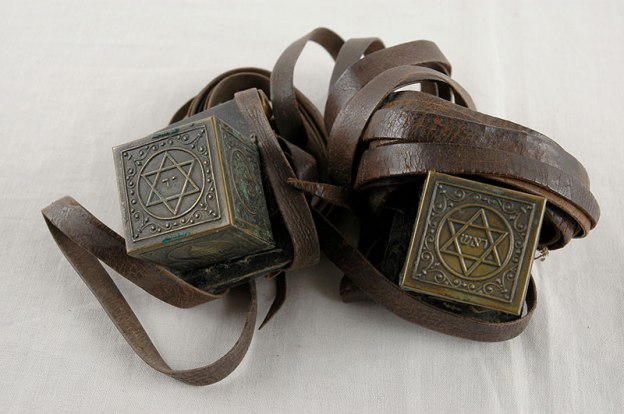
Moses is working at getting the living part right in the interwoven practices regarding the first born (Exod 13:1-2, 11-16) and unleavened bread (Exod 13:3-10). The practices will serve “as a sign (ˀôt) on your hand and as a reminder (zikkārôn) on your forehead” (v.9), and “as a sign (ˀôt) on your hand and as an emblem (ṭôṭāpôt) on your forehead” (v.16). By Jesus’ time Jews interpreted these texts literally, underwriting the use of tefillin (“phylacteries” Matt 23:5), small leather cubes bound on the arm and forehead.

For better or worse, Christians do not follow this practice, but the interpretive challenge remains. What Moses understands is that what and how we remember are profoundly formative of both the individual and community. Torah—particularly Deuteronomy—is filled with calls to remember; Jesus and the New Testament writers are no less attentive to remembering well and effectively. Torah is about love of God and neighbor: healthy memory nourishes that love; diseased memory starves that love.

In this season social distancing sidelines some of our cherished ways of remembering (e.g., Holy Eucharist), but may create space for other ways (e.g, Compline and the other services in the Daily Office). So, what are we supposed to remember, and how in this season can we better help ourselves remember?

But what about the texts that don’t show up in the Daily Office Lectionary?

Within our (Episcopal) tradition the Daily Office is the natural starting-point, and half a loaf is much better than no loaf. Full stop.

But its schedule of readings (lectionary) leaves out large chunks of the Old Testament, most notably, all of Song of Songs.

The attached PDF file presents one way the lectionary can be supplemented to achieve continuous readings of all the books in the pre-Reformation western canon within a two-year cycle.

Suggestions for improvement welcome!