Tag Archives: Daily Office

Re the Daily Office Readings 4/22/2020 (Take 2)

Photo by Pixabay on Pexels.com

From today’s readings: “But you are a chosen race, a royal priesthood, a holy nation, God’s own people, in order that you may proclaim the mighty acts of him who called you out of darkness into his marvelous light” (1 Pet. 2:9).

So on this Earth Day here’s St. Basil the Great’s Prayer of Compassion

O God, enlarge within us the sense of
fellowship with all living things,
our brothers the animals to whom thou
gavest the earth as their home in
common with us.

We remember with shame that in the past
we have exercised the high dominion
of man with ruthless cruelty
so that the voice of the earth,
which should have gone up to thee
in song, has been a groan of travail.

May we realize that they live not for
us alone but for themselves and for
thee, and that they love
the sweetness of live.

Source: https://earthministry.org/worship/prayers/

Re the Daily Office Readings 4/21/2020

The Readings: Exodus 15:1-21; 1 Peter 1:13-25; John 14:18-31

It is one of the oldest human stories: our God defeats chaos and death, wins sovereignty, creates a stable world in which we can thrive. Israel’s neighbors in the east, the Babylonians, had it in the epic “When on high” (Enuma Elish); to the north there was the cycle of Baal poems. Israel celebrated its occurrence in their history at the Red Sea, the oldest version of that celebration being today’s reading from Exodus. Whatever the threat, we need not fear. The Lord is risen indeed. Alleluia.

Peter picks up the Passover/exodus/wilderness imagery addressing those ransomed “with the precious blood of Christ, like that of a lamb without defect or blemish.” “…love one another deeply from the heart.” A seamless transition from celebrating God’s generosity to a corresponding generosity on our part. These days, maintaining the social distancing recommended by our physicians. (“There may come a time when recovery lies in the hands of physicians, for they too pray to the Lord that he grant them success in diagnosis and in healing, for the sake of preserving life. He who sins against his Maker, will be defiant toward the physician” [Sirach 38:13-15].) These days, at least remembering those whose fate has been pushed off the front page, e.g., the some 40,000 held in our immigrant detention centers (Amnesty International).

We have passed through the Red Sea / across the Atlantic / over the Rio Grande. Now what?

Re the Daily Office Readings 4/20/2020 (Take 2)

Psalm 104, assigned in the 30-day Psalm cycle to the evening of the 20th day of the month, begins:

“Bless the Lord, O my soul,
O Lord my God, how excellent is your greatness!
you are clothed with majesty and splendor.”

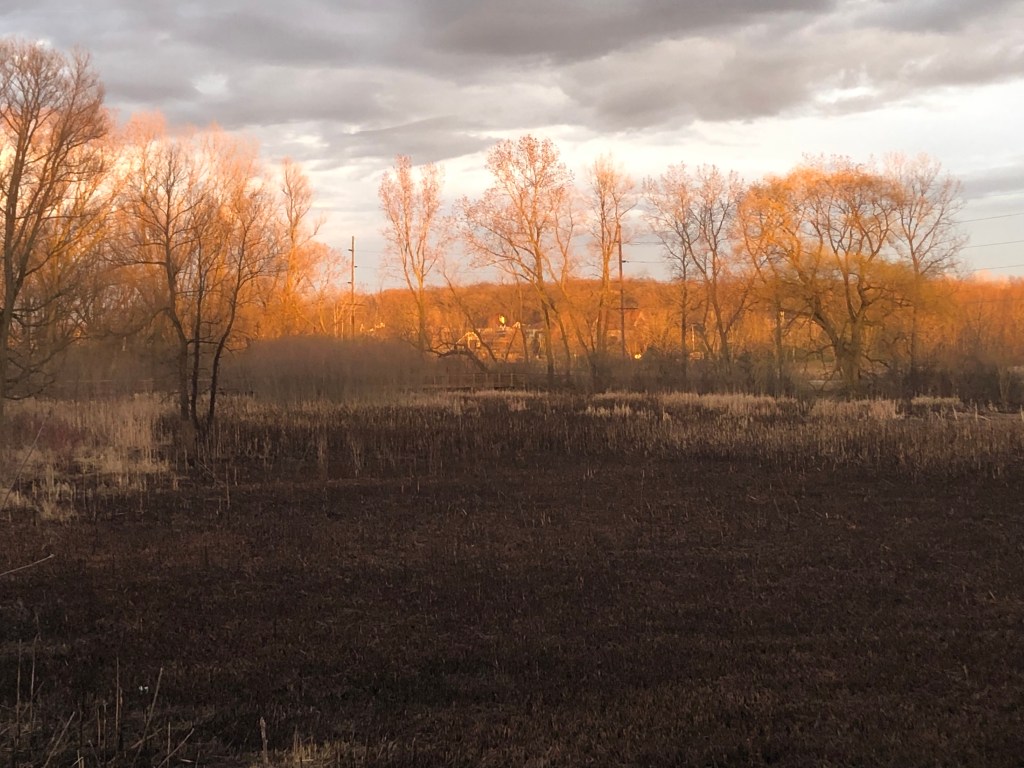
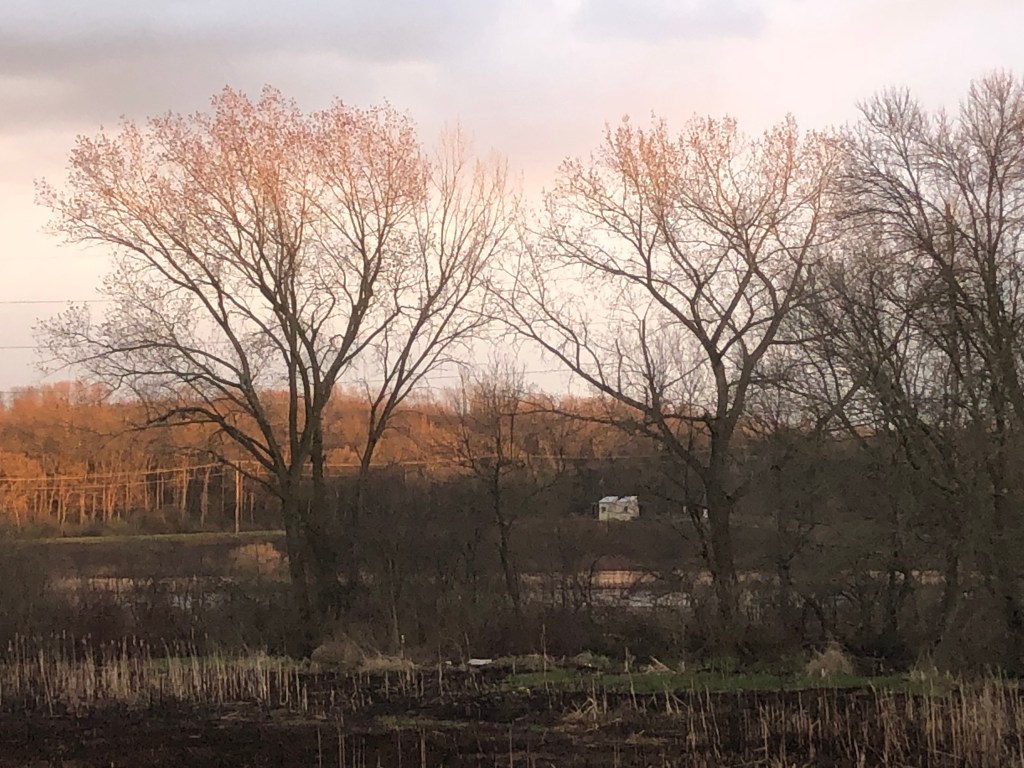
Tonight at dusk Dunn’s Marsh, across the street from our home, joined in the celebration. The majesty and splendor in creation, God’s open invitation to draw nearer to God, in whose right hand “are pleasures for evermore” (Ps. 16:11).

Re the Daily Office Readings 4/20/2020

The Readings: Exodus 14:21-31; 1 Peter 1:1-12; John 14:8-17

We heard the Exodus text just over a week ago at the Great Vigil. There it’s followed by this prayer:

O God, whose wonderful deeds of old shine forth even to our own day, you once delivered by the power of your mighty arm your chosen people from slavery under Pharaoh, to be a sign for us of the salvation of all nations by the water of Baptism: Grant that all the peoples of the earth may be numbered among the offspring of Abraham, and rejoice in the inheritance of Israel; through Jesus Christ our Lord. (BCP 289)

Coming at it cold, and, perhaps, more awake, the story may give us pause. Is this what the soldiers in Pharaoh’s army signed up for (if choice was even involved), soldiers not unlike those serving our country for which we pray weekly. We humans live in societies in which we’re profoundly interconnected. It makes our life possible; it allows both dying and killing to cascade.

The Jews have wrestled with this story, as in this saying: “God silenced the song of the angels with the words: ‘The work of My hands is drowning in the sea, and ye wish to chant songs!” (Ginzberg The Legends of the Jews, VI.12).

Can we bail with “Well, that’s the god of the Old Testament for you”? Not with today’s Gospel: “Do you not believe that I am in the Father and the Father is in me? The words that I say to you I do not speak on my own; but the Father who dwells in me does his works.” The God at work in Jesus: the God who orchestrated the Exodus.

Where might this reflection end up? Here’s one possibility: all those Egyptians “dead on the seashore”: we owe it to them not to replicate Egypt’s idolatry and oppression in our common life. Otherwise, they truly would have died for nothing.

Re the Daily Office Readings 4/18/2020

The Readings: Exodus 13:17—14:4; 2 Corinthians 4:16—5:10; Mark 12:18-27

What to make of Paul’s striking contrasts? “Even though our outer nature is wasting away, our inner nature is being renewed day by day” (4:16); “slight momentary affliction…an eternal weight of glory beyond all measure” (4:17); “we groan… we are always confident” (5:2, 6).

I doubt that it’s about having some sort of psychic balance sheet that happily ends in the black. That would set me off on a search for experiences to counterbalance the wasting and groaning. I might find them, but at the end of the day I’d still be at the center.

I suspect that what grounds Paul’s contrasts involves Rowan Williams’ decentering. Here’s a bit from The Wound of Knowledge: “To be absorbed in the sheer otherness of any created order or beauty is to open the door to God, because it involves that basic displacement of the dominating ego without which there can be no spiritual growth” (Cited in Burkhard Conrad’s essay “Rowan Williams on ‘Decentering’”). (“God is my copilot.” “You two really need to change places.”)

“…we look not at what can be seen but at what cannot be seen; for what can be seen is temporary, but what cannot be seen is eternal” (4:18). What Israel sees—anticipating next week’s readings—is the advancing Egyptian army in all its glory; what Israel cannot see is the glory of G-d, poised for Israel’s deliverance. (For a whimsical replay, Elisha and the Aramean army here.)

There are tools here for unsettling times: decentering, remembering that there are more pieces on the board than I can see… And letting Jesus awaken the imagination. How easy to repeatedly use a traditional phrase “God of Abraham, Isaac, and Jacob” never realizing its celebration of the God of the living!

Re the Daily Office Readings 4/16/2020

The Readings: Exodus 13:3-10; 1 Corinthians 15:41-50; Matthew 28:16-20

Exodus: unleavened bread to support Israel’s memory. Deuteronomy repeatedly stresses memory’s importance: the motor for trust in God (e.g., 8:17-18) and solidarity with the poor (e.g., 24:17-18). An honest memory: where does it need support today?

Paul’s argument for the continuity and discontinuity between our present and future bodies is dense, and complicated by challenges in translation. I find Hays helpful (First Corinthians):

“Yet the last item in this sequence is the one that he is driving toward: ‘It is sown a natural body [psychikon sōma], it is raised a spiritual body [pneumatikon sōma].’ (v.44, NIV). This is the nub of his argument. This last contrast, however, presents a vexing problem for translators… The phrase psychikon sōma is notoriously difficult to translate into English. The NRSV’s translation (‘physical body’) is especially unfortunate, for it reinstates precisely the dualistic dichotomy between physical and spiritual that Paul is struggling to overcome.…

“By far the most graceful translation of verse 44, and the one that best conveys the meaning of Paul’s sentence is found in the Jerusalem Bible: ‘When it is sown it embodies the soul, when it is raised it embodies the spirit. If the soul has its own embodiment, so des the spirit have its own embodiment.’ That is Paul’s point: our mortal bodies embody the psyche (‘soul’), the animating force of our present existence, but the resurrection body will embody the divinely given pneuma (‘spirit’). It is to be a ‘spiritual body’ not in the sense that it is somehow made out of spirit and vapors, but in the sense that it is determined by the spirit and gives the spirit form and local habitation.”

C. S. Lewis’ The Great Divorce, a fantasy in which the heavenly is more solid than anything preceding it, may help imagine what Paul’s pointing towards:

“Nothing, not even the best and noblest, can go on as it now is. Nothing, not even what is lowest and most bestial, will not be raised again if it submits to death. It is sown a natural body, it is raised a spiritual body. Flesh and blood cannot come to the Mountains. Not because they are too rank, but because they are too weak. What is a Lizard compared with a stallion? Lust is a poor, weak, whimpering whispering thing compared with that richness and energy of desire which will arise when lust has been killed.” Submit to death: now what does that mean in the middle of COVID-19?

Matthew. Previous generations obeyed that commission, so here we are in the New World. And, perhaps in an exercise of the reach exceeding the grasp, the corporate and legal entity of the Episcopal Church is the “Domestic and Foreign Missionary Society.”


Re the Daily Office Readings 4/15/2020

The Readings: Exodus 12:40-51; 1 Corinthians 15:29-41; Matthew 28:1-16

Exodus, again a careful blend of narration and instruction for remembering, with noticeable emphasis on eating the Passover restricted to the households of circumcised males. Alter comments (note on Exodus 12:48): “Circumcision is the mark of belonging to the covenantal community, as God announced to Abraham when He enjoined the practice (Genesis 17); and so circumcision is a prerequisite to participation in the community-defining Passover ritual. But the mention of circumcision also ties in this law with the Bridegroom of Blood episode [Exodus 4:24-26] that was the prelude to Moses’ mission in Egypt: there is a symbolic overlap between the apotropaic blood of circumcision, the apotropaic blood of the lamb on the doorposts, and God’s saving Israel from the bloodbath of Egypt to make them His people?” Still wondering about that. Also wondering: in the current conversations regarding continuing to restrict the Eucharist to the baptized, is the restriction here an appropriate analogy?

Matthew’s narrative is a delight. One element that always delights me, and two that got me wondering today:

  • Jesus doesn’t seem to be able to stay on script. The script called for a rendezvous in Galilee (vv.7, 10). But Jesus sans SFX intercepts the two Marys. A brief lifting of the curtain on Jesus’ desire (need?) for connection with us?
  • The angel gets the SFX (earthquake, dazzling garments)—for the guards’ benefit? They’ll be given money to spread a different story; did our merciful God arrange for them an unforgettable experience?
  • Pilate had asked (cynically? pensively?) “What is truth?” Vv. 11-15 enact one answer to the question. Most of the time—truth occasionally crashes through—the important thing is what people believe, and money is very useful for shaping belief. Is Matthew warning church leaders to watch how they themselves use money?

Re the Daily Office Readings 4/14/2020 (Take 2)

“For since death came through a human being, the resurrection of the dead has also come through a human being; for as all die in Adam, so all will be made alive in Christ” (1 Cor. 15:21-22).

Gracious God,

Looking out the window at the two sandhill cranes on our front yard, rejoicing in their grace and beauty, about that “all” in Paul’s letter…

You repeatedly rejoiced in the goodness of your creation (Genesis 1), and elsewhere Paul writes “For the creation waits with eager longing for the revealing of the children of God; for the creation was subjected to futility, not of its own will but by the will of the one who subjected it, in hope that the creation itself will be set free from its bondage to decay and will obtain the freedom of the glory of the children of God” (Rom. 8:19-21).

We’ve made it to Easter and are celebrating Jesus’ resurrection. I really hope those two cranes get to share in that. Bluntly, it sure seems like it would be a shabby general resurrection if it were just about us humans—without all the fellow creatures that are integral to our humanity. And if getting the cranes means also getting the mosquitos, that’s OK.

So please, as you make good on that “See, I am making all things new” (Rev. 21:5), remember the joy you experienced in all the days of this world’s creation.

Tom

Re Daily Office Readings 4/14/2020

The Readings: Exodus 12:28-39; 1 Corinthians 15:12-28; Mark 16:9-20

Some time ago we read:

And the LORD said to Moses, “When you go back to Egypt, see that you perform before Pharaoh all the wonders that I have put in your power; but I will harden his heart, so that he will not let the people go. Then you shall say to Pharaoh, ‘Thus says the LORD: Israel is my firstborn son. I said to you, “Let my son go that he may worship me.” But you refused to let him go; now I will kill your firstborn son.'” (Exod. 4:21-23)

And in today’s reading it all plays out. There’s a sort of brutal symmetry to it all. Pharaoh had commanded that all newborn males be thrown into the Nile (1:22); G-d or “the destroyer” (12:23) kills the firstborn, and the Egyptian army will soon perish in another body of water. Pharaoh sins; all the people suffer. Sarna: “The Torah recognizes societal responsibility; thus, the entire Egyptian people is subject to judgment for having tolerated the inflexibly perverse will of the pharaoh” (JPS Torah Commentary). Perhaps, but just what “the entire Egyptian people” were in a position to do is an open question, as it is in many other times and places.

Mercifully, all this is not the last word re Egypt. From Isaiah: “On that day Israel will be the third with Egypt and Assyria, a blessing in the midst of the earth, whom the LORD of hosts has blessed, saying, ‘Blessed be Egypt my people, and Assyria the work of my hands, and Israel my heritage’” (19:24-25).

“…how can some of you say there is no resurrection of the dead?” What’s at stake? Hays’ argument merits reflection: “The resurrection of the dead is necessary in order to hold creation and redemption together [italics his]. If there is no resurrection of the dead, God has capriciously abandoned the bodies he has given us. The promise of resurrection of the body, however, makes Christian hope concrete and confirms God’s love for the created order. God, the creator of the world, has not abandoned the creation. Furthermore, this teaching is consistent with what we have come to understand about the psychosomatic unity of the human person. Contrary to the ideas that held sway in much of Hellenistic antiquity, we are not ethereal souls imprisoned in bodies. Rather, our identity is bound up inextricably with our bodily existence. If we are to be saved, we must be saved as embodied persons, whatever that may mean” (Interpretation commentary).

Re the Daily Office Readings April 13, 2020

The Readings: Exodus 12:14-27; 1 Corinthians 15:1-11; Mark 16:1-8

The Exodus reading, equally concerned to narrate the one-off events and to institute their yearly remembrance. It succeeded, and continues to succeed. (Twenty centuries later in Connecticut our Jewish friends would sell us their leaven at this feast, which we’d sell back to them a week later.) What about these one-off events is so important that such care is invested in preserving its memory?

Paul, just warming up for the argument that starts in v.12 (“Now if Christ is proclaimed as raised from the dead, how can some of you say there is no resurrection of the dead?”). We can come back to it later in the week.

“So they went out and fled from the tomb, for terror and amazement had seized them; and they said nothing to anyone, for they were afraid” (Mark. 16:8). Familiarity breeds, if not contempt, complacency. If the dead don’t stay dead, if G-d raises from the dead one legally executed by the governing authorities instituted by G-d (Rom 13:1), perhaps more terror and amazement are in order?

Since the first century readers have been puzzled by the ending to Mark’s Gospel. The various endings following v.8 are almost certainly not original; did Mark intend v.8 as the ending, or did his ending somehow get lost or not get written?

I like what Joel Marcus does in his Anchor Yale Bible commentary, reminding us that v.8 is something like that scene in Genesis when Sarah laughs at the divine promise of a son, and then denies the laugh “for she was afraid”) (Genesis 18:9-15). “Here, as in our periscope, there is a divine promise of life springing out of deadness, a promise that human incredulity, which is linked with fear, finds impossible to accept” (Marcus). And it’s something like the ending of Jonah (and the ending of the parable of the two lost sons) in which the divine question posed to Jonah (and the elder brother) hangs unanswered because we the readers must answer it (Jonah 4:1-11; Luke 15:11-32).

Marcus concludes: “Since Mark does not wrap up all the loose ends, we have no alternative but to return to the inception of the narrative, “the beginning of the good news of Jesus Christ” (1:1), and read it again as our story… Mark’s Gospel is just the beginning of the good news, because Jesus’ story has become ours, and we take it up where Mark leaves off.”