Tag Archives: Ecclesiastes 2

Re the Daily Office Readings June 2 Anno Domini 2020

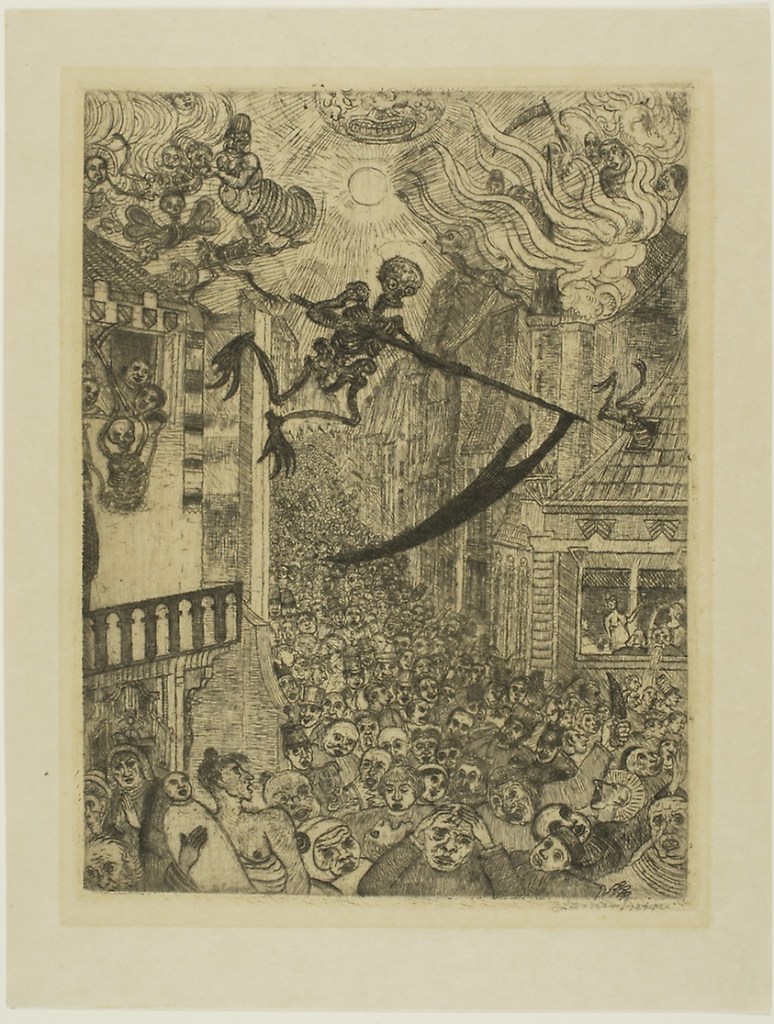
Death chasing a flock of mortals by James Ensor

The Readings: Ecclesiastes 2:16-26; Galatians 1:18––2:10; Matthew 13:53-58

Death is a deal-breaker in Ecclesiastes, but not in Proverbs. Why? Part of the answer may lie in the difference between the worlds implied in the two books. Here are a couple characteristic contrasts:

“The memory of the righteous is a blessing, but the name of the wicked will rot.” (Prov. 10:7)

“For there is no enduring remembrance of the wise or of fools.” (Eccl. 2:16a)

“Train children in the right way, and when old, they will not stray.” (Prov. 22:6)

“I hated all my toil in which I had toiled under the sun, seeing that I must leave it to those who come after me — and who knows whether they will be wise or foolish?”  (Eccl. 2:18-19a)

And with the social world becoming less stable, the sense of self links less to the multi-generational community, more to the individual—which can also shift perceptions of what counts as justice. Jeremiah: “In those days they shall no longer say: ‘The parents have eaten sour grapes, and the children’s teeth are set on edge.’ But all shall die for their own sins; the teeth of everyone who eats sour grapes shall be set on edge” (31:29-30).

The world of Proverbs may feel like a more comfortable world— “Nice work if you can get it”—but it’s Ecclesiastes that sets death up as the enemy, with its conqueror not yet on the horizon.

Re the Daily Office Readings June 1 Anno Domini 2020

St Mark’s Cathedral, Venice

The Readings: Ecclesiastes 2:1-15; Galatians 1:1-17; Matthew 13:44-52

In the first two chapters—and only there—the speaker adopts a royal persona (“the son of David, king in Jerusalem”), thus the traditional identification of Solomon as the author. “Then I considered all that my hands had done and the toil I had spent in doing it, and again, all was vanity and a chasing after wind, and there was nothing to be gained under the sun.” Why, wondered early readers, would Solomon say that?

Early Jewish interpretation, preserved in an Aramaic paraphrase (the Targum), provides one answer: ”When Solomon the King of Israel foresaw, by the spirit of prophecy that the kingdom of Rehoboam his son would be divided with Jeroboam the son of Nebat, that Jerusalem and the holy temple would be destroyed, and that the people of Israel would be exiled, he said by the divine word, ‘Vanity of vanities is this world! Vanity of vanities is all which I and my father David strived for. All of it is vanity.’”

Well, even if we don’t follow the Targum in making Solomon a prophet, the Targum’s picked up on one of the book’s central themes: our works don’t last. They turn out to be no more substantial than hebel (‘breath’, ‘vanity’, etc.). Recall Shelley’s Ozymandias with its line “Look on my works, ye mighty, and despair.”

So what? Perhaps (1) O Hearer, if this is Solomon’s verdict, what does this say about the toil you’re investing in your more modest projects? And (2) O Hearer, perhaps Solomon will help you properly evaluate the conspicuous consumption practiced by the movers and shakers in your time?

What do you see?