“Surely the Lord is in this place—and I did not know it” (Gen 28:16). Here we wonder about encountering G-d at the intersection of Bible and Life–typically prompted by the (Episcopal) Book of Common Prayer.
The structure—not the conclusion—of today’s Romans text should feel familiar to anyone who’s called Technical Support re some computer or mechanical problem. Paul outlines how the process is supposed to work (vv.14-15), acknowledges that it isn’t (vv.16-17), and trouble-shoots, searching for where the process is breaking down (vv.18-21). The analogy breaks down in vv.18-21, because the texts Paul chooses—perhaps inviting the hearer to retrace Paul’s own process of discovery—is that this breakdown (the lack of response [10:16] or, more precisely, the Gentiles attaining righteousness and Israel not [9:30-31]) is also foreseen. It’s not a bug; it’s a feature. And Paul will devote the next chapter to exploring this “feature.” Stay tuned.
“The righteousness that comes from the law” (v.5); “the righteousness that comes from faith” (v.6): judging by the epistle itself, bringing/keeping this contrast in focus was not a simple matter. “Should we continue in sin in order that grace may abound?” (6:1) “Should we sin because we are not under law but under grace?” (6:15) So, while today’s text does not lack elements that might keep us occupied…
Would it help to notice some of the things Matthew does with righteousness and the law? (“Some” so as not to commit to a book-length post!). For example:
Matthew starts his story by introducing Joseph as a “righteous man,” whose response to Mary’s pregnancy is to plan to break off the engagement quietly. An angel sets him on a different course, which may prompt the reader to wonder if this divine initiative is going to unsettle other assumptions regarding righteousness.
“…unless your righteousness exceeds that of the scribes and Pharisees, you will never enter the kingdom of heaven” (5:20)—and the examples which follow take our notions of righteousness in unexpected directions.
At the end of an interchange with the Pharisees: “Go and learn what this means, ‘I desire mercy, not sacrifice.’ For I have come to call not the righteous but sinners” (9:13).
It looks like the question of what righteousness God (now?) requires is central to Matthew. So how is this question like or unlike the question(s) Paul is dealing with in Romans?
Shifting gears, Byrne makes an important observation re “zeal” (v.2): “While it is true that nothing masks human need for the gift of salvation so successfully as misguided religious zeal, that failure is not tied to any particular religion nor is the faith that overcomes it tied to any particular religious system—Christianity or any other. Both attitudes are possible within theistic systems and both are equally possible within Judaism and Christianity.”
God as potter, humans as clay: various Old Testament texts use the image (e.g., Isa 29:15-16; 45:9-11; 64:8-9; Jer 18:1-12). If the issue here is God’s right to incorporate the gentiles as gentiles into God’s people, the most relevant parallel is Isa 45:9-11, which looks like a response to questions about God’s right to name the pagan Cyrus “the anointed” (Messiah!) to redeem Israel.
Works vs. faith in vv.31-32a: it’s probably too simple to interpret this simply as competing strategies for Torah implementation: implementation for the purpose of excluding vs including the Gentiles. But Torah (or Gospel) as instrument of exclusion or inclusion is not irrelevant either.
Verses 32b-33 merge Isa 8:14 and 28:16. There’s evidence that some of Paul’s contemporaries were reading both texts as messianic, so it would make historic sense to read the stone as Jesus. So we might wonder: what relation—if any—is there between Paul’s faith/works contrast and the issues the Gospels portray as separating Jesus and his religious opponents? (More on this tomorrow.)
Postscript: I have been looking for a reading of Paul that renders his various statements about the law consistent. The challenges of that search have me currently reading E. P. Sanders’ Paul, the Law, and the Jewish People, who argues that Paul’s consistency consists in a number of central convictions, e.g., “that God had sent Jesus Christ to provide for the salvation of all; that salvation is thus available for all, whether Jew or Greek, on the same basis,” that God does things for good reasons, and works back from these to offer different (inconsistent) answers to questions like what is the law for, in what does Israel’s failure consist. Clearly a perspective worth considering.
Readers have long recognized Romans 9-11 as a unit. In recent decades many readers have recognized the ways the unit integrally relates to the rest of the book, rather than being a dispensable digression.
Prior to engaging the individual parts of the unit, it’s probably helpful to read Rom 9-11 in a single sitting to get a sense of where Paul is going with the argument. Paul sets himself an ambitious challenge: how to make sense of the large number of Jews who do not recognize Jesus as Messiah. As Byrne notes, the problem is theodicy: “If the divine ‘word’ spoken to Israel appears to have been so ineffective (9:6a), where does this leave God’s faithfulness?” After working through the chapters we may make our own judgments regarding Paul’s success.
Working through the chapters we may wonder what Paul would have written after twenty centuries of sorrow- and anguish-producing Jewish/Christian history.
“For not all Israelites truly belong to Israel” (v.6b). The claim is similar to that of 2:25-29. And as with that text, it is not clear what Paul gains with the claim.
“So then he has mercy on whomever he chooses, and he hardens the heart of whomever he chooses” (v.18). Here it’s probably important to let Paul’s description of God’s righteousness and love in chapters 1-8 scatter our theological nightmares (e.g., “double predestination”).
It looks like Paul could have gone directly from 8:30 to 9:1. But, something like the doxology ending chapters 9-11, he goes for a summary. “God is for us… the love of God in Christ Jesus our Lord.” These affirmations, bookending the section, might be the most important thing to hear in chapters 1-8, chapters in which it’s so easy to lose the thread in the density of the theological argument or to simply fall asleep, as did Eutychus that night in Troas (Acts 20:7-12). “God is for us.”
“Who will separate us from the love of Christ?” Speaking personally, the one serious candidate I’m aware of is the guy who meets me in the mirror each morning, who regularly confesses “We have not loved you with our whole heart; we have not loved our neighbors as ourselves.” And that, in turn, sends me back to Ps 23. (Paul did, after all, introduce Jesus by recalling David [1:3], with whom Ps. 23 is associated. Pure speculation: if Paul had wanted to update Ps 23, today’s text could have been the outcome.) “Yes, goodness and faithful love will pursue me all the days of my life…” (Common English Bible; my italics). So while that guy in the mirror is not to be underestimated, God is giving his salvation God’s best shot. Ditto each of that guy’s neighbors. “God is for us.”
“Why is the author saying this here?” I don’t know if it’s possible to ask this question too often. Re today’s Romans text, it helps me recognize that vv.26-30 are tightly connected to the previous verses, rather than, say, v.28 as a stand-alone consolation for Difficult Times, and vv.29-30, a Handy Summary of the Process of Individual Salvation.
The previous verses: regularly encountering suffering and futility, together with the whole creation we’re groaning, even as we await the redemption of our bodies. In that situation we regularly don’t know how to pray, and in the midst of our weakness and incoherence the Spirit is interceding. That part of prayer that I find the least satisfying and could judge the least productive is where the Spirit is actively engaged.
And it’s in these least satisfying and apparently least productive situations in which God is working all things for good.
These least satisfying and apparently least productive situations: they’re part of being “conformed to the image of [God’s] Son, a process in which God’s initiatives restore, rather than threaten, my agency.
And glory, with which the text ends? I think Wright nails it: “the purpose is never simply that God’s people in Christ should resemble him, spectacular and glorious though that promise is. As we saw in vv. 18-21, it is that, as true image-bearers, they might reflect that same image into the world, bringing to creation the healing, freedom, and life for which it longs. To be conformed to the image of God, or of God’s Son, is a dynamic, not a static concept. Reflecting God into the world is a matter of costly vocation.”
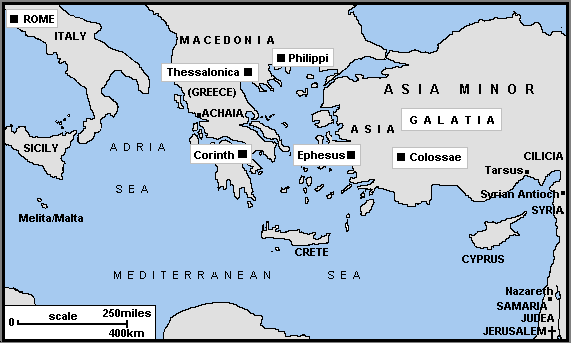
In today’s second reading Luke summarizes Paul’s stay in Ephesus. The Lectionary assigns vv.11-20; since we’re reading through Romans, it may be useful to read vv.1-22, and wonder how Luke’s portrait might relate to our encounter with Paul as author of Romans. For example, Paul describes the gospel as “the power of God for salvation to everyone who has faith” (1:16), and toward the end of the letter says “For I will not venture to speak of anything except what Christ has accomplished through me to win obedience from the Gentiles, by word and deed, by the power of signs and wonders, by the power of the Spirit of God, so that from Jerusalem and as far around as Illyricum I have fully proclaimed the good news of Christ” (15:18-19). Perhaps Luke’s portrait gives us some idea of the sorts of experiences of power that lie behind Paul’s words.
Hear the word of the LORD, O people of Israel; for the LORD has an indictment against the inhabitants of the land. There is no faithfulness or loyalty, and no knowledge of God in the land. Swearing, lying, and murder, and stealing and adultery break out; bloodshed follows bloodshed. Therefore the land mourns, and all who live in it languish; together with the wild animals and the birds of the air, even the fish of the sea are perishing. (Hos. 4:1-3)
As the ecologists remind us, everything is connected to everything, and so the effects of human rebellion ripple out through all creation. And in today’s Romans text Paul looks forward to the healing of the damage occasioned by the rebellion described in chapter 1. Notice the vocabulary links: ‘creation’ (1:20, 25; 8:20-22), ‘futility’ (1:21; 8:20), ‘to glorify’ (1:21; 8:30), ‘glory’ (1:23; 8:18, 21), ‘image’ (1:23; 8:29), ‘bodies’ (1:24; 8:24) (Dunn).
Meanwhile, creation groans; we groan. This text: an underutilized resource both for spirituality (checking any cheap triumphalism) and ecological ethics. Arguably, a single subject: we are ˀādām (human) from the ˀădāmâh (humus): how could our healing/redemption not be connected?
Meanwhile, for the current administration’s rollback of multiple environmental protections, here and here. Happy July 4th!
With Wright, the Romans text does sound like Exodus 2.0, with the people guided not by pillars of cloud and fire, but by the Spirit toward the promised inheritance, with Ex 4:2 (“Israel is my firstborn son”) one of the sources words like ‘adoption’ and ‘children’. The last is particularly striking: the Father “sending his own Son” (v.3) and us “in Christ Jesus” (v.1) described through another series of verbs with ‘sun’ (‘with’) prefixed (see June 27 post): inheriting with Christ, suffering with Christ, being glorified with Christ.
“Crying out ‘Abba [Aramaic] Patēr [Greek]’”—what would it take to recover this as a central celebration of our identity?
They say that there are two seasons in Wisconsin: Winter and Road Construction. That’s not a bad analogy for what Paul’s describing here. To recap, two epochs, Adam and Christ (5:12-21), and since the latter has invaded the former, we straddle both, with schizoid experiences of ourselves (delighting in the good, doing evil) and of Torah (a delight—“the law of the Spirit of life in Christ Jesus” and coopted by sin—“the law of sin and death”). But this straddling isn’t the last word, and the Spirit will supervise the construction until all is renewed.
“If the Spirit of him who raised Jesus from the dead dwells in you, he who raised Christ from the dead will give life to your mortal bodies also through his Spirit that dwells in you.” So road construction is a weak analogy; caterpillar to butterfly might be better—and only the beginning.