Readings (Track 1)
A moment ago we heard Jesus saying “You know that among the Gentiles those whom they recognize as their rulers lord it over them, and their great ones are tyrants over them. But it is not so among you…” On the heels of the Lord’s speech in Job we might wonder if “lord it over them” and “tyrants over them” isn’t a pretty good description of the Lord’s conduct in our first reading. That’s the challenge (invitation?) these texts pose to our imaginations, our ways of making sense of what the whole biblical story comes to.
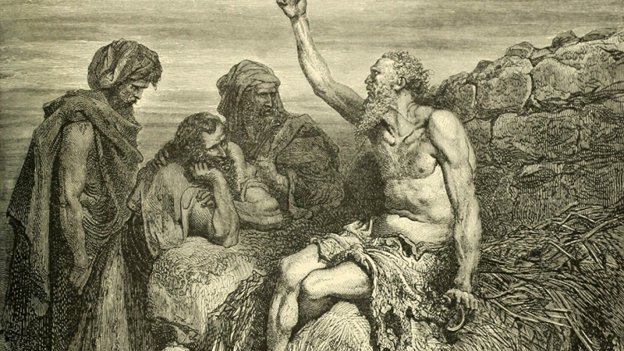
The Lord’s “Where were you…” in our first reading can be interpreted as browbeating. In this interpretation the Lord finally aligns with Job’s friends. Of them G. K. Chesterton writes “All that they really believe is not that God is good but that God is so strong that it is much more judicious to call Him good.”[1] But in the last chapter the Lord says to Eliphaz the Temanite: “My wrath is kindled against you and against your two friends; for you have not spoken of me what is right, as my servant Job has,” so that interpretation is a non-starter. Something else, something more interesting is going on, the Lord engaging Job in a serious conversation about just how the Lord is supposed to serve these unruly humans.
The God portrayed in Job—in the Old Testament, for that matter—can be interpreted in multiple ways. I believe that here—as elsewhere—Jesus guides our interpretation. In the Gospel of John we hear Jesus’ “The Father and I are one” (10:30), or, more pointedly, “Whoever has seen me has seen the Father” (14:9). As we heard two weeks ago, the Epistle to the Hebrews fleshes this out: “He [Jesus] is the reflection of God’s glory and the exact imprint of God’s very being” (Heb. 1:3). So if Jesus came “not to be served but to serve,” that’s probably what the Father has been about—even in dealing with Job. The alternative would be some cosmic version of Good Cop/Bad Cop, the Son playing Good Cop, the Father, Bad Cop.
So how do we read/interpret how God plays the divine role in our day-to-day? The combination of our Job and John readings invite us to give this some ongoing attention. And our psalm, Psalm 104, shows us what that might look like: God’s creation, not something stuck way back when, but an ongoing exercise in generosity, in service. If we’re fortunate this is the way we’re experiencing the world, and I’m preaching to the choir. But our culture’s winds push us in other directions: nature (not creation) as arbitrary, the god of the Christians as just another tyrant to be sidestepped or appeased. So for many of us it’s a conscious exercise in recovery, because most of the reinforcement of our mental models happens at the pre-conscious level.
So some form of Morning Prayer—and there are many possible forms—is a core part of our tradition, in which we’re reminded—daily—that how we experience the world also involves our choices.
All this is not to discount the abundant evil and pain in the world. It is to declare—to celebrate—that the evil and pain are not the baseline. Our God’s ongoing generosity and service as experienced also in creation: that’s the baseline. A near-contemporary celebration of this that regularly finds its way into my morning prayers is Gerard Manley Hopkins’ poem “God’s Grandeur,” with which I close.
God’s Grandeur[2]
The world is charged with the grandeur of God.
It will flame out, like shining from shook foil;
It gathers to a greatness, like the ooze of oil
Crushed. Why do men then now not reck his rod?
Generations have trod, have trod, have trod;
And all is seared with trade; bleared, smeared with toil;
And wears man’s smudge and shares man’s smell: the soil
Is bare now, nor can foot feel, being shod.
And for all this, nature is never spent;
There lives the dearest freshness deep down things;
And though the last lights off the black West went
Oh, morning, at the brown brink eastward, springs —
Because the Holy Ghost over the bent
World broods with warm breast and with ah! bright wings.
And the neat thing: this remains true no matter what happens on November 5.
[1] From his “Introduction to the Book of Job” (https://www.chesterton.org/introduction-to-job/).
[2] From https://www.poetryfoundation.org/poems/44395/gods-grandeur.
 With Jacob at Bethel