Lessons (but reading all of 2 Samuel 6)
These last two weeks David and Jerusalem have been centerstage as David captures Jerusalem (last Sunday’s reading) and brings the Ark into it (today’s reading). In our days is there a city more contested? So what might these stories of its early history suggest to us?
And in our first reading the Revised Common Lectionary has—probably inadvertently—raised a second question: how do we recount our histories? The difference between the full chapter and the parts selected by the RCL is dramatic. In our days, renewed energy around the questions of what’s in our high school history books, what monuments we keep or tear down, what names we keep on military bases, schools, etc. or not. And again, what might the 2nd Samel texts suggest to us?
David and Jerusalem. Last week narrated David’s taking of Jerusalem. What was that about? Well, why is our capital in Washington D.C.? In our new nation, trust between the states was low enough that the only feasible site for a national capital was a new city unclaimed by any of the states. So Washington was founded in 1791. Tribe is pretty much everything in David’s time; from where will he rule? Jerusalem, centuries after Joshua, was still controlled by the Jebusites. David takes it; it becomes the City of David. That solves that political problem. But it creates a new political problem: what does Jerusalem have to do with Moses, with Israel’s faith? Outside of that strange story about Abram and Melchizedek (Genesis 14), nothing! So now the Ark, a central symbol of that faith, becomes Really Important.
So David organizes an impressive procession, cut brutally short by Uzzah’s death. It’s a divine shot across David’s bow: is David the Lord’s patron or the Lord David’s? It’s hard on Uzzah; subjects often suffer for the sins of their sovereigns. We trust that the Lord has or will make things right with Uzzah. David, the narrator tells us, was afraid of the Lord, and asks the right question: “How can the ark of God come into my care?” We wish that David had asked that question more often.
Anyhow, the procession is put on hold—until David hears that “the Lord blessed Obed-edom and all his household.” David responds, leaving us wondering whether greed has trumped fear. He organizes an even more elaborate procession. Multiple sacrifices, with David in an ephod (typically a priestly garment) dancing before the Lord “with all his might,” more sacrifices, a blessing on the people, and a meal for all. The narrator has given us a thoroughly ambiguous picture. It’s clearly a high point for David. Equally clearly, that nagging question of whether the Lord is David’s patron or vice versa remains open.
The narrator’s chosen to give us an account that raises as many questions as it answers. And were that not enough, the narrator choses to include Michal’s reaction. Michal, Saul’s daughter, David’s first wife. She’d saved David’s life when Saul sent to have him killed. Saul had later given her to another man. David, now with various additional wives, had demanded her return as the price of peace with Saul’s house. Michal’s response to David may have been fully justified, but it was not smart. Kings are not hard to manipulate—just ask Herodias (today’s Gospel reading)—but you have to be smart about it. In any case, the account ends “And Michal the daughter of Saul had no child to the day of her death.” Personal tragedy, but also national tragedy. A child of David and Michal might have held the tribes together. Instead, on David’s son Solomon’s death they split into North and South and spend as much time fighting each other as anyone else until they’re swallowed up by the Assyrians and Babylonians. For that matter, had David reciprocated Michal’s love, perhaps the sordid incident with Bathsheba could have been avoided.
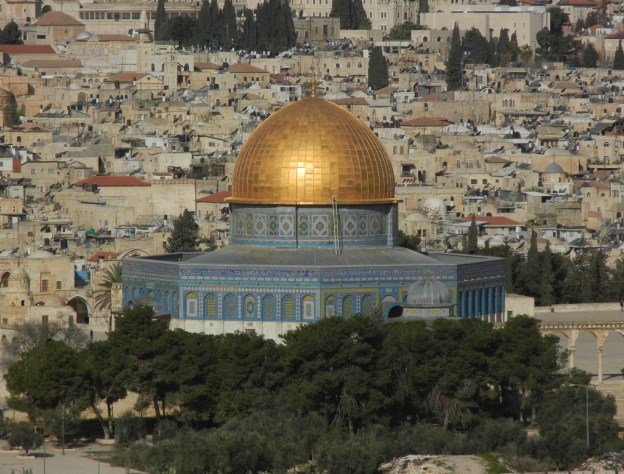
So, Jerusalem: chosen by David as a neutral city from which to rule the tribes, new home of the Ark through the convoluted process our text has narrated. And in the middle that haunting question after David collides with the Lord’s holiness: “How can the ark of God come into my care?” Jerusalem, often called the Holy City. Oh that the Jews and Muslims (and we Christians, for that matter) could so recapture a sense of God’s holiness that the arguments about Jerusalem would be: “You take it!” “No, you take it!”
As for David, what the narrator has done with David in this chapter the narrator does throughout Samuel and into the first chapters of Kings. There’s more than enough to celebrate in David, more than enough to mourn, more than enough to wonder about. So that’s one way to tell David’s story—the national story—not highlighting the messiness, but not leaving it out.
In the Gospels—particularly in Matthew—Jesus is addressed as “Son of David.” Thank God for the Books of Samuel that pretty much force Jesus to ask “Son of which David?” The David who faced down Goliath and danced in ecstatic abandon before the Ark or the David who arranged for the death of Uriah, Bathsheba’s husband, in battle? How we tell our stories can alert us or blind us to the choices facing us.
And when I look at my own life—thank God for the Books of Samuel. Not that I’ve generated the same quantity of headlines, but the messiness is certainly there, and the fact that God didn’t run away screaming from the unedited David gives me hope. In our second reading Paul speaks repeatedly of redemption: our lives are lives that need redemption, and Paul’s talking about more than the occasional failure to make a full stop before turning on a red light.
How shall we summarize? Early in our second reading we heard “just as he chose us in Christ…to be holy and blameless before him in love.” Not “because we were holy and blameless before him.” If we take that love seriously we can risk telling our stories not to vindicate ourselves, but to celebrate that love, and position ourselves to face life’s recurrent challenges. “Holy and blameless” is the goal. We’re not in 10th century b.c. Jerusalem or 1st century a.d. Ephesus, but the challenges then and now are often the same.
 With Jacob at Bethel