
Tag Archives: King David

Beginners at believing (11th after Pentecost, 8/4/2024)

Readings (Track 1)

What a combination of readings! We might title two of them “The Morning after the Night Before,” so let’s start there.

Last week we heard the story of Jesus feeding the large crowd. The starting point there as in the David story is divine generosity. Recall how Nathan’s oracle begins: “I anointed you king over Israel, and I rescued you from the hand of Saul; I gave you your master’s house…” Now the crowd has followed Jesus, and Jesus tries for a debrief: what was yesterday all about?

Jesus leads with this: “Very truly, I tell you, you are looking for me, not because you saw signs, but because you ate your fill of the loaves.” Nothing wrong with eating one’s fill, but if the conversation—if the relationship—stays at that level, it doesn’t have much of a future. It’s where many of Jesus’ interactions with folk—then and now—start, with our needs as we define them. And Jesus, being generous, will start there. But if that’s where things stay—my needs as I define them—then there’s about as much future there as in any relationship. Within that framework Jesus is at most one of many possible means to fulfill my ends.

Jesus’ statement gives us a way of wondering about how David got so badly off track. “I anointed you king over Israel, and I rescued you from the hand of Saul; I gave you your master’s house…” David more than got his fill, but did he wonder about what the Lord wanted out of the relationship? Perhaps not often enough. Not often enough for Uriah the Hittite. But David chose not to disappear Nathan for his unwelcome words. David chose to repent—recall our psalm. So David ends as a figure of hope, and as a model for the serious acts of repentance most of us need from time to time.

A bit later in the conversation with the crowd: “This is the work of God, that you believe in him whom he has sent.” ‘Believe’: that’s one of this Gospel’s favorite words (32 times in the first three Gospels combined, 85 times in John). Oddly, John never bothers to define it, which may be one source of the arguments regarding how faith and works relate in the rest of the New Testament. Perhaps he thought he didn’t need to. Consider the word’s first occurrence in the Old Testament. Abram’s been in the Promised Land for a good stretch, but no children and he asks what’s going on. At the end of the dialogue: “And he believed the LORD; and the LORD reckoned it to him as righteousness” (Gen. 15:6). It’s more than a mental act; it’s deciding whether to keep trusting or head back to civilization. Later it shows up in the wilderness after the spies’ pessimistic report regarding the land. “And the LORD said to Moses, ‘How long will this people despise me? And how long will they refuse to believe in me…’” (Num. 14:11). Again, more than a mental act: the people are ready to stone Moses and Aaron and to choose someone to lead them back to Egypt! So, back to John: believing in Jesus means trusting Jesus, particularly when that trust looks like a really bad idea.

So, in our context: believing is more than a hoop I’m supposed to jump through. How easy it is for baptism or confirmation to become hoops! That works about as well as treating marriage as a hoop, rather than as setting the agenda for the rest of one’s life. “This is the work of God, that you believe in him whom he has sent.” Believing in Jesus, trusting Jesus: paying attention to what Jesus is up to, letting him turn our world upside down and inside out multiple times so that at last we become, well, human.

Become human, or, in Paul’s language, “grow up in every way into him who is the head, into Christ.” And because God is generous, because, as Paul spells out, God has showered all of us with gifts, this is doable. We’re on a trajectory toward life. Hallelujah? Hallelujah!

Now, in closing, two things to notice about Paul’s vision. First, this life “worthy of the calling” is inescapably corporate. This contrasts with the scripts that reduce the faith to me and Jesus, which in Episcopal circles can translate into “my spirituality is my affair and all I ask of others is that they not make noise.” This life is corporate. The gifts I receive are gifts my neighbor needs and vice versa. Aristotle got it right: the human being is a political animal, an animal of the polis, and God builds on that. Besides, the endgame is a banquet, a celebration, and who wants to party alone?

Second, the older we get (sorry!) the stronger the temptation to set everything on cruise control. So notice Paul’s language: “We must no longer be children, tossed to and fro and blown about by every wind of doctrine, by people’s trickery, by their craftiness in deceitful scheming. But speaking the truth in love, we must grow up.” Here Paul is at his most diplomatic, so diplomatic that we can miss the point. Shorn of the diplomatic padding: “Grow up!” And when I find that discouraging or off-putting, I’m reminded of Thomas Merton’s observation in talking about prayer: “We do not want to be beginners. But let us be convinced of the fact that we will never be anything else but beginners, all our life!” (Contemplative prayer p.37)

“This is the work of God, that you believe in him whom he has sent.” In the coming week we’ll have multiple opportunities to do that work; may we stay awake enough to recognize them.
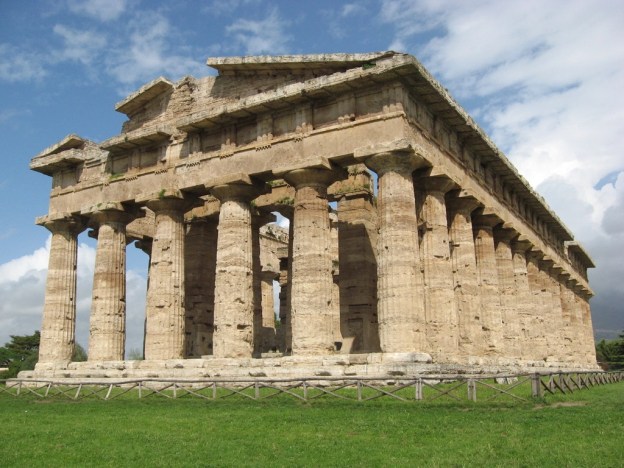
What’s the temple that God wants? (9th after Pentecost, 7/21/2024)

The Readings (Track 1)

We’re going to give the lion’s share of attention to the Ephesians reading, but, first, a bit of muddling around in the other readings.

Tour guides often have pages like “If you have only one day in New York…” Any equivalent guide to the Old Testament would include our first reading. God’s promise to David of an eternal house (dynasty) is the basis for all the hopes for a coming son of David. It’s the reason ‘Messiah’/’Christ’ (the anointed one) is such a key title. It starts here with Nathan’s words to David.

One element worth noticing in Nathan’s words is the repeated reference to houses of cedar (houses at the high end of the market): “See now, I am living in a house of cedar, but the ark of God stays in a tent.” “…did I ever speak a word with any of the tribal leaders of Israel, whom I commanded to shepherd my people Israel, saying, ‘Why have you not built me a house of cedar?’” There is probably some exasperation in God’s response: I don’t need a house of cedar; why do you think you need a house of cedar? Why this question? Consider, a few centuries later, Jeremiah’s words (22:15) to the current Davidic king: “Are you a king because you compete in cedar?” This is the sort of question God directs to many of us from time to time: “Tom, why do you think you need…?” The Book of Proverbs nails it:

7 Two things I ask of you;
do not deny them to me before I die:
8 Remove far from me falsehood and lying;
give me neither poverty nor riches;
feed me with the food that I need,
9 or I shall be full, and deny you,
and say, “Who is the LORD?”
or I shall be poor, and steal,
and profane the name of my God. (30:7-9)

So Paul, in the other Testament: “for I have learned to be content with whatever I have” (Phil 4:11). That’s a hard sell in this culture, but probably necessary for our sanity and sanctity.

The Gospel. The omitted verses (vv.35-52) mostly narrate the feeding of the five thousand. The lectionary omits these because in the next five weeks we’ll be hearing John’s narrative. That’s fair, but misses Mark’s mischievous juxtaposition of the two feasts: Herod’s, in which John the Baptist loses his head, and Jesus’, in which five thousand are fed. Mark’s suggesting, I think, that we need to choose which feast we end up at, a choice not unrelated to our ability to say “enough.”

In our first reading house as temple and house as dynasty contrast: David won’t build God a house (temple); God will build David a house (dynasty). But as Ephesians makes clear, God’s option for the dynasty gets God the temple God really wanted: “In him [David’s son, the Messiah] the whole structure is joined together and grows into a holy temple in the Lord; in whom you also are built together spiritually into a dwelling place for God.”

“You also.” Throughout the chapter Paul’s focused on the Jew/Gentile division, now abolished through the generous and costly work of the Messiah. In this vision the Jews don’t stop being Jews; the Gentiles don’t stop being Gentiles. But in Jesus these differences no longer divide, no longer fuel enmity. And Jew/Gentile is paradigmatic for the many divisions in our world.

“Built together spiritually into a dwelling place for God.” Our building projects usually seek homogeneity. It’s simpler that way. “Birds of a feather…” But that’s not Paul’s vision: Jews and Gentiles, male and female, slave and free. One commentator, Marcus Barth, puts it this way: “There is no ideal of a Christian personality applicable to all church members alike, but there are men, women, children who because of their diverse origins, pasts, privileges, hopes, or despairs are by nature inclined to hate one another and God (Rom 5:6-10). Now they are enabled by the work and rule of Christ to contribute in common repentance and common faith their various idiosyncrasies, histories, experiences, and gifts to the peaceful common life of God’s people” (Ephesians 1-3, 311).

“Built together spiritually into a dwelling place for God.” That word ‘spiritually’ can trip us up. It’s not a synonym for ‘immaterial’. Barth again: “The people of God who are built together and become God’s house—the church—are as material, temporal, spatial, and concrete as sticks and stones” (Ephesians 1-3, 320).

“Spiritually,” because only the transformative power of the Holy Spirit can give this mad project any chance of success. At the beginning when all was waste and void, darkness on the face of the deep, God sent the Spirit. And today the Spirit continues to assist in the heavy lifting.

“Assist.” I use that word cautiously. It’s not as though the Spirit does 50% and we do 50%. It’s that we really need to want this project to succeed, to put our backs into it. Building cross-culturally is hard work. But, recalling the original cross-cultural challenge, men being from Mars and women from Venus, oh the pay-off!

The temple, the meeting point of heaven and earth. God is happy for that to be at the corner of Nelson Drive & Highway 83; God has no interest in it being only there. The vision is that the temple, the meeting point of heaven and earth, be everywhere we are 24/7, so that there is no place that the glory, mercy, love of God is not visible and tangible. So that we—to pick up Paul’s language from last week’s reading—“might live for the praise of his glory.”

Glory & Absurdity (4th Sunday of Advent)

Readings

The texts still ringing in our ears suggest point and counterpoint (on the one hand… on the other hand…). On the one hand, we celebrate the glorious history of our salvation. And it is glorious. About ten centuries before Jesus, the Lord promised to David, King of Israel and Judah, an eternal dynasty. And despite all the wars, a long exile, and all the other vicissitudes that accompany life, the Lord fulfills this promise, as the Gospel reminds us: “behold, you will conceive in your womb and bear a son, and you shall call his name Jesus. He will be great, and will be called the Son of the Most High; and the Lord God will give to him the throne of his father David, and he will reign over the house of Jacob for ever; and of his kingdom there will be no end.” And this is a reign not only over the house of Jacob. His reign will include all nations, and for this reason one of his servants, Paul, writes to the Christians in the capital of the Roman Empire, which letter we know as “Romans.” “Romans.” Every time we use this name it’s an invitation to recall something of the daring of this letter, directed to the capital, and proclaiming a future for the human race that ignores completely the pretensions of empire. That empire fell—in the West—in the fifth century, and fifteen centuries later the followers of Jesus compose more than 30% of the world’s population and are found in every country of the world.

Yes, it is a glorious history. And we, like the recipients of Paul’s letter, are invited to sense some of this glory in the midst of all that passes for glory in our culture and world.

On the other hand, there’s the continuity between the experience of King David and the Virgin and our quite unglorious experiences on the other. That continuity…

David. King of Israel and Judah, as our lesson opens he’s now in a position to build a temple worthy of the Lord his God. To Nathan his prophet the project seems so obvious, so natural, that he doesn’t even think of consulting the Lord. “Go, do all that is in your heart; for the LORD is with you.” That very night the Lord sends a message to David via Nathan, a combination of good news and bad news. The bad news: you are not to build me a house (a temple); the good news: I will build you a house (a dynasty). This promise of an eternal dynasty sustains the people during the darkest moments of their history, and is the basis for the hope for the Messiah, Son of David.

At the same time, this “you are not to build me a house” represents an enormous danger. Why? Because at that time, the construction of a temple for the king’s god signaled the god’s approval of the king. And this was particularly important for David, who was not himself the son of a king. So not building a temple would be something like winning the presidential election, but not moving into the White House. “No, Mr. Putin, you won’t be visiting President Biden in the White House, but at the Holiday Inn.… It’s actually a very nice suite… OK, I’ll tell him that you won’t be coming at this time…” So David not building the temple places a large question mark over his entire reign, and this may have something to do with the number of rebellions he had to put down.

If we ask the reason for this prohibition, the text gives no clue. There are attempts to answer the question elsewhere in the Old Testament, but here, no.

Mary. Real estate agents tell us that the three most important factors for the value of a home are location, location, and location. In a society that values honor, like Mary’s society, the important factor in marriage is timing: first the marriage, then the pregnancy. This doesn’t seem all that complicated, even for the Lord. Nevertheless, for Mary the order is pregnancy, then marriage, which represents a permanent stain on both Mary’s and Jesus’ reputation. “We were not born of fornication” gets hurled in Jesus’ face (John 8:41).

Again, if we ask what this divine decision was about, we encounter only silence.

That is, both David and Mary experienced what we know all too well, these elements in our life that don’t appear to have any meaning, these absurd elements that hobble our efforts and threaten the most beautiful of our days.

As we recall this dimension in the history of David and Mary, we might recall something St Paul wrote: “And to keep me from being too elated by the abundance of revelations, a thorn was given me in the flesh, a messenger of Satan, to harass me, to keep me from being too elated. Three times I besought the Lord about this, that it should leave me; but he said to me, ‘My grace is sufficient for you, for power is made fully present in weakness.’ I will all the more gladly boast of my weaknesses, that the power of Christ may rest upon me” (2 Corinthians 12:7-9 [RSV*]).

I wonder if these lines from Paul have something to do with David’s and Mary’s experience.

“Too elated” is a wonderfully diplomatic phrase, something like Alan Greenspan’s “irrational exuberance.” If the Old Testament is any indication, it’s a regular problem for God’s people. Moses: “Take heed lest you forget the LORD your God… when you have eaten and are full, and have built goodly houses and live in them, and when your herds and flocks multiply, and your silver and gold is multiplied, and all that you have is multiplied, then your heart be lifted up, and you forget the LORD your God, who brought you out of the land of Egypt, out of the house of bondage” (Deut 8:11-14).“Too elated” indeed.

“Too elated” is not, of course, a typically Episcopal problem. We “solved” that problem when we drove out the Methodists a couple centuries back! So we can hear week after week that we are sons and daughters of the living God, that we can talk directly to our Creator without any intermediary, no roaming or data charges—and we’re not elated. This is not necessarily a good thing. It’s like being in the driver’s seat of a Ferrari or Jaguar and not being tempted to go even a mile over the speed limit. We could do with a bit more elation. But I digress.

Whatever we do with the earlier part of Paul’s text, his more general point “power is made fully present in weakness” speaks directly to David and Mary and each one of us.

It’s not the script most of us would have chosen. Supermanwould have been more like it. (And the nice thing about playing Superman was that all you needed was a towel with one of the narrow sides tied around the neck!) Power, power, and more power.

What Mary is presented with is rather different. All her weakness and vulnerability remain. But what will grow within her is nothing other than the Son of God. And through that One those lines from her song will be fulfilled: “He has cast down the mighty from their thrones, / and has lifted up the lowly. / He has filled the hungry with good things, / and the rich he has sent away empty.”

And what the angel presented to Mary, our gracious God presents to each one of us. The weakness and the vulnerability don’t disappear. But what God would grow within us and among us is nothing less than the down payment on the fulfillment of all the hopes and dreams captured in the carols we will start singing this evening.

The Christmas story gives the absurdity and the futility of the world its full due. If the stories of David, Mary, and Paul are any indication, God’s not above using some of that to prevent too much elation. But at the end of the day, neither the absurdity nor the futility get the last word. “Power is made fully present in weakness,” and through Mary’s “let it be to me according to your word” the Savior of the world is again at our doorstep.