Tag Archives: Leviticus 23

Re the Daily Office Readings May 16 Anno Domini 2020

From St James Episcopal Church, Goshen New York

The Readings: Leviticus 23:23-44; 2 Thessalonians 3:1-18; Matthew 7:13-21

The calendar laid out in Leviticus 23 invites reflection on our Christian calendar. Here’s another bit from Heschel’s The Sabbath, equally suggestive for us:

“Judaism is a religion of time aiming at the sanctification of time. Unlike the space-minded man to whom time is unvaried, iterative, homogeneous, to whom all hours are alike, qualitiless, empty shells, the Bible senses the diversified character of time. There are no two hours alike. Every hour is unique and the only one given at the moment, exclusive and endlessly precious.

“Judaism teaches us to be attached to holiness in time, to be attached to sacred events, to learn how to consecrate sanctuaries that emerge from the magnificent stream of a year. The Sabbaths are our great cathedrals; and our Holy of Holies is a shrine that neither the Romans nor the Germans were able to burn; a shrine that even apostasy cannot easily obliterate: the Day of Atonement. According to the ancient rabbis, it is not the observance of tile Day of Atonement, but the Day itself, the ‘essence of the Day,’ which, with man’s repentance, atones for the sins of man.”

Christmas, Epiphany, Easter, Ascension, Pentecost, Trinity, All Saints: each year we’re invited to reexperience these divine acts, and let their life-giving power bleed into the surrounding time.

When we gather together all this is visible in the changing colors on the altar and audible in the changing prayers. In this season of social distancing, where can we change the colors where we live? What other ways can we find to acknowledge and celebrate that Jesus in his flesh claimed our time, our calendars?

(P.S. Jesus claiming our calendars: that’s behind the recent change in the titles of these posts, reclaiming—and writing out in full—the old abbreviation “AD”: Anno Domini, “The Year of the Lord.” 2020 is the year of COVID 19, but that is not its primary identity.)

For more on the festivals in Leviticus 23: The Bible Journey; and Catholic Resources.
Re the Daily Office Readings May 15 Anno Domini 2020

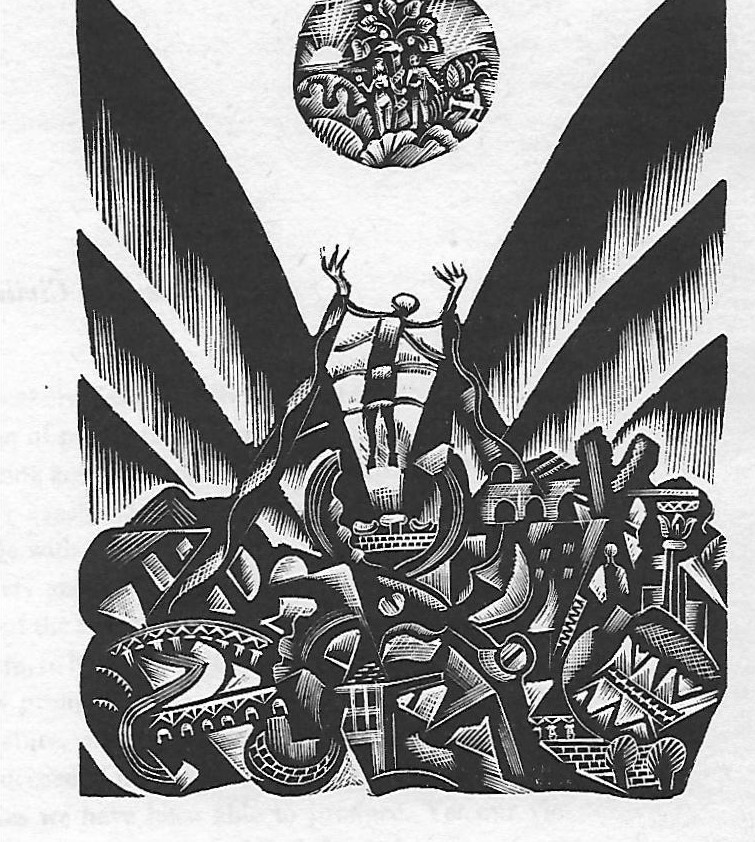
Wood Engraving by Ilya Schor in Heschel’s The Sabbath.

The Readings: Leviticus 23:1-22; 2 Thessalonians 2:1-17; Matthew 7:1-12

Leviticus 23 contains one of the Torah’s summaries of the major festivals. Our lectionary splits it between the Sabbath and Spring festivals (today) and the Fall festivals (tomorrow).

Readers whose introduction to the Sabbath is the arguments in the Gospels about permitted work and Paul’s arguments against the Gentile believers needing to observe the entire Law are liable to miss the joy, the spirituality, of the gift of the Sabbath. Abraham Heschel’s The Sabbath is a welcome corrective. Here’s a bit:

“According to the Talmud, the Sabbath is me’en ‘olam ha-ba, which means: somewhat like eternity or the world to come. This idea that a seventh part of our lives may be experienced as paradise is a scandal to the pagans and a revelation to the Jews. And yet to Rabbi Hayim of Krasne the Sabbath contains more than a morsel of eternity. To him the Sabbath is the fountainhead (ma’ yan) of eternity, the well from which heaven or the life in the world to come takes its source.

“Unless one learns how to relish the taste of Sabbath while still in this world, unless one is initiated in the appreciation of eternal life, one will be unable to enjoy the taste of eternity in the world to come. Sad is the lot of him who arrives inexperienced and when led to heaven has no power to perceive the beauty of the Sabbath.”

It is not necessary to define the precise relationship between the OT Sabbath and the Lord’s Day (Sunday) for Heschel to point us to a deepened appreciation of Sunday, the Eighth Day, the first day of the New Creation. At present we deeply miss being able to gather together on Sunday. But Sunday is exalted, a permanent source of joy and hope, not because we gather together. We have gathered together and will again gather together because it’s Sunday.

Better, recall that centuries before we celebrated Easter as an annual feast, we were celebrating Jesus’ resurrection—the inbreaking of the New Creation—every Sunday. So, for instance, we’d be quite justified in freeing the hymns filed under “Easter” (##174-213) for use on any Sunday. So, in the kitchen, Sunday is the day for the whole household to pull out all the stops. Every Sunday the ears of the chocolate Easter bunny may be at risk. Booze, bubble wands, fireworks: the current social distancing is our opportunity to find new ways to celebrate apart-and-together.

For more on Sunday, the Eighth Day, Preachers Institute, The Catholic Spirit.