Readings
Today we celebrate Trinity Sunday, one of the principal feasts of the Church. One God; Three Persons. But—with all due reverence—so what? There are many ways we might answer that question; here are a couple.
Confessing the Holy Trinity we say that before creation there is a community of love: Father, Son, Holy Spirit. That’s probably the most profound sense of the statement “God is love:” Father, Son, Holy Spirit in an eternal relationship of love. ‘Relationship’: that’s probably too weak a word. We might call it a banquet or a dance. And out of that love God creates our universe. Not out of lack or necessity (nothing is lacking) but out of desire to share that primordial love.
To share that primordial love: that’s the human destiny. It appears throughout Scripture; here are three examples. The first comes at the culmination of the Exodus at Sinai:
Then Moses and Aaron, Nadab, and Abihu, and seventy of the elders of Israel went up, and they saw the God of Israel. Under his feet there was something like a pavement of sapphire stone, like the very heaven for clearness. God did not lay his hand on the chief men of the people of Israel; also they beheld God, and they ate and drank. (Exodus 24:9-11)
The second, from the prophet Isaiah:
On this mountain the LORD of hosts will make for all peoples a feast of rich food, a feast of well-aged wines, of rich food filled with marrow, of well-aged wines strained clear. And he will destroy on this mountain the shroud that is cast over all peoples, the sheet that is spread over all nations; he will swallow up death forever. (Isaiah 25:6-8a)
The third, from the end of the Revelation given to St John:
The Spirit and the bride say, “Come.” And let everyone who hears say, “Come.” And let everyone who is thirsty come. Let anyone who wishes take the water of life as a gift. (Revelation 22:17)
The party’s been going on from all eternity; we’re invited to join in.
Now, a parenthesis which for some will be quite unnecessary, for others—like the preacher—quite necessary. One God; billions of people scattered over the centuries. How could that not end up being organized bureaucratically? Here’s where my imagination needs stretching. Jesus, it turns out, is aware of the problem:
Are not two sparrows sold for a penny? Yet not one of them will fall to the ground apart from your Father. And even the hairs of your head are all counted. So do not be afraid; you are of more value than many sparrows. (Matthew 10:29-31)
Even the hairs of my head: counted. Perhaps not surprisingly this personal dimension to the divine invitation is captured most vividly in the Old Testament’s portraits of Lady Wisdom: “She hastens to make herself known to those who desire her.… because she goes about seeking those worthy of her, and she graciously appears to them in their paths, and meets them in every thought. (Wisdom 6:13, 16)
Which brings us to today’s second theme. The first: the Holy Trinity’s breath-taking invitation. The second: we’re not left to respond to that invitation on our own, as we’ve heard in the readings from Romans and John. In Romans Paul speaks of the Spirit empowering our prayers. A bit later he talks of those frequent situations in which we don’t have the slightest idea how to pray:
Likewise the Spirit helps us in our weakness; for we do not know how to pray as we ought, but that very Spirit intercedes with sighs too deep for words. And God, who searches the heart, knows what is the mind of the Spirit, because the Spirit intercedes for the saints according to the will of God. (Romans 8:26-27)
In John’s Gospel Jesus uses the image of birth: “Very truly, I tell you, no one can enter the kingdom of God without being born of water and Spirit.” And so we baptize (with water) in the Name of the Father, Son, and Holy Spirit. Birth: that suggests a one-off event. In practice it tends to be a recurring event as we—picking up Paul’s language—repeatedly by the Spirit put to death those destructive habits that still form part of our character.
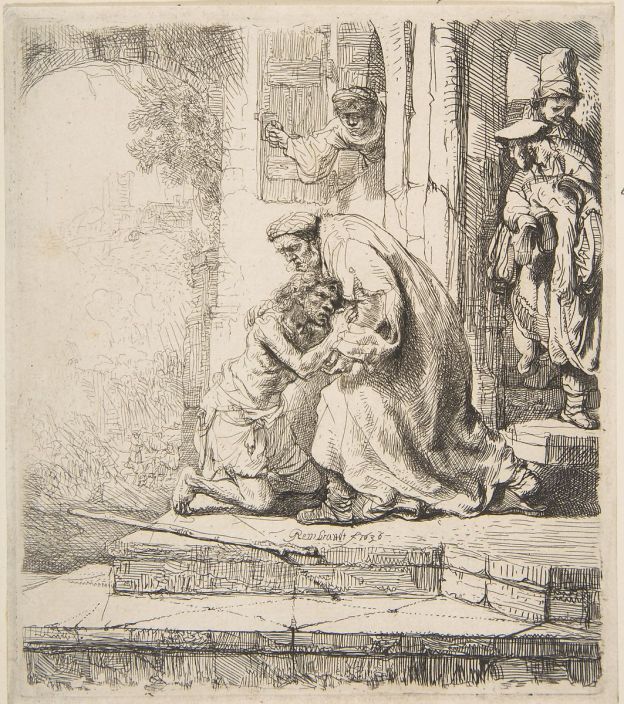
The Trinity’s breath-taking invitation, the Trinity’s daily assistance in responding to that invitation: that’s probably plenty for the sermon. But there’s that last bit in the Romans reading: “it is that very Spirit bearing witness with our spirit that we are children of God, and if children, then heirs, heirs of God and joint heirs with Christ– if, in fact, we suffer with him so that we may also be glorified with him.” Suffer with him? After all the talk of feast and banquet in the sermon, how’d that get in? A long answer would require another sermon; here’s the short answer. In Jesus’ parable that we usually call “The Prodigal Son” the Father wants both the younger prodigal son and the older self-righteous son at the banquet. But that’ll only happen if both recognize that the father’s love, forgiving, repaying evil with good, is an expression of strength, not weakness. That’ll only happen if both practice love in forgiving, in repaying evil with good.
The Holy Trinity wants us at the banquet. More precisely, us and our enemies at the banquet. But that’ll only happen if we recognize that the Trinity’s love, forgiving, repaying evil with good, is an expression of strength, not weakness. That’ll only happen if we’ve at least begun to practice that love in forgiving, in repaying evil with good. And that practice in this world means suffering—as every Eucharist reminds us.
The Holy Trinity, a community of love since before time, inviting us into that same community, empowering us through the Spirit to accept that invitation, empowering us through that same Spirit to walk in the way of forgiveness and repaying evil with good. If that’s not a reason to celebrate, I don’t know what is.
 With Jacob at Bethel