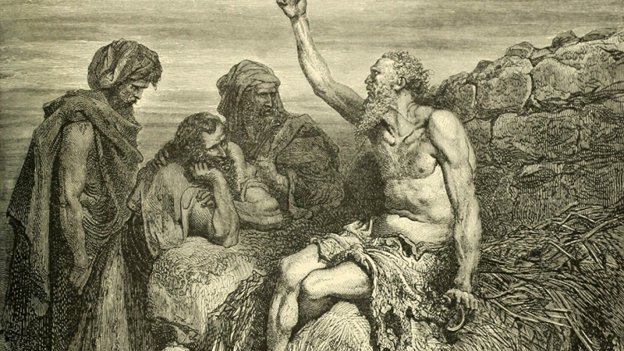
Job’s God, coming not to be served but to serve (22nd Sunday after Pentecost, 10/20/2024)

Readings (Track 1)

A moment ago we heard Jesus saying “You know that among the Gentiles those whom they recognize as their rulers lord it over them, and their great ones are tyrants over them. But it is not so among you…” On the heels of the Lord’s speech in Job we might wonder if “lord it over them” and “tyrants over them” isn’t a pretty good description of the Lord’s conduct in our first reading. That’s the challenge (invitation?) these texts pose to our imaginations, our ways of making sense of what the whole biblical story comes to.

The Lord’s “Where were you…” in our first reading can be interpreted as browbeating. In this interpretation the Lord finally aligns with Job’s friends. Of them G. K. Chesterton writes “All that they really believe is not that God is good but that God is so strong that it is much more judicious to call Him good.”[1] But in the last chapter the Lord says to Eliphaz the Temanite: “My wrath is kindled against you and against your two friends; for you have not spoken of me what is right, as my servant Job has,” so that interpretation is a non-starter. Something else, something more interesting is going on, the Lord engaging Job in a serious conversation about just how the Lord is supposed to serve these unruly humans.

The God portrayed in Job—in the Old Testament, for that matter—can be interpreted in multiple ways. I believe that here—as elsewhere—Jesus guides our interpretation. In the Gospel of John we hear Jesus’ “The Father and I are one” (10:30), or, more pointedly, “Whoever has seen me has seen the Father” (14:9). As we heard two weeks ago, the Epistle to the Hebrews fleshes this out: “He [Jesus] is the reflection of God’s glory and the exact imprint of God’s very being” (Heb. 1:3). So if Jesus came “not to be served but to serve,” that’s probably what the Father has been about—even in dealing with Job. The alternative would be some cosmic version of Good Cop/Bad Cop, the Son playing Good Cop, the Father, Bad Cop.

So how do we read/interpret how God plays the divine role in our day-to-day? The combination of our Job and John readings invite us to give this some ongoing attention. And our psalm, Psalm 104, shows us what that might look like: God’s creation, not something stuck way back when, but an ongoing exercise in generosity, in service. If we’re fortunate this is the way we’re experiencing the world, and I’m preaching to the choir. But our culture’s winds push us in other directions: nature (not creation) as arbitrary, the god of the Christians as just another tyrant to be sidestepped or appeased. So for many of us it’s a conscious exercise in recovery, because most of the reinforcement of our mental models happens at the pre-conscious level.

So some form of Morning Prayer—and there are many possible forms—is a core part of our tradition, in which we’re reminded—daily—that how we experience the world also involves our choices.

All this is not to discount the abundant evil and pain in the world. It is to declare—to celebrate—that the evil and pain are not the baseline. Our God’s ongoing generosity and service as experienced also in creation: that’s the baseline. A near-contemporary celebration of this that regularly finds its way into my morning prayers is Gerard Manley Hopkins’ poem “God’s Grandeur,” with which I close.

God’s Grandeur[2]

The world is charged with the grandeur of God.
    It will flame out, like shining from shook foil;
    It gathers to a greatness, like the ooze of oil
Crushed. Why do men then now not reck his rod?
Generations have trod, have trod, have trod;
    And all is seared with trade; bleared, smeared with toil;
    And wears man’s smudge and shares man’s smell: the soil
Is bare now, nor can foot feel, being shod.

And for all this, nature is never spent;
    There lives the dearest freshness deep down things;
And though the last lights off the black West went
    Oh, morning, at the brown brink eastward, springs —
Because the Holy Ghost over the bent
    World broods with warm breast and with ah! bright wings.

And the neat thing: this remains true no matter what happens on November 5.


[1] From his “Introduction to the Book of Job” (https://www.chesterton.org/introduction-to-job/).

[2] From https://www.poetryfoundation.org/poems/44395/gods-grandeur.

Jesus’ “Follow me:” Beyond Answers & Checklists (21st Sunday after Pentecost, 10/13/2024)

Readings (Track 1); expanded Hebrews reading here

Jesus, today’s Gospel tells us, loved the young man and offered him life. The young man loved other things, and declined the offer.

That scene is important for two reasons. It warns us of one possible outcome in our interactions with Jesus, and so is a narrative enactment of the warning on which the author of Hebrews is focusing: “Today, if you hear his voice, do not harden your hearts.” The second reason, the scene’s stress on Jesus’ love (“Jesus, looking at him, loved him”). We sometimes fear that God is playing “Gotcha,” looking for reasons to declare us guilty, and so read the text accordingly. Mark’s stress on Jesus’ love should save us from that misreading of both the Epistle and the Gospel.

Jesus loves the young man and offers him life; the young man loves other things and declines the offer. Why, we might wonder, does this scene repeat itself with such regularity that the author of Hebrews dedicates a much longer stretch of his letter than we read today to this warning (“Today, if you hear his voice, do not harden your hearts.”). The foundational answer, I think, is reflected in God’s words in Isaiah 55:

8 For my thoughts are not your thoughts,
nor are your ways my ways, says the LORD.
9 For as the heavens are higher than the earth,
so are my ways higher than your ways
and my thoughts than your thoughts. (Isa 55:8-9)

Recall Gregory of Nyssa: any god we could understand would not deserve our worship!

Now, in Isaiah 55 and Scripture in general “For my thoughts are not your thoughts, nor are your ways my ways” is good news. For instance, God does not “do” power like the self-proclaimed movers and shakers that fill our political landscape. But it also means that not understanding, being confused, is the normal experience of the people of this God, and we become less anxious as we approach getting used to this.

Let me unpack what I’m suggesting in a couple of ways, because this emphasis on Isaiah 55—and we could also recall St. Paul’s “For now we see in a mirror, dimly” (1Co 13:12)—runs counter to two popular ways of understanding our faith.

First, Isaiah 55 tells us that God’s not in the business of giving us the answers we want. Recall Job in our first lesson, or the psalmist’s multiple questions in Ps 22! Recall, for that matter, Jesus’ quite unnerving answer to the disciples’ question (“Then who can be saved?”…”For mortals it is impossible…”). Between our Bible (some 1600 pages) and the BCP (another 1000 pages), one might get the impression that being a Christian is a matter of having Answers. The more answers, the better!

But that’s to miss the point. Consider the Tabernacle, the place for a particular manifestation of God’s presence, described in detail in Exodus. Precise descriptions of the courtyard, the rooms in the Tabernacle, its furnishings, including the Ark of the Covenant with the two great creatures pointing toward the presence. But of the Presence itself, nothing. Or, better, when all is set up, Exodus tells us: “Then the cloud covered the tent of meeting, and the glory of the LORD filled the tabernacle. Moses was not able to enter the tent of meeting because the cloud settled upon it, and the glory of the LORD filled the tabernacle” (Exo 40:34-35). All the components of the Tabernacle: simply to guard the mystery.

Or consider the Nicene Creed. If we get under the hood, look at what motivated this particular collection of affirmations, we discover that virtually every line is to guard against a misunderstanding. So, the Bible, the BCP: resources to keep our questions alive, to pull us back from premature closure, and sometimes, maybe even often, to suggest new questions.

And before moving on, notice that Hebrews wants us to understand that Jesus fully entered into this human condition. (“For we do not have a high priest who is unable to sympathize with our weaknesses, but we have one who in every respect has been tested as we are, yet without sin.”) So Jesus on the cross makes his own the question with which Ps 22 opened. With all our questions and puzzlements we’re not in bad company.

Second, Isaiah 55 can help us guard against reducing the faith to a sort of checklist: baptism, first communion, confirmation, such that if we get everything ticked off we can go on autopilot. Baptism, for example, is as much about disorientation as it is about orientation. “N., you are sealed by the Holy Spirit in Baptism and marked as Christ’s own for ever.” So the parents’ and godparents’ hopes for the child are no longer the only hopes—or even the primary hopes—in play.

Now, if the faith isn’t about a growing tidy set of answers or a cradle-to-grave checklist, what is it? Notice that—back to the scene with Jesus and the young man—the central metaphor is “follow me.” Follow—well, start learning how to follow—this unpredictable God whose ways are not ours. In the section of the Gospel from which this reading is taken we’ve been watching this “follow me” play out as Jesus works at reducing the distance between his ways and the disciples’ ways:

No, arguing about who’s the greatest is not helpful

No, forbidding others from using Jesus’ name because they’re not “with us” is not helpful

No, keeping little children away from Jesus isn’t helpful either.

And in today’s Gospel, notice how this plays out immediately after the Jesus and young man scene. When Jesus describes how difficult it is for the rich to enter the kingdom, the disciples ask “Then who can be saved?” They assume that the rich have the inside track, because the rich have the leisure to study Torah and the wherewithal to ensure compliance with all the traditions.

Equally important, notice that Jesus doesn’t respond to their question by talking about the poor having the inside track. So, while some may properly hear Jesus’ command to sell everything as addressed to them—St. Francis comes to mind—it’s a misreading of the text to make that command universal or interpret it as defining a higher tier of discipleship. It’s Peter that tries that line: “Peter began to say to him, ‘Look, we have left everything and followed you…’” And Jesus’ reply leaves it clear that while the disciples’ action hasn’t been wrong, it’s not going to play out like they imagine. “But many who are first will be last, and the last will be first.”

Jesus loves the young man and offers him life; the young man loves other things and declines the offer. Jesus loves us, and offers us life. Because Jesus’ ways and our ways are so different, neither Answers nor Checklists will do: “follow me.” We’ll continue to have questions, continue to be puzzled, and Jesus will continue to offer us the mercy and grace to follow Him into the awe-inspiring and life-giving mystery that is the God for whom all things—even our salvation—are possible.

Serving God–and each other–“for nothing” (20th Sunday after Pentecost, 10/6/2024)

Readings

Among the courses in seminary that today I most regret not taking: juggling. Here’s why. Our Old Testament readings take us through Job and Ruth. The Epistle readings, again starting today, take us through the Epistle to the Hebrews. And in the Gospel readings in Mark, Jesus continues his march towards Jerusalem, accompanied by the apostles who continue to argue over whose name will be in the biggest lights on the marquee. So in a now venerable tradition of TV story-telling, we’ll all juggle multiple story lines together, and listen for what our gracious and subtle Lord might be saying to us.

Job

Today’s reading introduces Job and sets up the problem: if God doesn’t protect us –more broadly, if there are no concrete benefits—is God worth serving? That is a question no one wants to be the position of having to answer. But most of the rest of the Old Testament, and, in particular the Book of Proverbs, with its continual emphasis on the correlation between good behavior and good results, forces the question. Do we only serve God because/when it pays? Does God have to buy our love?

In setting the question, the book eliminates two of the three classic responses to the problem of evil: God’s power is unquestioned (Satan has to ask permission to do anything) and God’s knowledge is intact. What we are left to wonder about –and what Job will wonder about very loudly in the coming chapters—is whether God is good, or simply very big. Tune in next week.

Hebrews

Hebrews is one of the least accessible books in the New Testament. It was usually ascribed to Paul, who was almost certainly not its author. It seems to assume that its audience is in danger of abandoning faith in Jesus for some other form of Judaism. In any case, the bulk of the book is devoted to Jesus’ superiority. In the process, it offers perspectives that Christians throughout the centuries have found illuminating and encouraging.

For instance, in the second half of the 20th Century, Christians in many countries sought –as they have in every time and place—for ways of speaking of Jesus that resonated with their hearts. One of these: Jesus our Brother. Not: our God, our Lord, our Master –all true enough—but Jesus our Brother. And it was in this prickly epistle that we found the richest resources to develop this image: the one who “is not ashamed to call [us] brothers and sisters,” the one who shared our flesh and blood. Jesus is our Brother, who can help us when we suffer and are tested, because he suffered and was tested too; one of the few human beings worthy to be Job’s brother.

Shared our flesh and blood, “so that –listen carefully—through death he might destroy the one who has the power of death, that is, the devil, and free those who all their lives were held in slavery by the fear of death.” The New Testament is united in confessing that we are saved through Jesus’ death. But there is no unanimity regarding how Jesus’ death saves us, simply a wealth of different images and metaphors. This image, Jesus’ death effecting the defeat of the devil and our liberation, was perhaps the most frequently image Christians used in the early Centuries of the church’s life.

Chrysostom used to say: “the devil [is like] a creditor, who cast into prison those who are in debt to him; but now he imprisons one who owes him nothing. He has exceeded his rights, and he is deprived of his dominion.” Augustine used to say: “the devil found Christ innocent, but none the less smote Him; he shed innocent blood, and took what he had no right to take. Therefore it is fitting that he should be dethroned and forced to give up those who were under his power.” (Aulén in both cases: Christus Victor 51).

Matthew

One of the jokes about my people, the Scots, is that if there are three of us, there’ll be four political parties. This could have been said of the Jews of Jesus’ day, as illustrated by today’s reading. Moses permitted divorce; on what grounds could a man seek divorce? The School of Shammai said: only for unchastity; the School of Hillel said: for practically anything, including burning the roast. The Pharisees wanted to know what Jesus thought.

Jesus asks what Moses commanded; they reply citing the provision for a certificate of divorce. Jesus interprets that as a concession to their hardness of heart, and returns to the creation story: “‘the two shall become one flesh.’ So they are no longer two, but one flesh. Therefore what God has joined together, let no one separate.”

That certainly sounds as though Jesus is taking a position to the right of Shammai: there are no grounds on which a man could seek a divorce.

So that’s all we need to say about that? Hardly. Matthew tells the same story as Mark, but in his story Jesus says “whoever divorces his wife, except for unchastity, and marries another commits adultery.” So in Matthew, Rabbi Jesus aligns with Rabbi Shammai. Paul takes up marriage in his first letter to the Corinthians, and permits divorce and remarriage in the case of a Christian whose non-Christian spouse wants out.

So how do we respond to the NT as a whole? Over time the Greek-speaking Eastern Church and the Latin-speaking Western Church came to give quite different answers. The Western Church understood Jesus words as transmitted by Mark as canon law: no divorce. Unfortunately, what that often ended up meaning was that if you were well-connected (money helped), you could get an annulment, and if you weren’t, then you could either divorce & remarry or continue to receive Holy Communion, but not both. The Eastern Church read the same texts and concluded that marriages could die, and so divorce and remarriage were permitted as tragic concessions to our continuing hardness of heart. The history of the Western Church has been a history of gradually approaching the Eastern Church’s position; although some parts –most notably the Roman Catholics—continue to prohibit divorce.

Marriages can die. This certainly rings true. But does it really take Jesus’ words as recorded in Mark seriously? Well, yes, for I think what Jesus is doing here is like what he does in the Sermon on the Mount: “if you are angry with a brother or sister, you will be liable to judgment;” “everyone who looks at a woman with lust has already committed adultery with her in his heart.” Does this mean we adjust our laws accordingly? No. Jesus is, I think, making two points: we must not fall into the trap of equating obeying the law with goodness, because anyone with half a brain can figure out how to satisfy the law and still do evil. Second, if we tightened up the law to eliminate this problem, all of us would be locked up.

Marriages can die. The challenge Jesus’ words pose: how do we as a parish support the marriages in our midst and nourish virtues such as honesty, humility, and patience, without which no marriage will flourish?

And this is the point –I do see the light at the end of the tunnel—at which the worlds of our three lessons do converge, with whose convergence we can wrap this up.

In the first conversation between God and the Satan (“the accuser”), the Satan asks “Does Job fear God for nothing?” It’s one of the questions that drives the whole book, and it bleeds over into the rest of Scripture. Recall the ending of our Hebrews reading: “Because he himself [Jesus] was tested by what he suffered, he is able to help those who are being tested.” Did Jesus fear God for nothing? Precisely because the answer is yes, “he is able to help those who are being tested.” And the question lies just under the surface of our Gospel reading, for what often—not always—drives divorce is one of the partner’s decisions not to stay in the marriage “for nothing.” But that’s what the vows promise, right? “For better for worse, for richer for poorer, in sickness and in health” (BCP 427). Whether it’s our relationship with God, with our spouses, maybe even with any serious friendship, “for nothing” isn’t the whole story, but sometimes necessary to keep the story moving forward.

It’s popular to criticize Job’s wife for her “‘Curse God, and die.’” But notice: when Job’s friends start laying into him in chapters 3-37 –that’s right, chapters 3-37—she stays out of it, and she’s still around for Job’s restoration. Their marriage flourishes at the beginning and ending of the story, with a very rough patch in between. O, to be known as a parish that nourished such marriages!

Returning to Paul, he’s clear that both the single and married states are vocations, callings in which we can reflect God’s holiness. So, at a marriage, we’re asked “Will all of you witnessing these promises do all in your power to uphold these two persons in their marriage?” And we respond: “We will.” And we’re reminded of this obligation to mutual support as we celebrate marriage anniversaries. Sadly, there are no liturgical affirmations of this obligation to uphold those whose vocation is the single life. (Perhaps the folk thinking about Prayer Book revision could think about that!) But the obligation’s there, the obligation to uphold each other in either state, married or single. Perhaps today’s texts can encourage us to take this obligation more seriously, particularly when someone’s needle is hovering at “for nothing,” and do better than Job’s friends, who, hovering just offstage, can’t wait to tell Job what he’s done wrong.

Jesus “delivered into human hands”–ours! (19th Sunday after Pentecost, 9/29/2024)

Readings

Help us, Lord, to become masters of ourselves, that we may become the servants of others. Take our minds and think through them. Take our lips and speak through them. And, take our hearts and set them on fire. For Christ’s sake, Amen.

Masters of ourselves, that we may become the servants of others: that’s where we’ll end up; it will take some time to get there.

The first reading is the Lectionary’s only selection from the Book of Esther, the story of God’s saving the Jews from Haman’s genocidal attack throughout the Persian Empire through a Jewess named Esther. It’s a gem of a short story, filled with sharp humor, and is the basis for the Jewish feast of Purim, or Lots.

It is also a subversive story. When Cyrus the Persian gave the Jews permission to return home from exile toward the end of the 6th Century bc, Jewish leadership was united in urging, exhorting, guilting the Jews to return. Isaiah, Ezra, Nehemiah, Haggai, Zechariah, Malachi: all agree that Good Jews belong on the road back to Jerusalem. Esther is one of the Bad Jews who didn’t make the trip, and whom we encounter in Susa, the Persian capital. Obviously, God will be attending to the Good Jews, and not to Jews like Esther. But when this threat of genocide comes, deliverance comes not from Jerusalem, but from Susa. If there were ever a tale warning us against writing some portion of the Body of Christ off, it’s this one.

“Teacher, we saw someone casting out demons in your name, and we tried to stop him, because he was not following us.” “Do not stop him; for no one who does a deed of power in my name will be able soon afterward to speak evil of me.” Jesus, one suspects, has been reading Esther.

Our second lesson is the last part of the Epistle of James, in which James speaks to us of patience and the tongue.

Patience.Ambrose Bierce, probably in The Devil’s Dictionary, says “Patience is a minor form of despair, disguised as a virtue.” So we exercise patience when we don’t have other options. James’ vision of patience is quite different. The future is assured because Jesus is coming. There will be a rich harvest, so we can settle into the farmer’s patience. And, James reminds us, Jesus is coming as judge, so judging is something we don’t need to do and are positively forbidden to do.

But some people require so much patience! Yes; us –and God is patient with us. If, by the way, we don’t think that God has to exercise patience with us, we don’t know ourselves very well. So, our exercises in patience with others become a matter of exercising the same patience that we know we need from God. And, notice, the last thing we want from God is any hint of condescension. Are we in the company of an obnoxious person? Well, we have an excellent opportunity to mirror the patience we need from God.

The tongue. A couple chapters ago James warned us of its dangers; here, in an unguarded display of hope, he turns to its positive uses. Three points to notice:

Echoing Jesus, he warns us against oaths. Our ordinary speech should be trustworthy, so that “I promise to tell the truth, the whole truth, and nothing but the truth” is quite unnecessary. It’s a little disconcerting how often our speech betrays this problem. “Speaking frankly…”: so the rest of the time I’m not? “Honestly…”; and what was I saying before? “To be perfectly truthful…”

We use the tongue to bring our illnesses before the community and before God. “Are any…sick? They should call for the elders of the church…” Illness is not a private matter; if one of us is sick, all are affected. As we pray for the sick, we’re saying “God, this is our problem, not simply their problem. “The Lord will raise them up.” ‘Raise up’ is used both for healing and for resurrection. We do not know how God will respond to any particular request for healing. We pray for healing both because we can do no other, and because, bringing the sick to Jesus, there is no better place we can bring them.

We properly use the tongue to bring back those who wander from the truth. This sounds quite foreign to us, because we’re used to thinking of each person as having a rather large sphere marked “private” and live in a culture that constantly tells us that one person’s truth is not another’s. Ironically, the same society that hungers for community encourages us to act as strangers to each other. I have no interest in bringing in judging through the back door. But not judging is not the same thing as remaining silent. When we see a brother or sister acting self-destructively, we need to risk saying something. If our society can manage “Friends don’t let friends drive drunk,” we Christians should be able to take that a bit further. There are, in other words, things worse than conflict, and one of them is watching someone taking a wrong turn and saying nothing.

Our Gospel comes from that part of Mark that is structured thematically by Jesus’ repeated warnings of the fate that awaits him in Jerusalem. “The Son of Man is to be betrayed into human hands” says Jesus, and Mark follows this warning with stories of the disciples arguing over who’s greatest, trying to silence those who don’t follow them, etc. The human hands into which Jesus is most immediately and consistently betrayed are the disciples’!

Jesus follows his rebuke to the disciples regarding their treatment of others with exhortations regarding their treatment of themselves. The ruthlessness they’ve displayed towards others needs to be focused on themselves: If your hand, your foot, your eye, causes you to stumble, cut it off, tear it out. Metaphorically, but no less decisively for being metaphoric.

One of society’s most seductive promises is “you can have it all.” It shows up in songs, as the goal of various self-help schemes. A women’s organization that should know better will even sell you a t-shirt for your (grand)daughter: “Girls can have it all.”[1]

Nope. We have to choose, and the higher we aim, the more we have to give up. A relatively innocuous example of a literal enactment of Jesus words was provided by the NFL defensive back Ronnie Lott, who had the tip of his left pinky finger amputated during the offseason so he wouldn’t risk injuring it in the future and miss more football games.[2] Any sort of excellence demands hours of practice and preparation, time that’s simply not available for other things.

More fundamentally, Jesus’ words are about paying attention to the choices we have. Rather than spending our energy on the faults of others; we might spend our energy on the choices we have regarding how we live before God. Here some ruthlessness isn’t a bad thing, being as attentive to our life before God as the new car owner is to the sound of the engine, or the photographer is to the cleanliness of her lenses.

Why? Because the stuff that destroys us and those around us usually starts small. There are so many incitements to complain; it is so natural. But over time we can spend more and more time complaining, until there is no longer a person complaining, just an incessant complaint. Again, the disciples’ “Teacher, we saw someone casting out demons in your name, and we tried to stop him…”: well, they’re a small group and don’t have much power so that “someone” is probably safe. But with more power that same impulse drives the inquisition.

Bottom line: we have more power, more choices than we imagine. We may not appear center-stage to deliver our people as did Esther. All of us can pray, as did our brother Elijah, and thereby transformed the weather and the politics of Israel. And all of us daily make decisions: how much slack do I cut those around me; how much slack do I cut myself? Those around me: a lot, as God cuts us a lot of slack. Myself: very little, for little decisions add up, for good or ill, and at the last day I hope to be one who seeks, rather than avoids, God’s gaze.

Help us, Lord, to become masters of ourselves, that we may become the servants of others. Take our minds and think through them. Take our lips and speak through them. And, take our hearts and set them on fire. For Christ’s sake, Amen.


[1] http://www.now.org/cgi-bin/store/TK-GCH.html?id=3QKrWV34.

[2] http://en.wikipedia.org/wiki/Ronnie_Lott.

About that knife edge distance between wisdom and folly (17th Sunday after Pentecost, 9/15/2024)

Readings (Track 1)

In today’s sermon I’m inviting us to wonder about two questions. The first concerns the prayer after baptism found on p.308 of the BCP:

Heavenly Father, we thank you that by water and the Holy Spirit you have bestowed upon these your servants the forgiveness of sin, and have raised them to the new life of grace. Sustain them, O Lord, in your Holy Spirit. Give them an inquiring and discerning heart, the courage to will and to persevere, a spirit to know and to love you, and the gift of joy and wonder in all your works. Amen.

Given its strategic place, it looks like a prayer concerning all our life as Christians. So, for what are we asking? A complete answer would be too much to expect from a single sermon; but our second question can give us some hints.

For the second question we pull back the camera to the official author of Proverbs (our first reading): Solomon. 1 Kings presents him as proverbially wise. 1 Kings presents him as catastrophically foolish. His economic policies make of Israel a pressure cooker that explodes immediately after his death. So, what went wrong?

Well, there’s the official answer, and the answers a closer reading of the text might suggest. The official answer is found in 1 Kings chapter 11: “For when Solomon was old, his wives turned away his heart after other gods; and his heart was not true to the LORD his God, as was the heart of his father David” (v.4). And we might take that seriously, until we recognize that it’s the same voice we heard from Adam back in Genesis: “The woman whom you gave to be with me, she gave me fruit from the tree, and I ate” (Gen. 3:12). James’ words about the tongue in our second reading turn out to be applicable in unexpected places.

A closer reading of 1 Kings suggests three possible answers. First, Solomon is wise. And wisdom carries the inevitable temptation to assume that one’s wisdom has no important limits. And the wiser one is, the stronger the temptation. The burdens Solomon’s grand building projects and economic centralization placed on the backs of the people: was Solomon unaware, or simply unconcerned?

This helps us, I think, unpack that baptismal prayer: “Give them an inquiring and discerning heart.” An inquiring and discerning heart: even as it seeks to expand the limits of our wisdom it stays aware of those limits.

Recall today’s Gospel. Jesus asks “But who do you say that I am?” and Peter absolutely nails it: “You are the Messiah.” You may recall Jesus’ words in Matthew’s version of the scene: “Blessed are you, Simon son of Jonah! For flesh and blood has not revealed this to you, but my Father in heaven” (16:17). But in response to Jesus’ explanation of what being Messiah means, Peter rebukes Jesus and Jesus in turn rebukes Peter: “Get behind me, Satan! For you are setting your mind not on divine things but on human things.” In virtually a heartbeat Peter goes from what he knows to what he doesn’t know.

Fortunately we don’t live most of our lives on a knife edge, right at the fateful border between what we know and what we don’t know, but sometimes we’re there, and if Peter’s experience is any indication, we may not even be aware of it. “Give them—give us—an inquiring and discerning heart.”

The second thing that may have been going on with Solomon is captured by that ironic observation of Ben Franklin: “So convenient a thing it is to be a reasonable creature, since it enables one to find or make a reason for every thing one has a mind to do.” And the more reasonable one is, the wiser one is, the easier to find strong—ironclad—reasons for doing what one wants to do. Of course the temple must be magnificent. Of course the royal dwellings must be magnificent. Game, set, match. And the pressure in Israel the pressure-cooker goes up a few more notches.

This is what’s behind that strange turn in today’s psalm. The psalmist celebrates the excellence and the power of the law in vv.7-11. The law is perfect, and by it “your servant is enlightened.” The psalmist is talking about the law; the psalmist could as easily be talking about the wisdom whose voice we heard in our first reading. And we would think that with all this excellence and power nothing more needed to be said.

But v.12: “Who can tell how often he offends? / cleanse me from my secret faults.” The law/wisdom is powerful, but too vulnerable to being coopted by our desires. “So convenient a thing it is to be a reasonable creature, since it enables one to find or make a reason for every thing one has a mind to do.”

The Greeks thought—and until recently our culture has largely followed them—that if only reason reigned supreme everything would sort itself out. If only we could all be more reasonable! But reason, as Franklin noticed and the psychologists have confirmed, is no match for our desires. And our baptismal prayer pays as much, if not more, attention to those desires than to our reason.

And our baptismal prayer suggests a third way Solomon’s wisdom may have gone off the rails. I’m thinking of that bit toward the end: “the gift of joy and wonder in all your works.” That’s an invitation to continual contemplation. Not contemplation as opposed to action, but action and contemplation nurturing each other. Solomon’s no slouch when it comes to contemplation: “He composed three thousand proverbs, and his songs numbered a thousand and five. He would speak of trees, from the cedar that is in the Lebanon to the hyssop that grows in the wall; he would speak of animals, and birds, and reptiles, and fish” (4:32-33). But all that contemplation seems curiously siloed. When it comes to being king, he simply does what the surrounding kings do, enacting the prophet Samuel’s dire warning: “He will take your daughters to be perfumers and cooks and bakers. He will take the best of your fields and vineyards and olive orchards and give them to his courtiers. He will take one-tenth of your grain and of your vineyards and give it to his officers and his courtiers” (1 Sam. 8:13-15). Take, take, take. Autopilot. And the pressure in pressure-cooker Israel keeps rising.

Solomon: proverbially wise, catastrophically foolish. From what 1 Kings narrates of his actions three things could have been in play. First, wisdom tends to forget its limits, so even as Solomon was wisely building up Jerusalem and profiting from his international arms trade, he was ignoring the economic tensions that would explode at his death. Second, wisdom is vulnerable to being coopted by desire, so Solomon’s wisdom offered unanswerable reasons for the luxury he and his court desired. Third, wisdom can get siloed: contemplation for this, action for that, with that “joy and wonder in all your works” leaving untouched what most needs touching.

Why does 1 Kings tell us all this? Not to trash Solomon, just as Mark’s Gospel has no interest in trashing Peter. But so that we might be more aware of our own vulnerability, and of those knife-edge moments in which the space between wisdom and folly is only a knife-edge. And with 1 Kings and Mark still ringing in our ears perhaps we’ll be able to give greater attention to our baptismal prayer:

Heavenly Father, we thank you that by water and the Holy Spirit you have bestowed upon these your servants the forgiveness of sin, and have raised them to the new life of grace. Sustain them, O Lord, in your Holy Spirit. Give them an inquiring and discerning heart, the courage to will and to persevere, a spirit to know and to love you, and the gift of joy and wonder in all your works. Amen.

James (and Proverbs!) on Wealth (16th Sunday after Pentecost, 9/8/2024)

Readings

This morning our second reading from James will receive most of our attention. But, having just heard the Gospel, let’s start there. Jesus heals a girl possessed by a demon and a man both deaf and mute. Jesus was able to meet them in their need; Jesus is able to meet us in our need. That’s the starting point and foundation for everything else our texts want to tell us today.

It would be simpler if our sickness were confined to the body. Unfortunately, our souls are equally vulnerable, and vulnerable specifically to the temptation to be friends with both God and the world, James’ main concern. Let’s see what James has for us this week.

“My brothers and sisters, do you with your acts of favoritism really believe in our glorious Lord Jesus Christ?” A rich man and a poor man come into the sanctuary: if we treat them differently, we don’t believe in Jesus. For James, as for the rest of the New Testament, believing in Jesus isn’t believing things about Jesus, or even showing up at church every week. Believing in Jesus is following Jesus, doing what he said to do.

Now, my guess is that if James came here he’d like what he saw with respect to the particular issue he raises at the beginning of our reading. The issue underlying that particular issue is an opportunity for growth. That’s the issue of whether when we come together we’re simply mirroring the ways of relating we learned out there—sucking up to the rich and keeping the poor at arm’s length is only an example—or whether we’re learning new ways of relating to each other. Believing in Jesus is letting Jesus make us into the sort of parish whose common life is light and salt to the world around us.

This is why we say that believing in Jesus not something one can do alone, anymore than one can tango alone or play ping-pong alone. If God were out to save isolated souls, that could be done alone. But God’s going for all the marbles, all the human family, and for that God needs parishes that are light and salt.

Let’s return to James, for there are three other items in the text to attend to, the second of which will involve a major detour, and then we’re done.

‘Favoritism’ in the first verse in the Greek text is a direct allusion to Lev 19:15: “You shall not render an unjust judgment; you shall not be partial to the poor or defer to the great: with justice you shall judge your neighbor.” At multiple points in his letter James works from Moses’ law in general and Leviticus 19 in particular. When he speaks of the “royal law” (v.8) he is probably referring to all the Mosaic law. We tend to assume that after Jesus Moses is of simply historical interest; the New Testament understands that Jesus makes possible a life-giving implementation of Moses –but with some important shifts.

James, emphasizing the folly of favoritism, has some hard things to say about the rich. Since James here too is simply reading his reality through the lenses of the Old Testament, this is where we detour through our first reading from Proverbs, which ended with “Oppressing the poor in order to enrich oneself, and giving to the rich, will lead only to loss.”

What does the Book of Proverbs want to tell us about wealth? This is worth asking, because within the Old Testament Proverbs presents the most detailed analysis, and because the New Testament simply assumes Proverbs. Why reinvent the wheel?

Wealth means power: “7 The rich rule over the poor, and the borrower is the slave of the lender.” (See also 17:8; 18:23; 19:7). We could start anywhere; we start here to remind ourselves that Proverbs knows our world.

Wealth is the result of diligence. This is often what comes to mind when we think of Proverbs and wealth. (See 10:4; 20:4.) The portraits of the lazy are quite merciless, e.g., “13 The lazy person says, ‘There is a lion outside! I shall be killed in the streets!’”

Wealth is God’s reward. “4 The reward for humility and fear of the LORD is riches and honor and life.” (See 10:22; 13:21,22; 22:9). Recall Genesis, which makes the more basic point that all the sources of wealth come from God’s hand, whether the gold underground or the fertility which comes with God’s blessing.

The problem is, when folk think about Proverbs and wealth, this is often about as far as they get. It’s very neat, very tidy, but only half true. Here’s the other half:

Wealth tends to dull the senses, so that we easily overestimate the status and security it brings. Proverbs includes “2 The rich and the poor have this in common: the LORD is the maker of them all” because we tend to forget it. (See also 29:13).

Wealth can be seized: “The field of the poor may yield much food, but it is swept away through injustice” (13:23). So discernment is necessary. If someone is wealthy we don’t know immediately if it’s the result of honest labor or crime; if someone is poor we don’t know immediately if it’s the result of being robbed or sloth. (Other books in the Bible remind us that other factors come into play.) A careful reading of Proverbs undercuts both the conservative assumption that the rich are probably virtuous and the liberal/populist assumption that the rich are probably vicious.

Some things are more valuable than wealth: “Better is a little with the fear of the LORD than great treasure and trouble with it” (15:16; see also 15:17; 16:8,19; 17:1). Why does Proverbs want to tell us that? Not because it romanticizes poverty. But because, I think, Proverbs knows that sometimes these are the sorts of choices which need to be made, and wants us prepared also in these situations to choose rightly.

Because wealth is from a generous God, it is properly used generously. “26 All day long the wicked covet, but the righteous give and do not hold back” (21:26; see also 11.4,24,26; 14.31; 21.13,21; 28.27). Pragmatically, the best defense against the temptations of wealth is generosity. Theologically, here again ethics are simply a matter of the proper imitation of God. To the avaricious God simply says “What part of ‘I am generous’ don’t you understand?”

James has harsh words for the rich because they’ve forgotten this second half of Proverbs’teaching. The point of including this summary of Proverbs’ teaching on wealth here is to give us all an opportunity to measure our attitudes against Proverbs’.

Faith & Works. Toward the end of our text (v.14) James explicitly contrasts faith and works. He is not changing the subject; he is simply saying in more general terms what he has been saying in specific terms: “If any think they are religious, and do not bridle their tongues but deceive their hearts, their religion is worthless.” “My brothers and sisters, do you with your acts of favoritism really believe in our glorious Lord Jesus Christ?”

“Faith without works is dead.” Two thousand years later, we can also observe that faith without works splinters easily. The works of faith are precisely the works needed to keep sinful men and women around one Table: patience, forgiveness, humility. Where these are lacking, Jesus’ followers splinter. World-wide there are now some 38,000 separate Christian denominations.[1]

We can’t do much about that figure. We can do more about it closer to home. Patience, forgiveness, humility are hard work, particularly with regard to Episcopalians with whom we disagree. These works of faith are even harder with regard to members of the parish with whom we disagree. But James has laid it on the line for us: the test of our faith is the works that enable us to continue to live together and learn from each other.

The danger of this homily is that it sound like a lot of stick and not much carrot. So I’ll end, as I began, with the carrot: we work to stay together because Jesus has assured us that together we’ll continue to encounter him, the one who cast the demon out of the Syrophoenician’s daughter, the one who restored ears and vocal chords to the man from the Decapolis, the one who can name, bear, and finally cure our illnesses. Come, Lord Jesus.


[1] Barrett http://www.gcts.edu/ockenga/globalchristianity/resources.php.

Life with this generous God (15th Sunday after Pentecost, 9/1/2024)

Readings (Track 1)

For the next five weeks the second reading is from the Letter of James. The James who authored this book is St James of Jerusalem, Jesus’ brother, leader of the Jerusalem church, and martyred about ad 62. We celebrate his feast on October 23.

The letter is a long exhortation to the churches. If there’s a unifying theme, it’s the insight that friendship with God and with the world are mutually exclusive. James uses ‘world’ not for God’s good creation, but for the arrangements we impose on this creation that systematically distort and disfigure it—and us.

So why are God and world in this sense mutually exclusive? The world we’ve created is a zero-sum game: if you have more, I have less, so envy, competition, aggression are only logical. How does James bring God onstage? God is the one “who gives to all generously and ungrudgingly,” and–in the verses we read—“Every generous act of giving, with every perfect gift, is from above, coming down from the Father of lights.” It’s of a piece with what his Brother used to say: “Look at the birds of the air… Consider the lilies of the field…” Our God is a generous God. If we live both believing that and treating life as a zero-sum game, we’re consign ourselves to incoherency. James uses words like ‘double-minded’ and ‘adulterers’.

This sort of incoherency is something many of us have plenty of experience in, and I speak from experience. We track our finances on a piece of computer software called Quicken. It’s all there: checking accounts, savings accounts, credit cards, investments. When I’m working with it it’s difficult not to assume that what’s on the screen is what’s important about our family’s fortunes in the present and the future. Maybe an incense burner next to the computer would help, or a program that would send those birds that Jesus was talking about across the screen periodically. The comfort in all this is a remark Karl Barth makes in the midst of his massive Church Dogmatics, that the difference between the Christian and non-Christian is not that one is righteous and the other a sinner, but that the Christian is a sinner with an uneasy conscience.

Anyhow, back to James. Let’s walk through the text together, as James works at what it means to be a friend to this generous God.

“Every generous act of giving” is from the Father of lights. God is the generous giver. And what does God give? Well,—verse v.18—life: “he gave us birth by the word of truth.” The Father gives birth. There’s a flexibility in the biblical image of God the Father that we’ve lost. Or, if you’re looking for an image of God as Mother, here it is.

“…so that we would become a kind of first fruits of his creatures.” A different fertility image, and also a hint that what God is doing in us is for the benefit of all God’s creatures.

“Let everyone be quick to listen, slow to speak, slow to anger, for your anger does not produce God’s righteousness.” The prophets had used fruit as an image for the righteousness God sought in Israel; James uses that image: God’s still looking for fruit & your quick speech and quick anger won’t produce it. But I suspect there’s more here. James has just given us the image of God giving us birth. There’s mystery there, and if we’re attentive to that mystery we realize that quick speech and quick anger don’t cut it.

Let me stay with this for a moment. We realize instinctively that there’s mystery, something sacred, in birth. At the same time, we tend to assume that there’s no mystery to the people we interact with every day, or even the one we see in the mirror. What James is doing with this image is helping us to recover that sense of mystery and the sacred. Each one of us is someone God is birthing. We know we don’t understand God; why are we so quick to assume that we know all we need to know about what God’s birthing?

This works the other way, too. We may struggle with a sense of God’s absence. Well, one place to start is by attending to the mystery in God’s creatures. Attend to the mystery of God’s creatures; attend to the mystery of God. Who knows where that might lead?

Back to James. “Welcome with meekness the implanted word that has the power to save your souls.” This picks up the word from the birth image and urges us to care for it. We might recall Jesus’ parable of the sower and the different soils into which the seed falls. Guard that seed, that word, Jesus’ brother tells us. (You may recall Mark Twain’s comment that went something like this: “Some people say, don’t put all your eggs in one basket. I say, put all your eggs in one basket, and watch that basket.” That’s what’s in play here.)

How we guard that seed is developed in the following verses: “be doers of the word, and not merely hearers.” Again, James is working themes common to Jesus’ preaching, as in the conclusion to the Sermon on the Mount in Matthew: hearing the word and obeying it is like building your house on the rock; hearing and not obeying is like building on sand.

The last two verses contrast true and false religion: “If any think they are religious, and do not bridle their tongues but deceive their hearts, their religion is worthless. Religion that is pure and undefiled before God, the Father, is this: to care for orphans and widows in their distress, and to keep oneself unstained by the world.” True enough, we might say, but what an odd combination of themes.

“And do not bridle their tongues.” Why talk about this? His hearers need to hear it? True enough. We could also observe that in practice the tongue regularly has a role when we’re hearing but not doing the word. We may not be doing it, but we’re talking about it. This doesn’t confuse God, but it often confuses us.

[“If any one thinks he is religious, and does not bridle his tongue but deceives his heart, this man’s religion is vain.” There’s another dimension to this worth noticing, one I ran across in the middle of Revelation: “the accuser of our comrades has been thrown down, who accuses them day and night before our God” (12:10b). That description of Satan is worth chewing on. Of all the ways John could have described him, he focuses on Satan as accuser. And this description brings us full circle back to some of Satan’s earliest appearances in the Old Testament: the accuser of Job (“Job just worships you because you bless and protect him”), the accuser of Joshua the high priest (see Zechariah 3), and, in the garden, the accuser of God Almighty (“God’s prohibiting you this tree out of selfishness”). All these accusations—through the tongue. So let us watch our own tongues. How often do we accuse, lowering others and thereby—conveniently—raising ourselves up? That’s a habit to discourage—before our noses begin to complain of the smell of sulfur. ]

Pure and undefiled religion? “To care for orphans and widows in their distress, and to keep oneself unstained by the world.” We might recall Jesus’ many arguments with the Pharisees: mercy, not sacrifice. More, caring for orphans and widows reflects God’s generous character. And it’s in this context that we need to hear the last part: “to keep oneself unstained by the world.” James hasn’t changed the subject. The world tells us that we’re in a zero-sum game, so more for the orphans and widows means less for me. Believing that, acting on that, is getting stained by the world. Stained by the world: believing that more for the poor means less for me, that acknowledgement of your needs means that mine go unmet, that the most important information about me is in Quicken. Stained by the world: losing any sense of mystery and the sacred as we encounter one another.

I’ve focused this morning on our second reading. What happens if we pull back the camera? At least two things; perhaps you’ll discover others as you reread these lessons later today or later in the week. First, the first reading from Song of Songs and the Psalm give us a more specific image for this generous God: God as Lover. So these readings encourage us to experience God’s generosity as the generosity of a lover. Second, Jesus’ argument with some of the religious leaders ends with a list of things that defile: “fornication, theft, murder, adultery, avarice” etc. Notice how many of these result from that zero-sum game orientation. If we allow that vision of God’s generosity to form us, to transform us, we’re simultaneously draining the power of a number of these temptations.

“Every generous act of giving, with every perfect gift, is from above, coming down from the Father of lights.” This, if our eyes are open, is the world we live in. We often say in our dismissal “Go in peace to love and serve the Lord.” We can say that also because in this world God is already loving and serving us. In the week ahead we have the opportunity to discover this anew.

Armor for the struggle (14th Sunday after Pentecost, 8/25/2024)

Readings (Track 1)

Last week’s sermon was on the long side; this week’s on the short side, focusing on the Epistle and Gospel.

Paul writes “For our struggle is not against enemies of blood and flesh, but against the rulers, against the authorities, against the cosmic powers of this present darkness, against the spiritual forces of evil in the heavenly places.” In our generation perhaps no one has unpacked this better than Martin Luther King Jr. The following is from something he wrote in 1957 for the Christian Century, talking about non-violence.

“A third characteristic of this method is that the attack is directed against forces of evil rather than against persons who are caught in those forces. It is evil we are seeking to defeat, not the persons victimized by evil. Those of us who struggle against racial injustice must come to see that the basic tension is not between races. As I like to say to the people in Montgomery, Alabama: ‘The tension in this city is not between white people and Negro people. The tension is at bottom between justice and injustice, between the forces of light and the forces of darkness. And if there is a victory it will be a victory not merely for fifty thousand Negroes, but a victory for justice and the forces of light. We are out to defeat injustice and not white persons who may happen to be unjust.’”

Good words to remember during an election year. Good words to remember any year, a clear example of what Paul’s list (“the rulers, against the authorities, against the cosmic powers of this present darkness, against the spiritual forces of evil in the heavenly places”) is about. In King’s case, the cultural assumption that the blacks were less than the whites, an assumption reflected in customs and laws. But oppression takes many forms, and the spiritual forces of evil are happy to help us understand why it’s best left unchallenged.

But when Paul describes the armor for that struggle, it can begin to sound dicey. Weaponize truth, righteousness, the Word of God? We have the scars to remind us of how that often ends up. Recall Lincoln’s response to someone’s confident affirmation of God being on the Union’s side: “Sir, my concern is not whether God is on my side; my greatest concern is to be on God’s side.”

And if we wonder what being on God’s side looks like, we have today’s Gospel. In response to Jesus’ teaching regarding his flesh and blood, the narrator records the reaction of many of the disciples: “This teaching is difficult; who can accept it?” So Jesus asks the Twelve: “Do you also wish to go away?” Simon Peter: “Lord, to whom can we go? You have the words of eternal life.” It’s not that the Twelve find the teaching any less difficult, but they understand that they need to keep listening to Jesus.

This gives us, I think, a useful way of talking about belief and unbelief. Neither the believers nor the unbelievers understand Jesus; the believers are still trying to learn from him, still trying to follow him.

And this stance, this spirituality if you will, is what keeps the armor in our Epistle from becoming destructive. The truth, righteousness, faith, word of God: that’s what we need for our continuing learning, what—if we let it—gets us, as the text puts it, “ready to proclaim the gospel of peace.” Put another way, as Paul says, this armor isn’t for enemies of flesh and blood. If we find ourselves assuming that these enemies of flesh and blood are  the ones who really need the truth, righteousness, etc. we should be prepared to discover that the spiritual forces of evil are happy to welcome us as fellow travelers, useful idiots. And that we do want to avoid.

Eucharist and Liberation (13th Sunday after Pentecost, 8/18/2024)

Readings (Track 1)

One thing good movies and stories have in common is that they don’t waste our time. If they show or tell us something, sooner or later it’s going to be important. For instance, at the beginning of John’s account of the feeding of the 5,000, he says “Now the Passover, the festival of the Jews, was near.” That’s going to be important later, and he’s invited us to keep it in the back of our minds.

Meanwhile, on center stage Jesus feeds the 5,000 and the next day gets into a long conversation with the crowd. Today’s reading is the last part of it. If we had a bit further in the Gospel we’d have heard Jesus’ disciples saying “This teaching is difficult; who can accept it?”

The teaching is certainly unexpected. When the conversation started with the crowd still full of bread, Jesus told them: don’t focus on the bread; “I am the bread of life. Whoever comes to me will never be hungry, and whoever believes in me will never be thirsty.” No one else could or can say this, but it’s not that different from much of what Jesus says elsewhere in the Gospels. (“I am the light of the world”; “I am the way, the truth, and the life.”) Like the crowds, we hear it and think: right, we follow Jesus’ teaching and we have life. Our link to Jesus is through Jesus’ words, or, if you like, through our belief in Jesus words or our obedience to Jesus’ words. We think: OK, it’s not such a barrier that Jesus was in the 1st Century and we’re in the 21st Century. We relate to Jesus like a Buddhist relates to the Buddha or a Muslim relates to Mohammad.

And then we hit the verses we heard today: “Very truly, I tell you, unless you eat the flesh of the Son of Man and drink his blood, you have no life in you.” That was as scandalous in the first century as it is today, and Jesus makes no attempt to soften it. The next verse, translated literally: “The one who chews my flesh and drinks my blood…”

In the first three Gospels (Matthew, Mark, and Luke) Jesus celebrates the Passover with his disciples, and in the middle of the celebration reinterprets it: “Then he took a loaf of bread, and when he had given thanks, he broke it and gave it to them, saying, ‘This is my body, which is given for you. Do this in remembrance of me.’” There’s nothing like it in John’s story of Holy Week; rather, John gives us Jesus’ words “Very truly, I tell you, unless you eat the flesh of the Son of Man and drink his blood, you have no life in you” here after the feeding of the 5,000 near the feast of the Passover.

Since the time of Moses, Passover has been the Jewish festival. To get something close to it we American Gentiles would have to combine Thanksgiving and the Fourth of July. At Passover every generation of Jews is cotemporaneous with those who first experienced the Passover: God liberating them from slavery in Egypt and setting them on a journey to the Promised Land. At Passover every generation says “We were slaves of Pharaoh in Egypt and the Lord our God brought us out from there with a strong hand and an outstretched arm.”

You don’t mess with Passover. To return to our analogy, imagine the outcry and derision if a president said: “You see, Thanksgiving (or the Fourth of July) is really about me.” But that’s what Jesus is doing. He’s saying to the disciples: you need a more profound, a more complete liberation than the liberation you’ve been celebrating in the Passover. So, taking the bread and wine which already had their own meanings within the celebration of the Passover, he gave them new meanings— this is my Body; this is my blood—so that the same meal could hereafter celebrate that more profound, more complete liberation.

As long as the Church was working from a Jewish center of gravity, the Eucharist as transformation of Passover was obvious. Because that was obvious, it went without saying that Eucharist was about the gathering and sanctification of a people, and their liberation from every form of oppression, the breaking in of the world to come into this world.

That gathering, sanctification, liberation is not simply a matter of adopting a particular program, even Jesus’ teaching. It’s a matter of being grafted onto Jesus: “I am the vine, you are the branches.” It’s not simply a matter of ideas, values, goals or decisions. “Very truly, I tell you, unless you eat the flesh of the Son of Man and drink his blood, you have no life in you.”

This role for the Holy Eucharist can seem counterintuitive. We often think of our self as other than our body. But the big moments in our lives, birth and death, are body moments, to which we could easily add embracing, making love, sharing food, celebrating a touchdown, etc. So when God sets out to transform us, the body stays centerstage. Circumcision, baptism, Eucharist.

And I wonder if the element of vulnerability in eating and drinking isn’t relevant here. Eating and drinking is letting down our guard, opening ourselves –quite literally—to what we are about to receive. In the case of Holy Eucharist: Jesus’ Body and Blood. “Yes –we say—may Jesus’ life merge with ours so that his life flows through ours.”

“Abide in me as I abide in you.” So it’s just a matter of showing up at Eucharist? No. Consider what Jesus said about this abiding as recorded in John.

  • Those who eat my flesh and drink my blood abide in me, and I in them.
  • If you keep my commandments, you will abide in my love…
  • If you continue in my word, you are truly my disciples…

We can all think of Christians, churches, denominations in different times and places that have latched onto one of these to the virtual exclusion of the others:

  • Those who eat my flesh and drink my blood abide in me, and I in them. The Eucharist as magic.
  • If you keep my commandments, you will abide in my love… Jesus as Ethical Teacher, or New Moses.
  • If you continue in my word, you are truly my disciples… Belief and/or reading the Bible are what’s important.

It’s the same Jesus in the same Gospel who says all three! It only makes sense to show up for Eucharist if there is a real –but always imperfect—desire to keep Jesus’ commandments and to continue in Jesus’ word. That is why from the start the Eucharist has been something shared by the baptized.

The universe, scientists tell us, is held together by forces that pull in opposite directions. The reality I’ve been trying to describe here is like that. On the one hand, our Eucharist is Passover Remixed, celebrating a liberation more profound and complete than Moses could have dreamed. Its constant reduction to an act of individual piety would be absurd were it not so common. The Chinese Government has got it right: the status quo is in danger when Christians come together to celebrate Eucharist. From this perspective the Eucharist is a symbol.

On the other hand, in Eucharist heaven and earth meet, as “Abide in me as I abide in you” gets very personal, very physical, very intimate. How God does this is a mystery, though we Anglicans are pretty sure that neither Roman transubstantiation nor Baptist symbol are adequate explanations. Elizabeth I, as responsible as any one person for the enduring shape of Anglicanism, put it this way: “Twas God the Word that spake it, / He took the bread and brake it; / And what the Word did make it; / That I believe and take it.”[1]

On the other hand –yes, there’s a third hand here; it takes a community to do theology—Jesus tells us “abide in me” because only by staying connected to the vine does the branch bear fruit, and Jesus wants fruit. This brings us back to the feeding of the 5,000. What John has done in sticking the Eucharist in the middle of the feeding of the 5,000 is put us on notice that the world and the sanctuary are part of the same conversation. The multitudes who are like sheep without a shepherd and often needy are not one conversation and Eucharistic theology another conversation.

The UN estimates that about 25,000 people die of hunger every day. So God has us and Christians around the globe coming together to celebrate Eucharist because God doesn’t care? Precisely because God cares God gathers us together, because what happens here is God’s primary strategy for something better happening out there. This is the front line, and that’s why we show up here week after week –for our good and the world’s good.

We come to this table—and then hold the world’s needy before God in prayer, open our checkbooks, participate in the coming elections. We could say that where the Body and Blood are distributed at this table other tables with other distributions start popping up. We could say that it’s part of the same Eucharist, the same outpouring of thanks to God that can transform our world.

The Eucharist: New Passover, Feeding on God, Life for the World. Alleluia.


[1] Source: Clark’s “Ecclesiastical History–Life of Queen Elizabeth”, p. 94 (edition 1675). http://www.worldofquotes.com/author/Elizabeth-I/1/index.html

“Be angry, but do not sin.” And we do that how? (12th after Pentecost, 8/11/2024)

Readings (Track 1)

Let’s start with today’s Gospel, the middle section of John’s long exploration of the feeding of the five thousand. There are many things we could focus on; today let’s look at Jesus’ citation of the biblical (Old Testament) text “And they shall all be taught by God.” In Jesus’ mind it’s not simply a matter of the people and Jesus. The Father has been teaching the people, and those who’ve listened, who’ve learned, come to Jesus. (The text, in other words, has nothing to do with John Calvin’s nightmare, that God saves or damns us quite apart from anything we’ve thought or done.) Jesus comes at the end of a process: “Everyone who has heard and learned from the Father comes to me.”

We can take this further in two directions. First, since the way we tell our own stories is always subject to revision, Jesus’ arrival can be the occasion to revisit our own stories: “Oh, so that’s what God was trying to teach me.” If we’re paying attention, Jesus’ arrival brings both the question “What do I make of Jesus?” and “What do I make of myself?”

A second direction: what has the Father been teaching? The answer to that is, of course, not simple. The Old Testament is not a small book. But it’s a question we can use to unpack our reading from 2nd Samuel.

Our 2nd Samuel reading: the lectionary has hit the fast forward button—hard. Last Sunday he prophet Nathan had said “You have struck down Uriah the Hittite with the sword…Now therefore the sword shall never depart from your house.” And that’s been playing out ever. Amnon, David’s firstborn, desires his sister Tamar, and, in a parody of David and Bathsheba, rapes her and then discards her. David hears of it, gets angry, but “he would not punish his son Amnon, because he loved him, for he was his firstborn” (13:21). Absalom, Tamar’s brother, gets angry, bides his time for two years, and kills Amnon. David and Absalom eventually reconcile—sort of—but Absalom is soon plotting a rebellion whose ending we heard this morning.

Now, probably coincidentally, anger is one of the main themes in our Ephesians reading. “Be angry but do not sin; do not let the sun go down on your anger.” The main point, I’d guess, is not to let the anger fester: “Put away from you all bitterness and wrath and anger and wrangling and slander, together with all malice.” How do we do that? Paul talks about speaking truth, forgiving, imitating God.

What happens if we set Paul’s words next to the story of David and his children? Speaking truth: that’s always risky, also because the truth is rarely as flattering to us as we would like. David tended to run on the principle “What’s mine is mine and what’s yours is…not yet mine,” and truth-telling would have involved explaining why Amnon shouldn’t have done likewise. Absalom doesn’t even try truth-telling. We’re told that he “spoke to Amnon neither good nor bad” (13:22).

Forgiving. The prophet Nathan to David: “Now the Lord has put away your sin; you shall not die. Nevertheless…the child that is born to you shall die” (13:14). Recalling the question prompted by the Gospel reading (what are we supposed to learn from God), David in dealing with Amnon has maybe learned forgiveness, but not the need for truth-telling or (since Amnon is his son) some sort of accountability. David may have thought he was doing Amnon a favor; as it turns out, his inaction signed Amnon’s death warrant.

Imitating God. Recall Paul’s words: “Therefore be imitators of God, as beloved children, and live in love, as Christ loved us and gave himself up for us…” I suspect that that’s one idea not two: living in love is precisely how we imitate God, and the love involved is a love that increases, not decreases, our vulnerability. Neither David nor Amnon nor Absalom had any interest in increased vulnerability; that was reserved for Tamar.

Back to the question raised by today’s Gospel, whatever else God has been trying to teach, it is that badly managed anger is toxic. If we haven’t learned that, Jesus will probably make little sense to us.

Let’s return to Nathan’s words: “You have struck down Uriah the Hittite with the sword…Now therefore the sword shall never depart from your house.” As the story unfolds, it’s clearly not a Greek tragedy, in which the implacable Furies wreak havoc on the powerless humans. Rather, David continues to make bad choices—perhaps the best he’s capable of making—and his sons follow what he does, rather than whatever he might be saying. So the sword appears so frequently that we might as well count it as another member of David’s family. (And we haven’t even gotten to Solomon’s use of the sword to make his accession to the throne feel more secure.)

We live in a world in which anger is often the right response. The question—as we’re regularly reminded, also by today’s 2nd Samuel text—is what to do with that anger. I cannot—alas—channel Madison Avenue: here’s this pill, and for the next 10 minutes it’s on sale! What Paul offers: tell the truth, forgive, love like God loves, increasing our vulnerability. That can be messy: we do these things imperfectly, and rarely escape the illusion that we’re the ones wearing the white hats. That’s OK, for our God can do messy, as we’re reminded—as we celebrate—at every Eucharist. “He stretched out his arms upon the cross…” For David, Amnon, and Absalom Jesus chooses to stand with Tamar—and invites us to stand with the two of them.