“Surely the Lord is in this place—and I did not know it” (Gen 28:16). Here we wonder about encountering G-d at the intersection of Bible and Life–typically prompted by the (Episcopal) Book of Common Prayer.
Psalm 137 is one of the psalms assigned to the 28th day in the BCP’s 30-day cycle.
“Happy shall he be who takes your little ones, and dashes them against the rock!”
This is the verse in the Psalter, perhaps in the entire Bible, that prompts the most soul-searching. How can this be in our Bible? Yet, as Caitlin Dickerson reports, in March-April of this year we deported 915 migrant children back to the violence from which they fled, sometimes without notifying their families, sometimes in the middle of the night.
“Size matters.” That was one of the tag lines for the 1998 remake of Godzilla. Roger Ebert (Chicago Sun Times): “A big, ugly, ungainly device to give teenagers the impression they are seeing a movie.”
But examples like this don’t seem to stop us wondering whether what we do matters “in the larger scheme of things.” Our first reading wrestles with this: “For whoever has despised the day of small things shall rejoice.” The reference is probably to the beginning of the rebuilding of the temple after the return from exile. In Ezra we read “But many of the priests and Levites and heads of families, old people who had seen the first house on its foundations, wept with a loud voice when they saw this house, though many shouted aloud for joy, so that the people could not distinguish the sound of the joyful shout from the sound of the people’s weeping, for the people shouted so loudly that the sound was heard far away” (3:12-13). So the messenger’s word to Zechariah: “Not by might, nor by power, but by my spirit, says the LORD of hosts.”
The Christians in Ephesus, addressed in the second reading: numerically insignificant, does what they do matter? In their cut-throat urban world there’s plenty of reason for bitterness, wrath, anger, wrangling and slander. But they, like Zechariah’s hearers, are building a temple—their common life—in which the generosity and glory of the true God can be visible. So yes, what they do matters.
“Not by might, nor by power, but by my spirit, says the LORD of hosts.” Perhaps Zechariah can help us believe that what we do—irrespective of our size—matters.
As a bit of orientation, Isaiah 2-4 begins and ends with visions of Jerusalem’s bright future. In between: descriptions of its scandalous present. Today’s reading: the ending vision, evoking memories of the generation that came out of Egyptian slavery, guided by the cloud by day and pillar of fire by night.
The Isaiah and Ephesians texts: each in their own way a vision of renewed human communities. We might poke around in them a bit, wondering what they have in common, what distinguishes them. Glory, for example, is a prominent theme in Isaiah. The word is lacking in the Ephesians text, but the previous chapter concluded with “to him be glory in the church and in Christ Jesus to all generations, forever and ever. Amen.” So our text: the beginning of a description of how God’s glory is made visible in the church?
Another dimension of this renewed human community in Ephesians: “The gifts he gave were that some would be apostles, some prophets, some evangelists, some pastors and teachers, to equip the saints for the work of ministry, for building up the body of Christ, until all of us come to the unity of the faith and of the knowledge of the Son of God, to maturity, to the measure of the full stature of Christ” (vv.11-13). “The work of ministry”: what is that? However it gets defined, whether as “building up the body of Christ” or more broadly, the division of labor seems clear, and perhaps surprising. The apostles, prophets, evangelists, pastors, teachers: their work is preliminary, preparing “the saints” (all the baptized) for the work of ministry. The apostles etc.: the coaching staff; “the saints”: the folk on the field. So who’s in the bleachers? Perhaps 3:10 is a clue: “so that through the church the wisdom of God in its rich variety might now be made known to the rulers and authorities in the heavenly places.” The rulers and authorities, with their jaws dropping at the sight of Jews and Gentiles, slaves and free, women and men working freely together in love to build something beautiful: unexpected glory. Another take on Isaiah’s vision of the pilgrimage of the nations?
Looking toward Pentecost, the second reading celebrates the Spirit’s work in each of us. The second chapter of Ephesians climaxes in a corporate vision, through the Spirit the whole community “a holy temple in the Lord…a dwelling place for God.” Here, an equally powerful individual vision, “Christ [dwelling] in your hearts through faith, as you are being rooted and grounded in love…so that you may be filled with all the fullness of God.”
This second reading: a text to sit down with, let it grab me by the scruff of the neck, “Yes, you!” And perhaps let it transpose my hearing of the first reading.
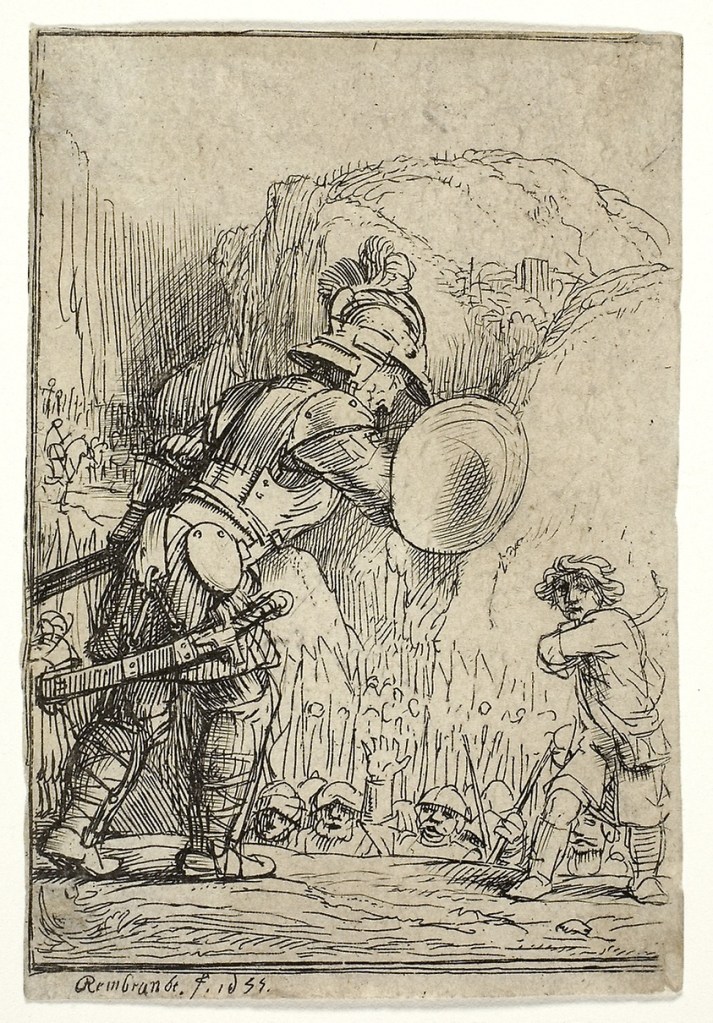
The LORD, who “looks on the heart” loves David, and needs David. The Philistines are out there with their superior technology, threatening Israel with permanent servitude. Israel, in need of better shepherding than Saul can provide. So Samuel anoints David “and the [S]pirit of the LORD came mightily upon David from that day forward.” And the Psalter, knowing this story in all its particularity, takes David as Everyman, the lens through which each of our lives before God is brought into focus.
God loves me. God needs me. There’s work to be done, and Jesus would make Himself at home in my core.
We miss the Holy Eucharist. “The Body of our Lord Jesus Christ keep you in everlasting life.” But the LORD who provided manna in the wilderness will hardly let COVID-19 interfere with dwelling in each of our hearts, of filling each of us “with all the fullness of God.”
“Like a thornbush brandished by the hand of a drunkard is a proverb in the mouth of a fool” (Prov. 26:9).
Or a text, for that matter. Like our first reading, used unwisely in too many places to underwrite hatred and violence. The challenge: what would a wise use look like? Perhaps when the community is relatively small and powerless, tempted to throw in the towel and assimilate: “Be strong and courageous; do not be frightened or dismayed.”
Or, even in this situation, to be guided by other stories. Elijah and Elisha, faced the danger of assimilation to the surrounding culture, and Elijah kept the Sidonian widow and her son alive (1 Kgs 17:9-24), and Elisha healed the Syrian general who was notably successful in defeating Israel (2 Kgs 5:1-19). Jonah, arguing unsuccessfully with God for the destruction of the capital of the brutal Assyrian Empire (Jon 4:1-11). Yes, God can eliminate the enemy, but it turns out that God would really rather not. (And since even a cursory reading of the Old Testament reveals that the people of God are God’s most implacable enemies, that’s perhaps a good thing.)
It does look like Paul and Jesus paid attention to those stories. So Paul celebrates God’s plan to make the Gentiles fellow heirs (the hill Paul was prepared to die on, as Acts 21-28 makes clear), and Jesus heals a Roman officer’s servant, and commends that officer’s faith.
“Interpret Scripture by Scripture” is one of the oldest principles in the Jewish and Christian communities. Which Scripture we use to interpret which Scripture turns out to be remarkably revelatory of who we are, and of how little space separates wisdom and folly.
From today through Pentecost in the Old Testament readings the Lectionary offers a collage of moments in the LORD’s long project of liberation and renewal. Today, the call of Moses, which Gregory of Nyssa (4th Century) recognized as analogous to the Annunciation, pairing Moses’ “yes” with Mary’s “yes.”
The reading might suggest something about our individual vocations, captured in Bianco of Siena’s “Come down, O Love divine” (15th Century):
Come down, O Love divine, seek thou this soul of mine, and visit it with thine own ardor glowing; O Comforter, draw near, within my heart appear, and kindle it, thy holy flame bestowing.
O let it freely burn, till earthly passions turn to dust and ashes in its heat consuming; and let thy glorious light shine ever on my sight, and clothe me round, the while my path illuming.
And so the yearning strong, with which the soul will long, shall far outpass the power of human telling; for none can guess its grace, till Love create a place wherein the Holy Spirit makes a dwelling.
And the reading might suggest something about the LORD. This, from Ellen Davis’ Getting involved with God:
“If, as I suppose, God is drawn to Moses because of his capacity to be derailed for the sake of the things of God, then this also reveals something to us about God. Here I think we are close to the heart of this first revelation at Horeb (Sinai). At Sinai, God is revealed as a deity who jumps the track, a God who gets derailed for the sake of the things of humanity, for the sake of the people Israel.”
(From today until Pentecost—Sunday excepted—the Lectionary offers a course reading in Matthew 7-9.)
With the Numbers reading we pivot towards the arrival of God’s Breath/Spirit/Wind at Pentecost, now just over a week away.
In a traditional Christian reading of Genesis 1 we first meet God’s Spirit brooding over a dark and chaotic world. Seven days later, all “very good.” (This might set us up for unrealistic expectations unless we recall that human decisions were not involved.) We might wonder: what else does this Spirit do? For what else does the Spirit come? Our readings suggest the start of a sketch of an answer; see what you think.
In Numbers, Moses is faced with a restive, suspicious, dangerous crowd. God’s Spirit will fall on the seventy elders to help him get the people to a better place.
In Ephesians the author celebrates God’s project of uniting Jew and Gentile, groups that at that time and place had little love lost between them. For that project to have any chance of success: God’s Breath.
In Matthew… Remember that Jesus healed in many ways, from using spit to make mud, to long-distance. If ever there was a time for long-distance healing, keeping up boundaries (social distancing!) it was in dealing with this demanding leper (recall Leviticus). And Jesus “stretched out his hand and touched him.” How can we be empowered to follow Jesus’ example, blowing through the cultural, political, social barriers that divide us? Again, God’s Wind.
From the dark, chaotic world at the beginning of our story, through Ezekiel’s valley filled with very dry bones and the Day of Pentecost, to our day, not lacking in darkness and chaos: Come, Holy Spirit; Veni Sancte Spiritus!
The verses to the linked song:
Come, Holy Spirit, from heaven shine forth with your glorious light.
Come, Father of the poor, come, generous Spirit, come, light of our hearts.
Come from the four winds, O Spirit, come breath of God, disperse the shadows over us, renew and strengthen your people.
Most kindly warming light! Enter the inmost depths of our hearts, for we are faithful to you. Without your presence, we have nothing worthy, nothing pure.
You are our only comforter, peace of the soul. In the heat you shade us; in our labor you refresh us, and in trouble, you are our strength.
On all who put their trust in you, and receive you in faith, shower all your gifts. Grant that they may grow in you and persevere to the end, give them lasting joy.
Flannery O’Connor: “I write because I don’t know what I think until I read what I say.”
It is too easy for the darkness to be overwhelming. The good news is that that doesn’t stop us praying (Psalm 59; 88). And, equally important, without going all Pangloss/Pollyanna, we can make choices re where we direct our attention. Retrospectively, the May 21 post was also an exercise in directing the attention too much to the darkness. Not that the darkness isn’t real and profoundly destructive. But it is disproportionate with our world’s bright beginning and brighter future, as witnessed in the Feast of the Ascension. Our rector, Miranda Hassett, posted this hymn yesterday; it’s worth reposting.
And have the bright immensities received our risen Lord, where light-years frame the Pleiades and point Orion’s sword? Do flaming suns his footsteps trace through corridors sublime, the Lord of interstellar space and Conqueror of time?
The heaven that hides him from our sight knows neither near nor far; an altar candle sheds its light as surely as a star: and where his loving people meet to share the gift divine, there stands he with unhurrying feet; there heavenly splendors shine.
These readings for the day after the Feast of the Ascension invite multiple readings. On the one hand, celebration, in which even “Land of Hope and Glory” (see yesterday’s blog) has a place. Hannah (whose song is the template for Mary’s song, the Magnificat) did not celebrate in vain; the Gospel is transforming Jewish and Gentile lives in the capital of the Roman province of Asia; in a world in which destructive storms are inevitable, it is possible to build well-grounded lives.
On the other hand, Lenten self-examination. It turns out that the congregation addressed in Ephesians is typical of congregations in other times and places, firmly in the “Please be patient, God isn’t finished with me yet” category. (The author, pleading [?]: “For once you were darkness, but now in the Lord you are light. Live as children of light” [5:8; italics mine].) Hannah and Mary, time-traveling to that congregation (or ours): would they be encouraged? And Jesus in the third reading (expanded to include v.21, the beginning of the thought): He loves us too much to be satisfied with “Lord, Lord.” Where do we need to share His dissatisfaction?
Celebrating Jesus’ ascension (one of our principle feasts) is hard liturgically, since most of the action happens off our stage: something like celebrating a wedding if all we were to see were the couple leaving for the church. Daniel’s dream may be the closest we get to an on-scene camera. Of the many things we might observe, here are two.
First, bottom line, our world’s future is human, not bestial. Many (most?) days that’s hard to believe in our race-to-the-bottom history. But there it is: Daniel sees something like a winged lion, then something like a bear, then something like a leopard, then something we only encounter in nightmares or the sci-fi/horror genre, but it is “one like a human being” who receives unending sovereignty.
Second, taking the chapter as a whole, we readers are often puzzled: is this “one like a human being” intended to represent an individual or a people? From the perspective of the New Testament that’s an illuminating puzzle: Jesus has so identified with his brothers and sisters (the second reading!) that his vindication and theirs are one.
The third reading. Before we succumb to the temptation to cue up “Land of Hope and Glory”, what is Jesus telling the eleven (us) to do? “Make disciples… baptizing… and teaching them to obey everything that I have commanded you.” “And teaching them” with us so good at obeying everything Jesus commands? Our discipling, evidence of a human future that is not bestial but humane?
Jesus, elsewhere (Matt. 19:26): “For mortals it is impossible, but for God all things are possible.” We can learn to obey while teaching others. But if only the “others” are being asked to change, that’s proselytism, not evangelism.



 With Jacob at Bethel