Tag Archives: Episcopal

Re the Daily Office Readings June 20 Anno Domini 2020

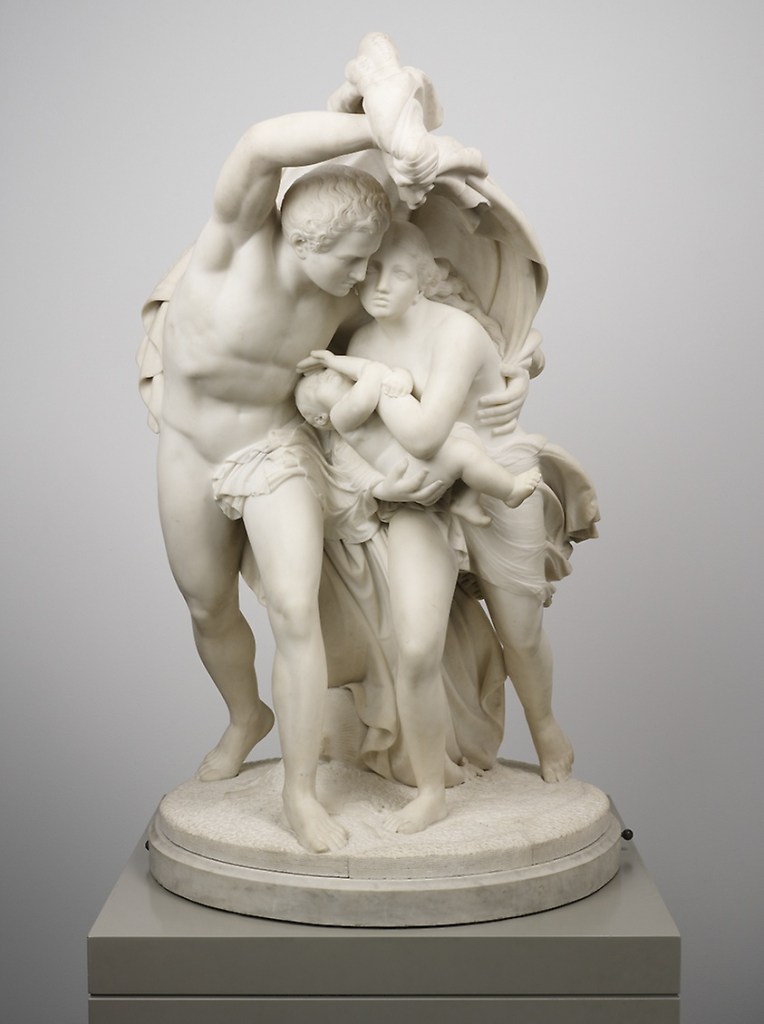
Flight from Pompeii by Benzoni

The Readings: Numbers 13:31––14:25; Romans 3:9-20; Matthew 19:1-12

Paul develops his “all…under the power of sin” theme through a series of OT quotations: “Vv.10-12: Pss 14.1-2; 53.1-2. 13: Pss 5.9; 140.3. 14: Ps 10.7. 15-17: Isa 59.7-8; Prov 1.16. 18: Ps 36.1” (New Oxford Annotated Bible). I am puzzled by the series, since all the citations except Isa 59:7-8 are descriptions offered by one group of another group, hardly intended to cover the speakers. But perhaps this is Paul’s polemical point, that our eloquent denunciations of others tend to boomerang?

(Verses 10-18 might be useful in preparing for the confession and absolution portion of our worship, since multiple issues highlighted there reappear as issues for Christian communities in the epistles, e.g., kindness (v.12, cf. Col 3:12), the tongue (vv.13-14, cf. Jas 3:1-12), peace (v.17, cf. 2 Cor 13:11).

All “under the power of sin” implies that what’s needed is not simply repentance, but rescue. So it might set the stage for God’s intervention as a sort of new Exodus. But that is in the text’s future, with the present portrayed by the text simply bleak. This would be an unfortunate place for the book to end.

Paul caps his argument citing Psalm 143:2, and in its own way that psalm points the way forward in two respects. First, the opening petition highlights the Lord’s righteousness as the motive for the Lord’s non-judgmental intervention:

Hear my prayer, O LORD;
give ear to my supplications in your faithfulness;
answer me in your righteousness.
Do not enter into judgment with your servant,
for no one living is righteous before you. (Vv.1-2; see also v.11)

So in Paul it’s the Lord’s righteousness (dikaiosunē) that drives the Lord’s saving action.

Second, later in the petitions:

Teach me to do your will,
for you are my God.
Let your good spirit lead me
on a level path. (v.10)

So in Paul it’s the Holy Spirit that leads those incorporated in the Messiah.

Re the Daily Office Readings June 19 Anno Domini 2020

The Readings: Numbers 13:1-3, 21-30; Romans 2:25––3:8; Matthew 18:21-35

I think I get Rom. 3:1-8. God has a global problem (see Genesis 1-11); God elects Israel to solve that problem but Israel falls victim to the same problem (see Genesis 12ff). So now God has two problems. But God’s faithfulness means not being satisfied with punishing the guilty, but rescuing both Israel and the world.

I don’t get Rom. 2:25-29, puzzled by at least three things. First, if Paul’s argument holds, there are by definition no disobedient Jews. Second, it’s not clear that Paul’s argument helps Paul, for he still agonizes over his fellow Jews who don’t acknowledge Jesus (chapters 9-11). Third, the stark contrast between keeping and breaking the law (v.27) is hard to square with our experience of the wide spectrum of unfaithfulness-faithfulness among both Jews and Christians. Help!

Re the Daily Office Readings June 18 Anno Domini 2020

The Triumph of Hypocrisy by Thomas Rolandson

The Readings: Numbers 12:1-16; Romans 2:12-24; Matthew 18:10-20

“For the wrath of God is revealed from heaven against all ungodliness and wickedness of those who by their wickedness suppress the truth” (1:18) It looks like Paul is still developing this theme, focusing on groups that think themselves exempt, e.g., the Jews.

Commentators wonder who these Gentiles who “do instinctively what the law requires” are: a strictly hypothetical group, righteous non-Christians, Christians? None of the proposed identifications are without problems.

Some 2,000 years out from Paul’s writing, today’s text sounds like it could as easily be written about Christians as a group. Paul: “For it is not the hearers of the law who are righteous in God’s sight, but the doers of the law who will be justified.” And already Paul’s contemporary James finds it necessary to remind his Christian readers “For if any are hearers of the word and not doers, they are like those who look at themselves in a mirror; for they look at themselves and, on going away, immediately forget what they were like” (Jas. 1:23-24). What do I do with that?

Re the Daily Office Readings June 17 Anno Domini 2020

An Allegory of Intemperance by H. Bosch

The Readings: Numbers 11:24-33(34-35); Romans 1:28––2:11; Matthew 18:1-9

For today’s reading in Romans we might bring two Russians into the conversation.

Fyodor Dostoevsky: “Above all, don’t lie to yourself. The man who lies to himself and listens to his own lie comes to a point that he cannot distinguish the truth within him, or around him, and so loses all respect for himself and for others. And having no respect he ceases to love” (The Brothers Karamazov).

Aleksandr Solzhenitsyn: “If only there were evil people somewhere insidiously committing evil deeds, and it were necessary only to separate them from the rest of us and destroy them. But the line dividing good and evil cuts through the heart of every human being. And who is willing to destroy a piece of his own heart?” (The Gulag Archipelago).

In short, idolatry not only profoundly insults God, but also profoundly degrades those truly created in God’s image: human beings. As the psalmist puts it:

The idols of the nations are silver and gold,
the work of human hands.
They have mouths, but they do not speak;
they have eyes, but they do not see;
they have ears, but they do not hear,
and there is no breath in their mouths.
Those who make them
and all who trust them
shall become like them. (Ps. 135:15-18)

“For he will repay according to each one’s deeds… For God shows no partiality. (Rom. 2:6, 11). Is this part of our picture of God? Why or why not?

Re the Daily Office Readings June 16 Anno Domini 2020

Let my people go by Aaron Douglas

The Readings: Numbers 11:1-23; Romans 1:16-25; Matthew 17:22-27

Reading Romans is challenging—also because it’s hard not to assume that Paul means what we mean by words shaped by 20 centuries of theology. And because translations always involve tradeoffs. Three examples:

First, “For I am not ashamed of the gospel; it is the power of God for salvation to everyone who has faith, to the Jew first and also to the Greek” (v.16). When we hear ‘salvation’ we’re apt to think of the destiny of the individual soul after death. When a first-century Jew heard ‘salvation’ they were apt to think of liberation from the Roman Empire. When a first-century patriotic Roman heard ‘salvation’ they were apt to assume that that was the law and order and prosperity that Rome was bringing. And what Paul means by it?

Second, “For therein is the righteousness of God revealed from faith to faith: as it is written, The just shall live by faith” (v.17, KJV). When we hear ‘righteousness’ we’re apt to think of an abstract standard of behavior, so probably bad news for everybody. In the Old Testament it’s about faithfulness to one’s responsibilities, e.g., God’s faithfulness to God’s responsibilities as defined in the covenants with Abraham and Moses. And when Israel is in trouble, God’s righteousness is good news:

To the sound of musicians at the watering places,
there they repeat the triumphs [literally ‘righteous acts’] of the LORD,
the triumphs [literally ‘righteous acts’] of his peasantry in Israel. (Jdg. 5:11 NRS)

So back in Rom 1:17 the New Jerusalem Bible uses ‘saving justice’ to translate dikaiosunē. Divine dikaiosunē, good news if I’m oppressed, less good news if I’m the oppressor. In Romans, what divine responsibilities define divine righteousness?

Third, re the same text. It’s easy to think of faith and faithfulness as two quite different things. But both words are possible translations of Greek pistis, and translations of v.17 make different choices. Perhaps we might expand the translation like this: “revealed from [God’s] faithfulness to [human] faith and faithfulness: as it is written, The just shall live by faith/faithfully.” When we encounter ‘faith’ or ‘faithfulness’ in the New Testament, we might wonder how the text would read if the other translation were used.

The Lectionary omits vv.26-27. On the one hand, regrettable: silencing troublesome voices is problematic (see Colin Kaepernick). On the other hand, entry into the arguments regarding their interpretation can too easily derail attention to Paul’s larger argument.

Re the Daily Office Readings June 15 Anno Domini 2020

Marble portrait of the emperor Augustus, ca. A.D. 14–37 Roman, Early Imperial, Julio-Claudian Marble; H. 12 in. (30.48 cm) The Metropolitan Museum of Art, New York, Rogers Fund, 1907 (07.286.115) http://www.metmuseum.org/Collections/search-the-collections/247993

The Readings: Numbers 9:15-23; 10:29-36; Romans 1:1-15; Matthew 17:14-21

If I’m one of the Christians to whom Paul is writing, what might I notice in these opening verses?

  • Paul describes himself as a doulos (‘servant’ in NRSV). On the one hand, no status; on the other, whose slave is he?
  • “Jesus the Anointed” (or “Jesus the Messiah”—the phrase is not yet functioning as a proper name), so three words into the letter and we’re already on thin ice politically.
  • “Gospel”—that’s the word used for “the announcement of the accession or the birthday of a ruler or emperor” (Wright).
  • “…the obedience of faith among all the Gentiles for the sake of his name, including yourselves who are called to belong to Jesus Christ.”

It takes more than a little chutzpah to write like this to folk in the capital of the empire. There’s more in the same vein, Paul reclaiming words that the emperors liked to use: ‘lord’, ‘son of God,’ and later ‘justice’, ‘salvation’, etc. The letter is not anti-Roman—Paul has bigger fish to fry—it just hasn’t drunk the Roman Kool-Aid. And ‘gospel’, not first about me and what I decide, but about who has authority in and over this world.

While these reflections on Romans owe much to a wide variety of secondary sources, they’re particularly indebted to N. T Wright’s work in both the “Paul for Everyone” series and The New Interpreter’s Bible Commentary.

Re the Daily Office Readings June 14 Anno Domini 2020

Photo by Ekaterina Litvinova

The Readings: Numbers 6:22-27; Acts 13:1-12; Luke 12:41-48

“The LORD spoke to Moses, saying: ‘Speak to Aaron and his sons, saying, “Thus you shall bless the Israelites: You shall say to them, ‘The LORD bless you and keep you; the LORD make his face to shine upon you, and be gracious to you; the LORD lift up his countenance upon you, and give you peace.’” So they shall put my name on the Israelites, and I will bless them.’”

What we know as the Aaronic Blessing, presented in the first reading, has long been used in Jewish and Christian liturgies. In our polarized context, it’s perhaps an opportunity to examine our speech.

“And forgive us our sins, for we ourselves forgive everyone indebted to us” (Lk. 11:4). That’s bad enough—but Jesus doesn’t stop there: “bless those who curse you, pray for those who abuse you” (Lk. 6:28). We have public figures with real power who are abusing too many people. On that we agree, even as we sharply disagree as to who these figures are. When they come to my attention—usually on the evening news—my body reacts, my emotions engage, my mouth responds, whether audibly or inaudibly. Jesus’ notion seems to be that my response track with the Aaronic Blessing. “[Name], may the LORD bless you and keep you…” That is not what usually happens. I have work to do.

Jesus’ brother James gets at it this way: “With it [the tongue] we bless the Lord and Father, and with it we curse those who are made in the likeness of God. From the same mouth come blessing and cursing. My brothers and sisters, this ought not to be so” (Jas. 3:9-10). “Made in the likeness of God”—no matter what they’re doing. Perhaps the idea is that the likeness of God gives me my starting point, encouraging me to pray that that likeness be as clear and life-giving as possible. As I said, I have work to do.

Re the Daily Office Readings June 13 Anno Domini

The Readings: Numbers 3:1-13; Galatians 6:11-18; Matthew 17:1-13

Matthew begins “Six days later”: six days after Peter’s confession and Jesus’ pivot to warning his disciples about his coming passion. This narrative of “the Transfiguration” might take us in many directions; here are two.

The same Jesus whose face is shining like the sun will undergo great suffering. We might think that the one excluded the other; we might wonder about recalibrating our ideas of how glory and honor work.

The Jewish disciples know Moses and Elijah, and are still trying to puzzle out Jesus. The heavenly voice’s “listen to him” suggests that Jesus properly interprets Moses and Elijah. We Gentile disciples aren’t worried about Moses and Elijah, but have our own set of authorities who jealously guard their turf: Mars (war, national security), Pluto (wealth, the economy), Venus (beauty), etc. And the heavenly voice’s “listen to him” is telling us how to and when to listen to them?

“He is the image of the invisible God, the firstborn of all creation; for in him all things in heaven and on earth were created, things visible and invisible, whether thrones or dominions or rulers or powers– all things have been created through him and for him. He himself is before all things, and in him all things hold together” (Col. 1:15-17).

Re the Daily Office Readings June 12 Anno Domini 2020

The Readings: Ecclesiastes 11:9––12:14; Galatians 5:25––6:10; Matthew 16:21-28

There are any number of things we might take away from Ecclesiastes. One is what William Brown in Wisdom’s Wonder sees as the teacher’s redefinition of the fear of God: “To fear God…is to be fearfully receptive in the domain of the Holy, where human initiative is minimized and all scheming is eliminated. To fear God is to acknowledge the gulf between transcendent eminence and fragile creatureliness… Reverence is equated with utmost reticence in matters pertaining to the Divine, both discursive and performative.”

And this fear translates into the formation of a particular sort of character:

  1. The God fearer is receptive to the pleasure that God gives. “Carpe diem is all about reshaping desire to what is given, not to what one strives for.” The pleasures that God gives are typically small in comparison to the grandiosity of the projects narrated in Eccl. 2. The God-fearer embraces simplicity.
  2. The God fearer toils for pleasure, not gain.
  3. The God fearer eschews virtue-osity, any pursuit of virtue as a means of securing one’s existence.
  4. The God fearer seeks wisdom, that is, wisdom as redefined by Qohelet’s search: “Faced with a world that cannot be mastered, Qohelet urges his readers to go forth freed from obsession and extremism, freed from illusions of grandeur, freed from compulsive striving, yet filled with fear and wonder in the receiving and in the doing, with wonder minus the glory, with wisdom minus Wisdom.”

That’s worth some reflection!

Re the Daily Office Readings June 11 Anno Domini 2020

The Readings: Ecclesiastes 11:1-8; Galatians 5:16-24; Matthew 16:13-20

“…you do not know the work of God, who makes everything.” Our not-knowing: that’s been one of the teacher’s main themes. It would not be hard for that not-knowing to be paralyzing, precisely the danger today’s text addresses.

Verses 1-2 are sometimes taken as investment strategies, but since that involves a fair amount of interpretive squinting, perhaps the older Egyptian proverb is a better clue: “Do a good deed and throw it in the water; when it dries you will find it.” Why not some senseless random acts of kindness: who knows what effects they might have?

“Whoever observes the wind will not sow; and whoever regards the clouds will not reap.” That’s the pragmatic angle: when do we have the information we’d like before making an important decision?

“Just as you do not know how the breath comes to the bones in the mother’s womb, so you do not know the work of God, who makes everything.” The teacher could have chosen any example; why this one? Perhaps G. K. Chesterton’s observation re Job provides a clue: “Lastly, the poet has achieved in this speech…another and much more delicate thing. Without once relaxing the rigid impenetrability of Jehovah in His deliberate declaration, he has contrived to let fall here and there in the metaphors, in the parenthetical imagery, sudden and splendid suggestions that the secret of God is a bright and not a sad one–semi-accidental suggestions, like light seen for an instant through the cracks of a closed door.”

Where were you when I laid the earth’s foundations?
Speak if you have understanding.
Do you know who fixed its dimensions
Or who measured it with a line?
Onto what were its bases sunk?
Who set its cornerstone
When the morning stars sang together
And all the divine beings shouted for joy? (Job 38:4-7)