“Surely the Lord is in this place—and I did not know it” (Gen 28:16). Here we wonder about encountering G-d at the intersection of Bible and Life–typically prompted by the (Episcopal) Book of Common Prayer.
This chapter of Exodus, a sleeper, with much to wonder about. We met its virtual protagonist, Jethro, after young Moses’ flight from Egypt; he does not appear elsewhere in the Old Testament.
Today’s text together with the battle with Amalek (Exodus 17:8-16) form a sort of diptych, sharply contrasting non-Israelite responses to YHWH’s deliverance (for detail, Robert Alter’s notes in his translation). The Evangelists do something similar in the birth/infancy and passion narratives, juxtaposing different responses to Jesus (Raymond Brown). Perhaps Exodus 17:8-18:12 needs to be read together for the full effect.
We may find the author’s treatment of Zipporah and the sons quite jarring (How did Moses receive them? What did they make of all this?). The author—necessarily—chooses which stories to tell, which not to tell.
The end of v.11 is obscure in Hebrew and receives varied translations: “when they dealt arrogantly with them” (NRSV); “by the result of their very schemes against the people” (NJPS). The NRSV might encourage us to reflect on arrogance/presumption as something to be avoided (cf. Nehemiah 9: 10, 16, 29); the NJPS (new Jewish Publication Society) perhaps recalls Targum Onkelos’ interpretation: “the Egyptians plotted to destroy the Hebrews by drowning and they themselves were then drowned” (Alter’s summary).
“And Jethro, Moses’ father-in-law, brought a burnt offering and sacrifices to God; and Aaron came with all the elders of Israel to eat bread with Moses’ father-in-law in the presence of God” (v.12).The local is “at the mountain of God” (v.5); this may be the fulfillment of the divine promise given at Moses’ call (Exodus 3:12). Eating “in the presence of God” sounds like the language Deuteronomy uses to describe various sacrifices in (unnamed) Jerusalem (Deut. 12:7, 18; 14:23, 26; 15:20; 16:7), perhaps an example of Deuteronomy coalescing Horeb (Sinai) and Jerusalem. Is it a sort of victory banquet?
Jethro does not become a Jew. But from his own perspective he freely acknowledges and celebrates YHWH’s action in his world. Is this also part of “and in you all the families of the earth shall be blessed” involves (Genesis 12:3b)?
Toward the end of the Who’s iconic “Won’t get fooled again” there’s a line that captures repeated human experience: “Meet the New Boss. Same as the Old Boss.” So what is Israel going to discover, free from Pharaoh, now dependent on YHWH? Yesterday’s stories of manna (“whatsit”) and quail provide part of the answer, today’s story about the seventh day, another part.
As the story’s told, on the sixth day the people are surprised to discover that they’ve gathered twice the normal amount, and look to Moses for an explanation. Moses: “This is what the LORD has commanded: ‘Tomorrow is a day of solemn rest, a holy sabbath to the LORD; bake what you want to bake and boil what you want to boil, and all that is left over put aside to be kept until morning.’” Israel is miles (and chapters) away from Sinai (the Ten Commandments). But the LORD does not wait for Sinai, and surprises Israel here with the gift of the sabbath. (‘Sabbath’ appears for the first time in this text.) Under Pharaoh seven days of labor might yield seven days’ worth of food. Under the LORD, six days of labor, seven days of food. The Sovereign qualitatively more powerful than Pharaoh invites Israel into a weekly day of rest and renewal. Here the Who’s lyrics do not apply.
Jesus and the New Testament writers pick up the manna story and employ it, figuratively, in powerfully ways. Jesus, in the conversation with the crowd the day after the feeding of the five thousand: “I am the bread of life. Your ancestors ate the manna in the wilderness, and they died. This is the bread that comes down from heaven, so that one may eat of it and not die. I am the living bread that came down from heaven. Whoever eats of this bread will live forever; and the bread that I will give for the life of the world is my flesh” (John 6:48-51). Hallelujah—and looking forward to again celebrating that together.
The Jesus who speaks these words is also the Jesus who constantly reminds us of God’s generosity. “Therefore do not worry, saying, ‘What will we eat?’ or ‘What will we drink?’ or ‘What will we wear?’ For it is the Gentiles who strive for all these things; and indeed your heavenly Father knows that you need all these things. But strive first for the kingdom of God and his righteousness, and all these things will be given to you as well” (Matt. 6:31-33)—as evidenced also in the manna story.
God is generous. How generous? God’s creation has enough for all. In that creation six days’ labor yields seven days of food. Obscenely, too few experience this today, with modern pharaohs subverting creation and insulting the Creator.
Gratitude and anger, perhaps both are necessary responses to this reading.
Part II: Why read the text this way?
Not that this is (God forbid) the only or best reading—but why hear it this way at all?
The above reading takes Exodus 16 to be economically paradigmatic: before arriving at the land, God shows Israel how the land’s resources are to be received and used. Other readings often take the text as simply a story of God’s provision in the wilderness, and, if there’s a lesson for other times and places, it’s a general one: trust God. (We don’t go around talking to or striking rocks to get our water—in contrast to Moses (Exodus 17:1-7; Numbers 20:1-13). So why this reading?
Big picture: God calls Israel for the sake of the nations (Genesis 12:1-3). How’s that supposed to work? Israel as regional (global?) superpower enforcing compliance? When I worked with World Vision’s development projects, agricultural innovation was often a part of the mix. Farmers tend to be conservative, so innovation is not an easy sell. It turns out that a good strategy is to find one or two farmers willing to try the innovation. If it works, other farmers will notice, ask questions, and the innovation sells itself. That seems to be the primary strategy God employs with Israel vis à vis the nations, reflected in texts like this from Isaiah:
In days to come the mountain of the LORD’s house shall be established as the highest of the mountains, and shall be raised above the hills; all the nations shall stream to it. Many peoples shall come and say, “Come, let us go up to the mountain of the LORD, to the house of the God of Jacob; that he may teach us his ways and that we may walk in his paths.” For out of Zion shall go forth instruction, and the word of the LORD from Jerusalem. He shall judge between the nations, and shall arbitrate for many peoples; they shall beat their swords into plowshares, and their spears into pruning hooks; nation shall not lift up sword against nation, neither shall they learn war any more. (2:2-4)
Israel is the test plot. Its ways are potentially paradigmatic for the nations. As a psalm celebrates:
The LORD works vindication and justice for all who are oppressed. He made known his ways to Moses, his acts to the people of Israel. (Ps. 103:6-7)
Which of Israel’s ways? That’s the tricky question, whose answer depends on (and sometimes reveals) our (limited, fallible) understanding of the shape and thrust of Holy Scripture. The traditional ceremonial/civil/moral distinction (enshrined also in #VII of the Articles of Religion (BCP 869) is not a bad starting point, but not designed to identify which precepts are ceremonial, civil, or moral. Here I’ve read Exodus 16 as economically paradigmatic because I perceive this reading to fit well both with Scripture’s portrayal of divine generosity and its prophets’ portrayal of human greed.
Part III: A hat-tip to Christopher J. H. Wright
While the inevitable errors in the above are my own, I’ve been encouraged by and engaged with Wright’s work, laid out in various books and articles (e.g., An Eye for an eye: The Place of Old Testament Ethics Today [InterVarsity Press 1983]). Wright illustrates his interpretive model with the following (p.100):
Very briefly, the creation stories present a thick set of relationships between God, humanity, and the earth. Human disobedience fractures all of these relationships. Israel in the Land of Israel is God’s pilot project so show the nations what restored relationships look like. (Note: this says nothing about how one might reflect on the current state of Israel.) Jesus renews and expands the Israel project, with koinonia (the Greek word often translated ‘fellowship’ but in some contexts perhaps more appropriately translated as ‘solidarity’) naming our mediated relationships with the earth. Both Israel 1.0 and 2.0 (the numbering not to be interpreted in a supersessionist way) witness to humanity’s future in a renewed creation.
The people are in the wilderness, transitional or liminal space between slavery and having land. And, as in the Native American vision quest, perhaps learning what they need to learn for their future responsibilities. These days’ readings: the “whatsit,” a.k.a. “manna” (our transcription of the Hebrew word that might translate as “Whatsit?”). I wonder if the whatsit doesn’t turn out to be about divine generosity and human stewardship, passable themes for Earth Day + 1.
Most days—we meet the other days in tomorrow’s reading—they gather what they need for the day (an omer, or about two quarts, per person). The divine generosity: the whatsit’s there. And the generosity extends to the gathering process: “…some gathering more, some less. But when they measured it with an omer, those who gathered much had nothing over, and those who gathered little had no shortage; they gathered as much as each of them needed.” The weak do not go hungry.
Human stewardship: it resists hoarding. “And Moses said to them, ‘Let no one leave any of it over until morning.’ But they did not listen to Moses; some left part of it until morning, and it bred worms and became foul.”
After a long stretch of slavery and its distorting effects, the whatsit is a reintroduction to this G-d’s creation: there is enough for everyone, it is dependable, hoarding is counterproductive.
Fast-forward several centuries: how much of the societal sickness diagnosed by Israel’s prophets came from not having learned from the whatsit?
Fast-forward several centuries: “Do not store up for yourselves treasures on earth, where moth and rust consume and where thieves break in and steal… do not worry about your life, what you will eat or what you will drink, or about your body, what you will wear. Is not life more than food, and the body more than clothing?” (Matthew 6:19,-25) Same G-d, same creation, same lesson to be learned.
“Give us today our daily bread. Forgive us our sins.”
Peter continues to expound his new exodus theme. Arriving at Sinai Israel heard: “Now therefore, if you obey my voice and keep my covenant, you shall be my treasured possession out of all the peoples. Indeed, the whole earth is mine, but you shall be for me a priestly kingdom and a holy nation” (Exod 19:5-6a). Peter: “But you are a chosen race, a royal priesthood, a holy nation, God’s own people, in order that you may proclaim the mighty acts of him who called you out of darkness into his marvelous light” (2:9). So William Temple, Archbishop of Canterbury during WW II: “The church exists primarily for the sake of those who are still outside it” (for variants, see here).
That’s the goal; in today’s Exodus reading Israel is, like us, very much a work in progress. Temple again: “Thou canst do all things. I have nothing. I am not fit to offer the meanest service. Surely God will first require and help me form a character worthy to serve him, and then appoint me my task. No; in point of fact it is only through service that such a character could be formed.” (Readings in St John’s Gospel, cited in Schmidt’s Glorious Companions). So perhaps we can be patient with ourselves and those around us.
In that last quote Temple could have been talking about today’s reading from John. It’s one of Jesus’ two retellings of Isaiah’s Song of the Vineyard (5:1-7), the other being the parable of the wicked tenants (Matt 21:33-46 and parallels). Isaiah’s song concludes: “For the vineyard of the LORD of hosts is the house of Israel, and the people of Judah are his pleasant planting; he expected justice, but saw bloodshed; righteousness, but heard a cry!” I’m puzzled. When we explore what sort of fruit God is seeking in John 15, why doesn’t the exploration start with Isaiah 5?
From today’s readings: “But you are a chosen race, a royal priesthood, a holy nation, God’s own people, in order that you may proclaim the mighty acts of him who called you out of darkness into his marvelous light” (1 Pet. 2:9).
So on this Earth Day here’s St. Basil the Great’s Prayer of Compassion
O God, enlarge within us the sense of fellowship with all living things, our brothers the animals to whom thou gavest the earth as their home in common with us.
We remember with shame that in the past we have exercised the high dominion of man with ruthless cruelty so that the voice of the earth, which should have gone up to thee in song, has been a groan of travail.
May we realize that they live not for us alone but for themselves and for thee, and that they love the sweetness of live.
It is one of the oldest human stories: our God defeats chaos and death, wins sovereignty, creates a stable world in which we can thrive. Israel’s neighbors in the east, the Babylonians, had it in the epic “When on high” (Enuma Elish); to the north there was the cycle of Baal poems. Israel celebrated its occurrence in their history at the Red Sea, the oldest version of that celebration being today’s reading from Exodus. Whatever the threat, we need not fear. The Lord is risen indeed. Alleluia.
Peter picks up the Passover/exodus/wilderness imagery addressing those ransomed “with the precious blood of Christ, like that of a lamb without defect or blemish.” “…love one another deeply from the heart.” A seamless transition from celebrating God’s generosity to a corresponding generosity on our part. These days, maintaining the social distancing recommended by our physicians. (“There may come a time when recovery lies in the hands of physicians, for they too pray to the Lord that he grant them success in diagnosis and in healing, for the sake of preserving life. He who sins against his Maker, will be defiant toward the physician” [Sirach 38:13-15].) These days, at least remembering those whose fate has been pushed off the front page, e.g., the some 40,000 held in our immigrant detention centers (Amnesty International).
We have passed through the Red Sea / across the Atlantic / over the Rio Grande. Now what?
Psalm 104, assigned in the 30-day Psalm cycle to the evening of the 20th day of the month, begins:
“Bless the Lord, O my soul, O Lord my God, how excellent is your greatness! you are clothed with majesty and splendor.”
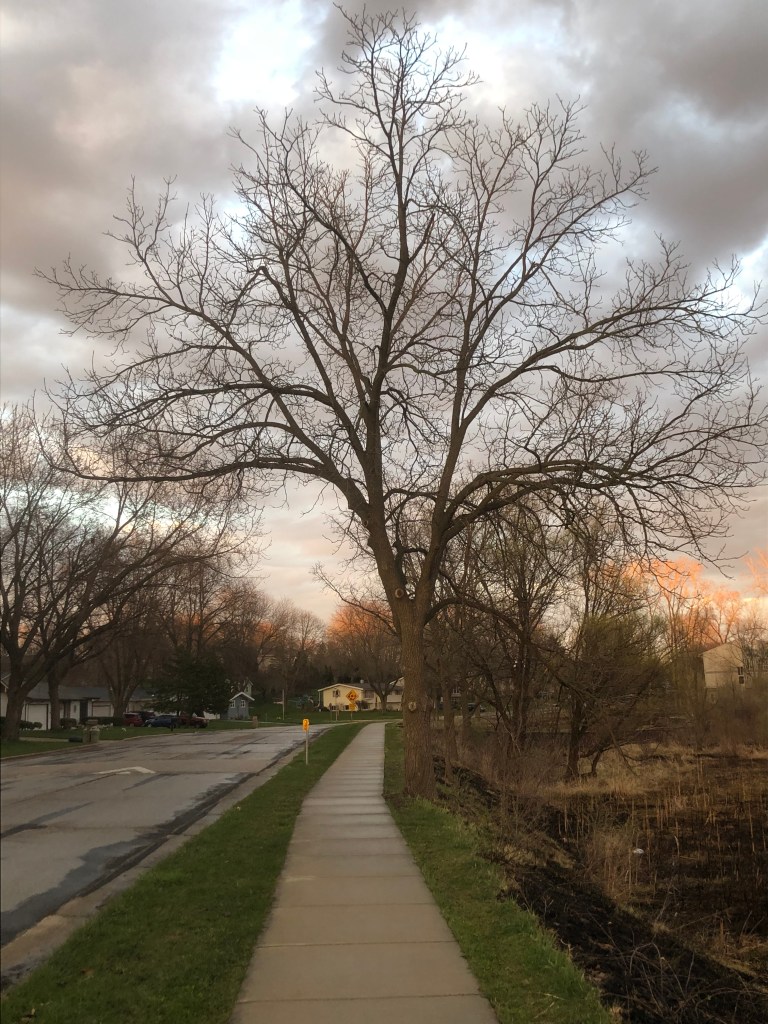
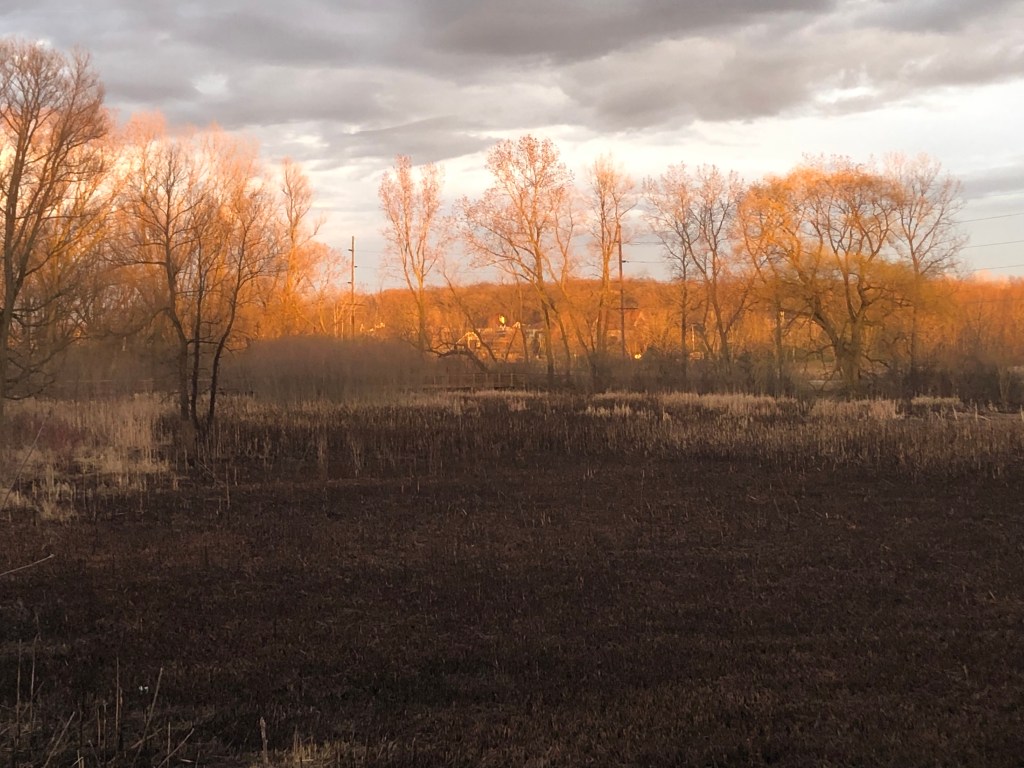
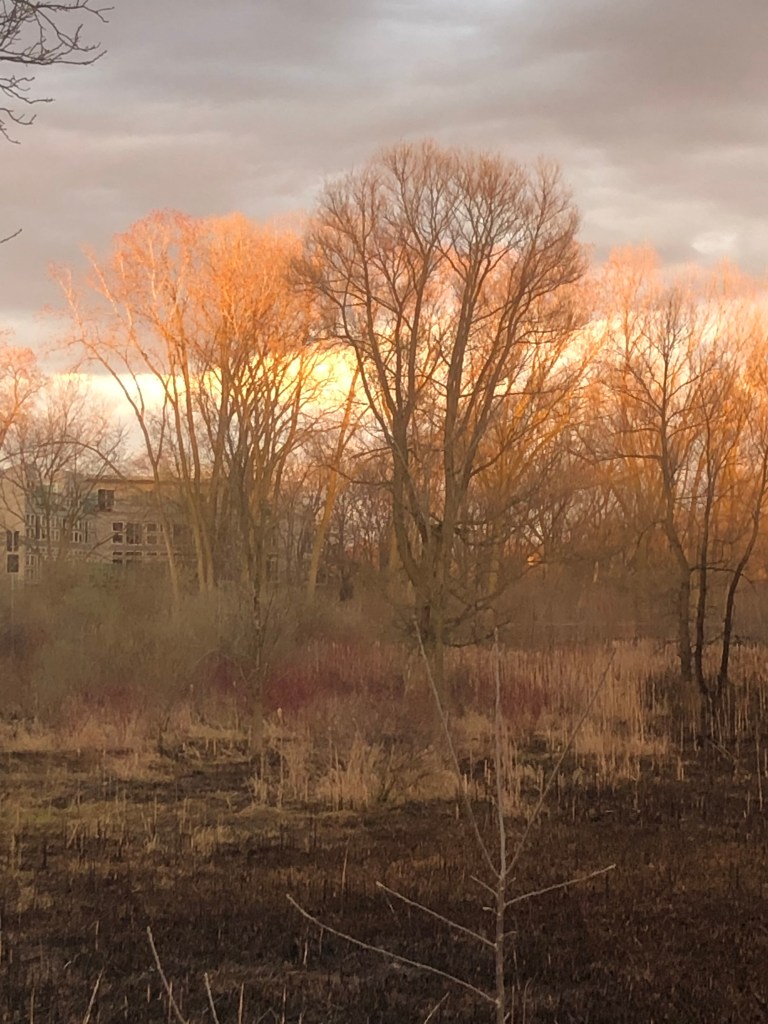
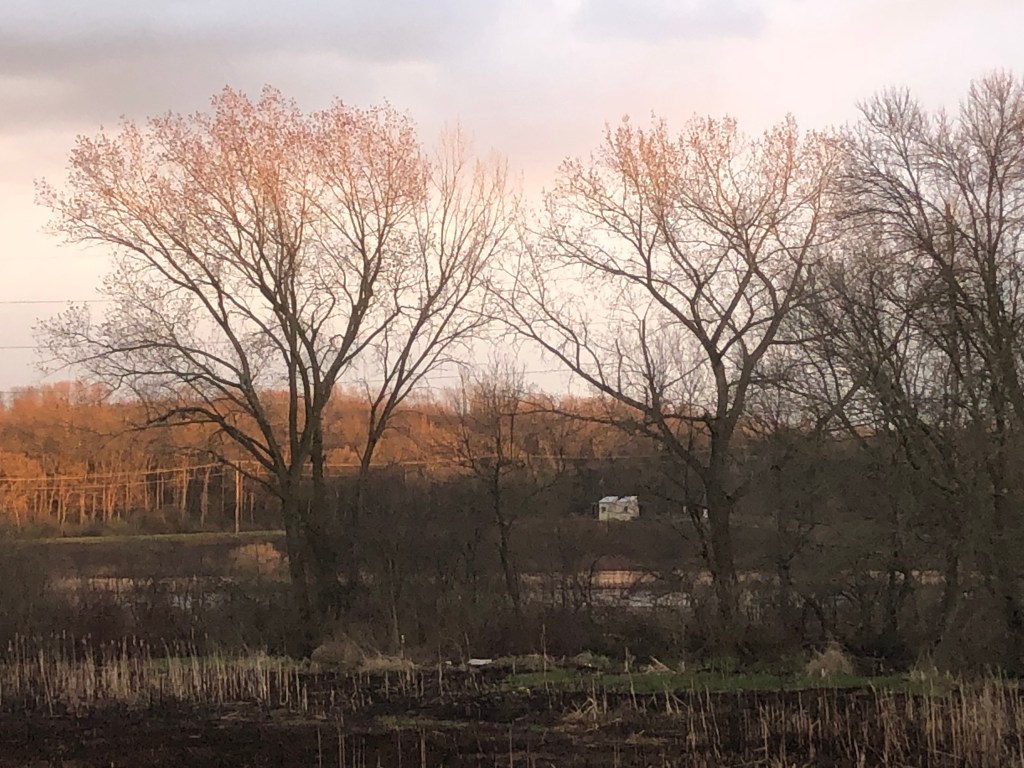
Tonight at dusk Dunn’s Marsh, across the street from our home, joined in the celebration. The majesty and splendor in creation, God’s open invitation to draw nearer to God, in whose right hand “are pleasures for evermore” (Ps. 16:11).
We heard the Exodus text just over a week ago at the Great Vigil. There it’s followed by this prayer:
O God, whose wonderful deeds of old shine forth even to our own day, you once delivered by the power of your mighty arm your chosen people from slavery under Pharaoh, to be a sign for us of the salvation of all nations by the water of Baptism: Grant that all the peoples of the earth may be numbered among the offspring of Abraham, and rejoice in the inheritance of Israel; through Jesus Christ our Lord. (BCP 289)
Coming at it cold, and, perhaps, more awake, the story may give us pause. Is this what the soldiers in Pharaoh’s army signed up for (if choice was even involved), soldiers not unlike those serving our country for which we pray weekly. We humans live in societies in which we’re profoundly interconnected. It makes our life possible; it allows both dying and killing to cascade.
The Jews have wrestled with this story, as in this saying: “God silenced the song of the angels with the words: ‘The work of My hands is drowning in the sea, and ye wish to chant songs!” (Ginzberg The Legends of the Jews, VI.12).
Can we bail with “Well, that’s the god of the Old Testament for you”? Not with today’s Gospel: “Do you not believe that I am in the Father and the Father is in me? The words that I say to you I do not speak on my own; but the Father who dwells in me does his works.” The God at work in Jesus: the God who orchestrated the Exodus.
Where might this reflection end up? Here’s one possibility: all those Egyptians “dead on the seashore”: we owe it to them not to replicate Egypt’s idolatry and oppression in our common life. Otherwise, they truly would have died for nothing.
Exodus: A paradigmatic deliverance story, also, perhaps, a reflection on the challenge of belief. The Hebrew words for ‘to see’ (rāˀâ) and ‘to fear’ (yārāˀ) are close in sound, and the story employs them from the introduction of the crisis to its resolution (‘to see’: 14:13, 30, 31; ‘to fear’ 14:10, 13, 31). And so the story ends (tomorrow’s reading) with “Israel saw the great work that the LORD did against the Egyptians. So the people feared the LORD and believed in the LORD and in his servant Moses” (v.31).
That’s the end of that story; it’s more challenging in the middle. The Letter to the Hebrews: “Now faith is the assurance of things hoped for, the conviction of things not seen” (11:1). I like Jim Wallis’ paraphrase: “Hope means believing in spite of the evidence and then watching the evidence change” (“The Way of Hope,” written in 2015, but equally relevant today).
Program note: Jesus’ words in John come right after Judas’ departure to betray Jesus and Jesus’ prediction of Peter’s denials. The soundtrack for Exodus is increasingly dominated by approaching Egyptian army; the soundtrack for John by the approaching soldiers and police.
COVID-19 and fear, both in the air. So I might take some time to enter today’s Exodus reading contemplatively. The Jesuits talk of “composing the place,” asking for God’s help to imagine oneself in the story in as much detail as possible. What do I see? What do I hear? What do I smell? What do I feel? What do I taste? Now, the place composed, I ask God to be with me as I let the story play out in my imagination. How will the story play out? What will God and I discover together? (See “Father James Martin: An Introduction to Ignatian Contemplation.)
What to make of Paul’s striking contrasts? “Even though our outer nature is wasting away, our inner nature is being renewed day by day” (4:16); “slight momentary affliction…an eternal weight of glory beyond all measure” (4:17); “we groan… we are always confident” (5:2, 6).
I doubt that it’s about having some sort of psychic balance sheet that happily ends in the black. That would set me off on a search for experiences to counterbalance the wasting and groaning. I might find them, but at the end of the day I’d still be at the center.
I suspect that what grounds Paul’s contrasts involves Rowan Williams’ decentering. Here’s a bit from The Wound of Knowledge: “To be absorbed in the sheer otherness of any created order or beauty is to open the door to God, because it involves that basic displacement of the dominating ego without which there can be no spiritual growth” (Cited in Burkhard Conrad’s essay “Rowan Williams on ‘Decentering’”). (“God is my copilot.” “You two really need to change places.”)
“…we look not at what can be seen but at what cannot be seen; for what can be seen is temporary, but what cannot be seen is eternal” (4:18). What Israel sees—anticipating next week’s readings—is the advancing Egyptian army in all its glory; what Israel cannot see is the glory of G-d, poised for Israel’s deliverance. (For a whimsical replay, Elisha and the Aramean army here.)
There are tools here for unsettling times: decentering, remembering that there are more pieces on the board than I can see… And letting Jesus awaken the imagination. How easy to repeatedly use a traditional phrase “God of Abraham, Isaac, and Jacob” never realizing its celebration of the God of the living!





 With Jacob at Bethel