Readings (Track 2)
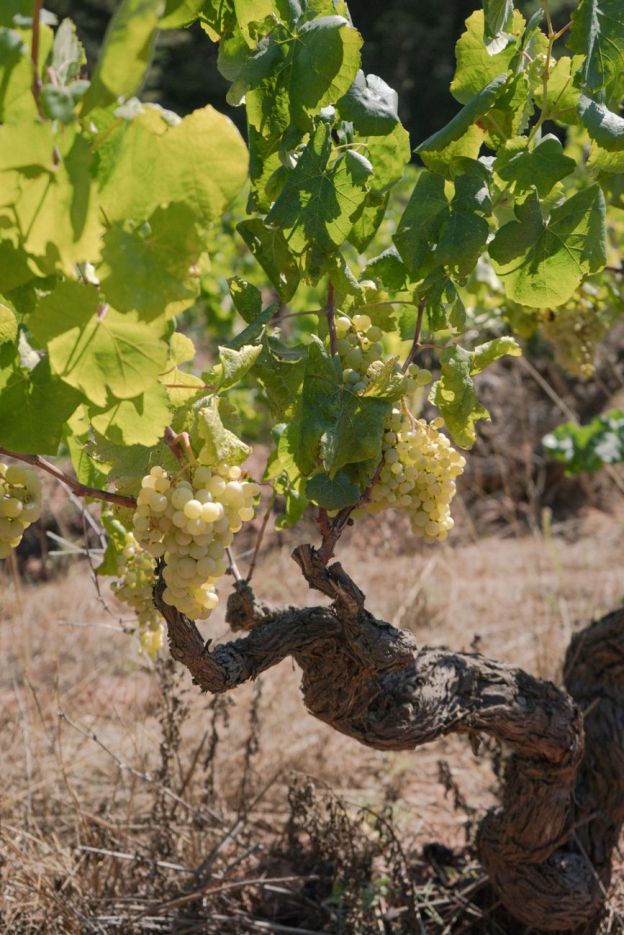
When things go well, the grape harvest brings joy. When things don’t go well, it gets complicated. Happily, our God is creative enough—not to mention downright stubborn—that “complicated” doesn’t get the last word. That’s more or less what today’s readings are about.
As you probably guessed listening to the readings, Jesus is playing off Isaiah’s “love-song:” the vineyard, the watchtower, the wine vat. That love-song is transparently about the Lord’s history with Israel, a history intended to result in justice and righteousness, but actually resulting in bloodshed and a cry.
Isaiah, of course, had a lot to say about justice and righteousness. If we asked what justice and righteousness are for, he might direct us to another of his oracles: “The wolf shall live with the lamb, / the leopard shall lie down with the kid, …They will not hurt or destroy / on all my holy mountain” (11:6a, 9a). Jesus’ “I came that they may have life, and have it abundantly” (Jn 10:10b) applies equally to the Lord’s project with Israel: life in abundance for all, not just the top 1%. But faced with bloodshed and a cry the project is going to get more costly. The hymn about Jesus Paul cited that we heard last week talked about that: “who, though he was in the form of God, did not regard equality with God as something to be exploited, but emptied himself, taking the form of a slave, being born in human likeness” (Phi 2:6-7). And in today’s Gospel we’re approaching that hymn’s center.
Jesus, playing off Isaiah’s love-song, updates it. The vineyard owner sends servants to collect the produce, or, literally, the fruit. “Fruit:” Matthew uses the word more than any of the other Gospels, and almost always metaphorically. John the Baptist: “Bear fruit worthy of repentance” (3:8). Jesus: “You will know them by their fruits” (7:16a). And in Jesus’ parable about the sower and the soils: “Other seeds fell on good soil and brought forth fruit, some a hundredfold, some sixty, some thirty” (13:8). It would be imprudent to assume that this fruit is simply Isaiah’s “justice and righteousness.” It would be equally imprudent to assume that they’re much different. Early in the Sermon on the Mount we heard “unless your righteousness exceeds that of the scribes and Pharisees, you will never enter the kingdom of heaven” (5:20). So Jesus’ updating of Isaiah’s love-song is not about redefining the fruit, but is about the vineyard owner’s son now being onstage.
Before moving on to Philippians, what of “the kingdom of God will be taken away from you and given to a people that produces the fruits of the kingdom”? The Jews are out and the Christians are in? While the parable’s been read that way, that reading runs counter to Matthew’s framing. Recall the ending: “When the chief priests and the Pharisees heard his parables, they realized that he was speaking about them.” Matthew hears the parable as being pretty tightly focused.
But on to Philippians! With both vineyard parables still ringing in our ears, how do we hear Paul? One popular reading of texts like this text: after Jesus, God’s given up on looking for justice and righteousness (Isaiah) or fruit (Matthew) from us; all we have to do is have “faith.” But with this reading why does Paul say “I want to know Christ and the power of his resurrection and the sharing of his sufferings by becoming like him in his death, if somehow I may attain the resurrection from the dead”? Now just before that, that phrase about Paul’s preferred righteousness “through faith in Christ” might better be translated “through Christ’s faithfulness” (so the NRSV note and the CEB). This shifts the focus from our faith to what God has accomplished through Christ’s faithfulness, that is, opening for us the way to life by participating in that faithfulness.
What does participating in that faithfulness look like? Paul’s description here is one that’s liable to have us looking for the nearest exit: “I want to know Christ and the power of his resurrection and the sharing of his sufferings by becoming like him in his death, if somehow I may attain the resurrection from the dead.” So it’s important to notice that this is in essence what we heard Paul calling on his hearers (us!) to do last week: “Do nothing from selfish ambition or conceit, but in humility regard others as better than yourselves. Let each of you look not to your own interests, but to the interests of others. Let the same mind be in you that was in Christ Jesus, who, being in the form of God, did not regard equality with God as something to be exploited…” (2:3-6 NRS alt). Sometimes this participating involves literal death; more often it involves accepting that I’m not the center of the universe—which is often harder. The world tells us that “Let each of you look not to your own interests, but to the interests of others” is a sure way of ending up as roadkill. But we’ve already heard Jesus tell us “For those who want to save their life will lose it, and those who lose their life for my sake will find it” (Mt 16:25). So we do have a choice we need to keep making.
The important thing here is that Paul isn’t talking about imitation, as we might try to imitate Gandhi or Martin Luther King Jr. Recall his language: “in order that I may gain Christ and be found in him… but I press on to make it my own, because Christ Jesus has made me his own,” or, from last week’s reading “work out your own salvation with fear and trembling; for it is God who is at work in you, enabling you both to will and to work for his good pleasure” (2:12-13). There’s effort involved (“straining forward to what lies ahead”), but it’s not a self-improvement project.
Participating in Christ’s faithfulness: that sounds like what Paul’s colleague John the Evangelist records Jesus talking about: “I am the true vine, and my Father is the vinegrower. He removes every branch in me that bears no fruit. Every branch that bears fruit he prunes to make it bear more fruit.… Abide in me as I abide in you. Just as the branch cannot bear fruit by itself unless it abides in the vine, neither can you unless you abide in me. I am the vine, you are the branches. Those who abide in me and I in them bear much fruit, because apart from me you can do nothing” (Jn 15:1-2, 4-5).
So here we have, if you like, a third vineyard parable. The Lord, it seems, has solved the vineyard/fruit problem by Jesus himself becoming the vine, and those participating in Jesus’ faithfulness, the branches.
OK, preacher, you might say, you’ve just swapped one metaphor for another: what’s John’s “abide” about? Well, too briefly, it’s about two things. First, it’s about the typical practices in our Episcopal tradition, “the means of grace” as the General Thanksgiving puts it. Perhaps its most concentrated form is in the Holy Eucharist, in which we ask God to roll up the sleeves for two projects: “Sanctify [make holy] them [the bread and wine] … to be for your people the Body and Blood of your Son… Sanctify [make holy] us also that we may faithfully receive this holy Sacrament, and serve you in unity, constancy, and peace.” (No points for guessing which project involves more exertion on God’s part!) Second, it’s about the neighbor, because the neighbor is usually the test of whether I’m looking to my own interests or to the interests of others. Perhaps we should simply add “the neighbor” to our listing of the “means of grace.”
In any case, Jesus talking about being the vine, with the branches bearing fruit brings us back full circle. “The wolf shall live with the lamb, / the leopard shall lie down with the kid, …They will not hurt or destroy / on all my holy mountain.” Life in abundance for all. That’s still the endgame. Participating in Christ’s faithfulness our fruit witnesses to it and, God knows, perhaps even contributes to its realization.

